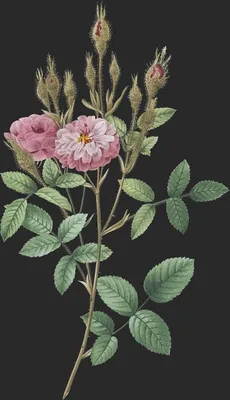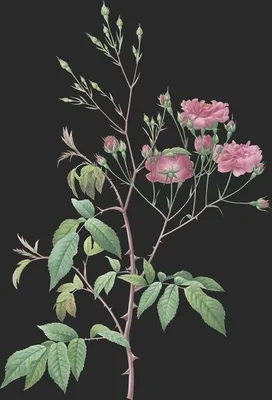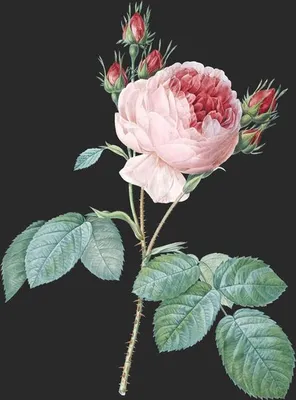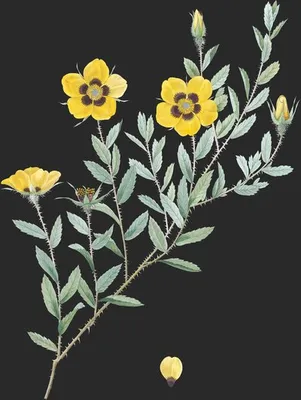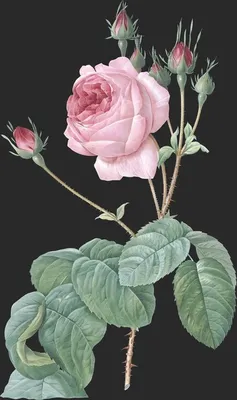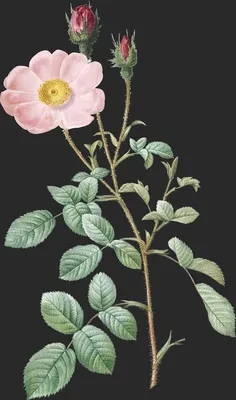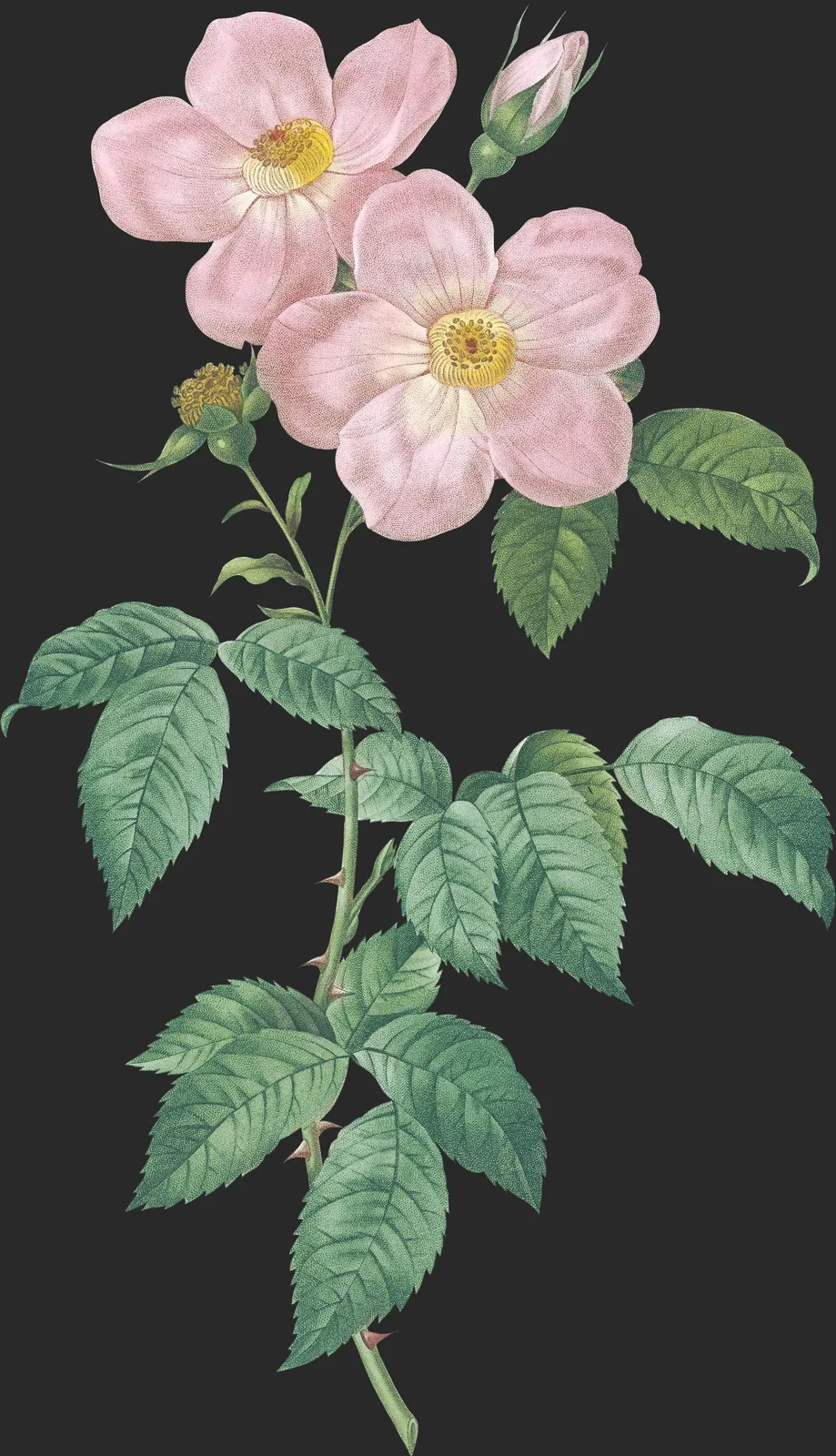
Rosa Indica Fragranas var Flore Simplici
树脂薄皮孔菌
Le Rosier a Odeur de Thé
Ten ways of seeing
- measured cast yellow-green
- upright 1.74 : 1
First Look
论画以形似,见与儿童邻。
—— 宋·苏轼《书鄢陵王主簿所画折枝》
To judge painting by likeness alone is the view of a child.
The sheet is vertical: the eye climbs and settles in the upper half. Let the plant stand before you look for detail. Then step in close: watch where colour meets line, and whether the line ever breaks. Third, find where the green is deepest: the whole tonal order is measured from that patch.
Name and Thing
Only the genus Rosa is given; species-level names came later. The Chinese name 树脂薄皮孔菌 is a modern rendering of the Latin, not an old garden name.
Form and Colour
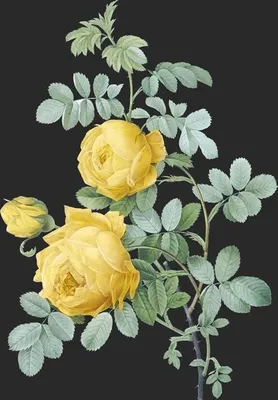
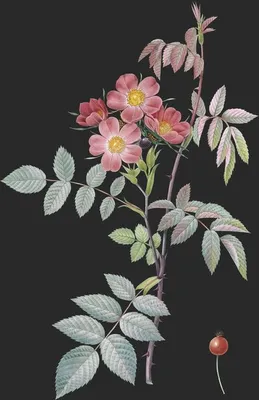
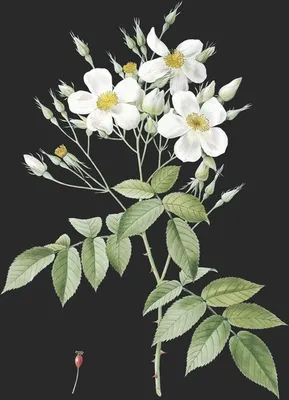
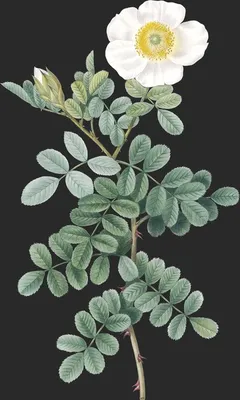
Measured on this plate: flower colour covers 2.2% of the sheet, foliage 15.1%, the cast yellow-green with a second note of red. No other plate shares exactly this measure. Roses are shrubs or scramblers with pinnate leaves of three to seven serrated leaflets; the double flowers open in crumpled, inward-curling layers around a small knot of yellow stamens. a moss green. Read the outline, then the colour layers, then the brush.
Composition
The sheet is tall. No details are appended: a plate for looking, not for keying out. The plant takes about 38% of the sheet, centred above centre — the easy measure most florists kept to.
Line and Colour
The first half of the nineteenth century moved from copper to steel to lithography; stipple could render the softest transition. There is evidence on the back too: the plate mark pressed into the paper, the slight relief of the pigment, lines worn shallow in a later printing. If you mean to copy it: take its skeleton, its margins and the order of its colours; the burin's hatching is the language of copper — suggest it with pencil density, do not imitate it stroke for stroke.
Poetic Resonance
对乱花丛竹,翠红交错。
—— 宋·李曾伯《满江红》
The poem gives the mood first and the picture supplies the form; set the line beside the plate and the green the corolla becomes its resting point.
Symbolism
In Europe the rose means love and secrecy ('sub rosa'); in Chinese verse the rambling rose leans and clings — lingering attachment rather than ardour. In a flora it is a species first and a symbol second; the order is worth keeping.
Season and Place
Late spring into early summer, peaking in May — the first flush of the garden year. Widespread in the temperate north. Chinese gardeners knew roses since the Han. The year 1824 on the plate is that of publication, not of flowering — the gathering came a year or two earlier. The bud and the ripe fruit on one branch tell the season; the name in the title often tells the journey.
The Book and the Hand
“Les Roses” carries only Pierre-Joseph Redouté's name. A plate is collective work: drawer, engraver and colourist were different hands, and the unnamed ones decided how good it looks.
What to Take Away
If you keep one line, keep Guo Xi's: from afar its momentum, up close its texture. The flower of that year is dust, yet its image on paper has outlived every living cousin.
About this plate
Description
Petit arbrisseau dont les tiges sont armées d’aiguillons épars, droits, dilatés à leur base. Les feuilles se composent de trois, ou de cinq folioles ellipsoïdes, pointues à la base et au sommet, glabres, luisantes en-dessus, crénelées en leur bordure. Elles sont portées par un pétiole légèrement velu, garni de quelques petits aiguillons très-fins que, le plus souvent, on sent plutôt au toucher qu’on ne peut les apercevoir à l’œil nu: à sa base sont deux stipules étroites, bifides, denticulées sur leur bord. Les fleurs sont disposées par trois ou quatre à l’extrémité des rameaux qui sortent des branches principales. Le pédoncule et les pédicelles qui les supportent sont glabres; chaque pédicelle est muni de bractées très-étroites, allongées et pointues au sommet. Les tubes des calices sont arrondis et glabres. Les divisions du limbe, trois pinnatifides et deux simples, sont également glabres, pointues, rarement spatulées. Corolle de einq pétales assez grands, échancrés en cœur, d’un rose-ten-dre, et répandant au loin une odeur suave. Étamines longues, renversées sur les styles, comme dans toutes les variétés du R. Indica. Fruit presque globuleux, d’abord rouge, et noir, ensuite, à sa maturité.
Observations
Cette Rose provient de la semence des graines du Rosier à odeur de thé, faite, à Auteuil, dans les pépinières de M. Ternaux. Elle est principalement remarquable par son odeur et la jolie couleur de ses pétales. Il faut cultiver l’arbrisseau en pot, et le rentrer dans l’orangerie, comme tous les Rosiers délicats:
Voir, dans cet ouvrage, Rosa Indica fragrans, vol. 1, p. et fig. 61.