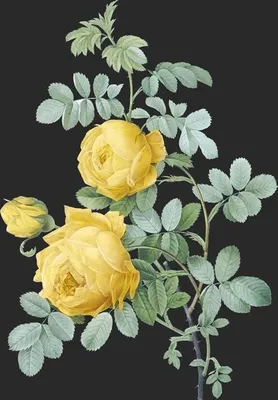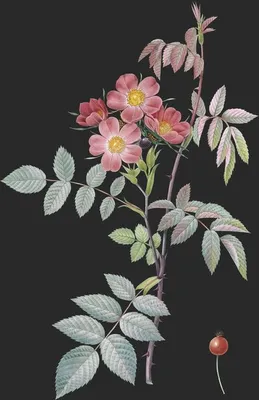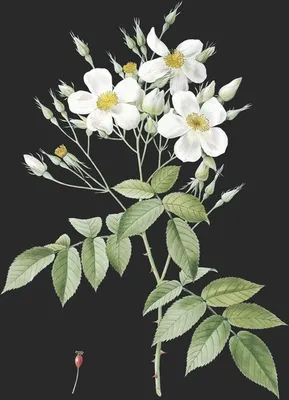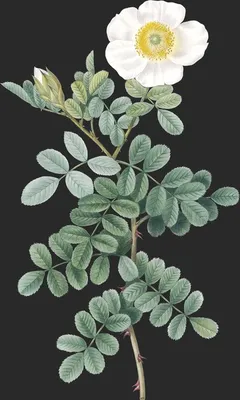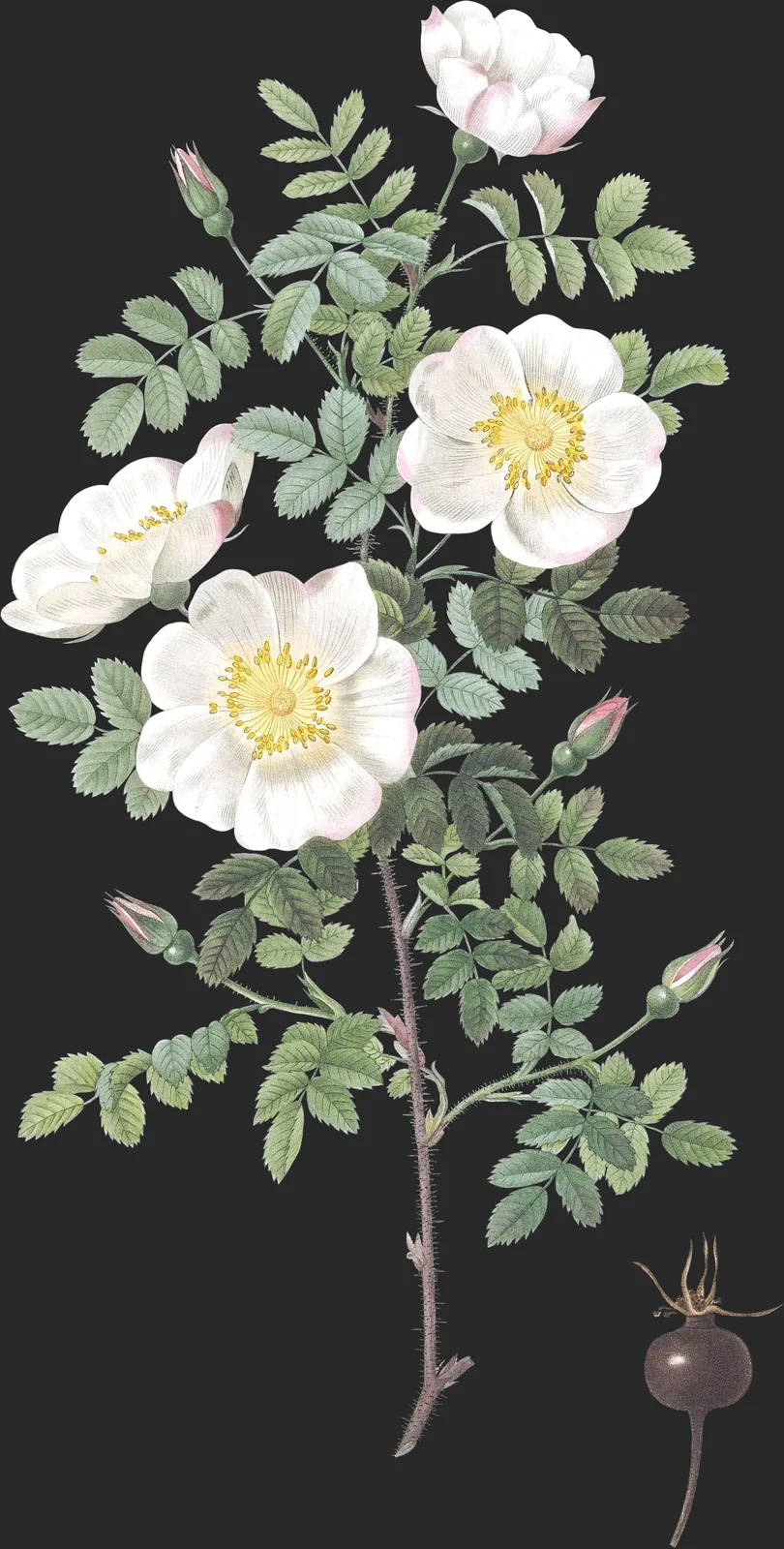
Rosa Pimpinellifolia var Mariæburgensis
Rosa Pimpinellifolia var Mariæburgensis
Le Rosier Pimprenelle
Ten ways of seeing
- measured cast yellow-green
- upright 1.97 : 1
First Look
夫象物必在于形似,形似须全其骨气。
—— 唐·张彦远《历代名画记》
Likeness is the threshold; bone-and-breath is the point.
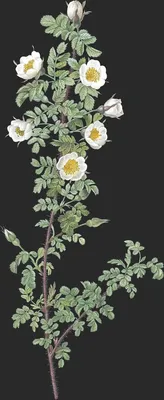
The sheet is vertical: the eye climbs and settles in the upper half. Let the plant stand before you look for detail. Then step in close: watch where colour meets line, and whether the line ever breaks. Third, find where the green is deepest: the whole tonal order is measured from that patch.
Name and Thing
The binomial is Rosa pimpinellifolia: the first word is the genus it belongs among, the second the epithet that sets it apart. The genus name Rosa: Rosa is simply the Latin for rose, from Greek rhodon. No established Chinese name exists, so it is cited by its binomial alone.
Form and Colour
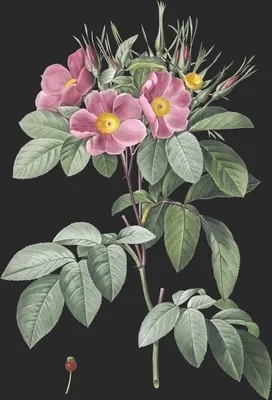
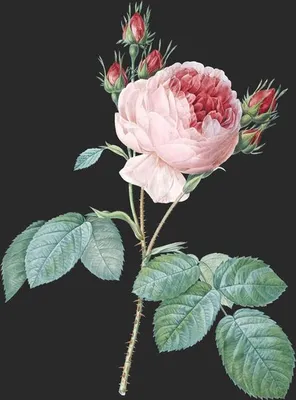
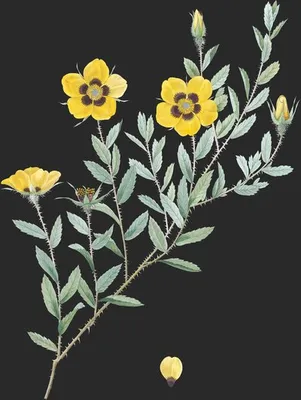
Measured on this plate: flower colour covers 1.7% of the sheet, foliage 4.7%, the cast yellow-green. No other plate shares exactly this measure. Roses are shrubs or scramblers with pinnate leaves of three to seven serrated leaflets; the double flowers open in crumpled, inward-curling layers around a small knot of yellow stamens. a moss green. A single plant, laid out with nothing hidden.
Composition
The sheet is tall. No details are appended: a plate for looking, not for keying out. The plant takes about 36% of the sheet, centred above centre — the easy measure most florists kept to.
Line and Colour
The first half of the nineteenth century moved from copper to steel to lithography; stipple could render the softest transition. There is evidence on the back too: the plate mark pressed into the paper, the slight relief of the pigment, lines worn shallow in a later printing. If you mean to copy it: take its skeleton, its margins and the order of its colours; the burin's hatching is the language of copper — suggest it with pencil density, do not imitate it stroke for stroke.
Poetic Resonance
泉冽偏宜雪茗,粳香雅称丝莼。
—— 宋·陆游《乌夜啼》
The poem gives the mood first and the picture supplies the form; set the line beside the plate and the green the corolla becomes its resting point.
Symbolism
In Europe the rose means love and secrecy ('sub rosa'); in Chinese verse the rambling rose leans and clings — lingering attachment rather than ardour. Flower language was added later; the flower knows nothing of it, and that innocence is part of its power.
Season and Place
Late spring into early summer, peaking in May — the first flush of the garden year. the ever-blooming modern rose is a nineteenth-century crossing of European and Chinese stock. The year 1817 on the plate is that of publication, not of flowering — the gathering came a year or two earlier. Read the locality and the flowering season both with a discount: one is hearsay, the other a ten-day peak.
The Book and the Hand
“Les Roses” carries only Pierre-Joseph Redouté's name. From drawing to plate the sheet passed through several hands — the engraver aimed at accuracy, the colourist at speed, and between them lies each plate's unevenness.
What to Take Away
If you keep one line, keep Guo Xi's: from afar its momentum, up close its texture. The flower of that year is dust, yet its image on paper has outlived every living cousin.
About this plate
Description
Ce Rosier, dans son pays natal, ne s’élève guère qu’à un pied et demi, mais, dans nos jardins, il parvient à la hauteur de trois à quatre pieds. Ses tiges adultes sont munies d’ai-guillons, inégaux, presque droits, qui, comme dans tous les individus de ce groupe, tombent avec l’âge, et les font paraître raboteuses. Les pousses de l’année sont armées d’aiguil lons pareils, un peu rougeâtres, serrés et très-aigus. Les feuilles se composent de neuf à onze folioles, ovales-obtuses, très-entières à la base, simplement dentées, portées par un pétiole muni de petits aiguillons jaunes un peú courbés. Les fleurs, grandes, souvent du diamètre de plus de deux pouces, odorantes, naissent solitaires à l’extrémité des ramuscules qui croissent le long des rameaux principaux. Les pédoncules et l’ovaire sont glabres; les divisions du calice sont simples et lancéolées. La corolle est composée de cinq pétales blancs, un peu jaunes vers l’onglet, plus ou moins échancrés au som-met. Stigmates sessiles: fruit noir et penché à la maturité
Observations
Ce Rosier croit, dans les Ardennes, sur la montagne aux buis, près la roche-à-l’homme, patrie du peintre de cet ouvrage. Il y a été découvert par M. Henry Redouté, son frère, membre de l’Institut d’Égypte, peintre d’histoire naturelle. On le trouve aussi sur les Alpes. Il exige l’exposition du midi, et presque jamais il ne fleurit à l’ombre.
Description spécifique, et Nomenclature de variétés et sous-variétés du Rosier à feuilles de Pimprenelle
- R. Germinibus globosis pedunculisque glabris hispidisse; caule aculeis inequalibus, confertis, rectis; foliolis ovatis, obtusis, simpliciter serratis, basi integerrimis, utrinque glabris; calycibus integris; foribus solitaris. (N.)
A l’imitation de quelques auteurs, nous avons compris dans une seule série le Pimpi-nellifolia et le Spinosissima, qui ne sont que des variétés l’un de l’autre, réunies naturellement par leurs folioles simplement dentées et leurs pédoncules uniflores.
-
- R. Pimpinellifolia. L. sp. 703. Ait. Kew. p. 202. Wild. sp. 2, 1067. D. C. Fl. franç. 3697. Desv. Journal de Bot. 1813, p. 119. Nouv. Duham. vol. 7, p. 19, pl. 16, fig. 2. Roess. fig. ? 9.
- R. (Spinosissima). L. spec. 705. Smith, Fl. brit. 2., pag. 537. Aiton Kew. 2, pag. 203. D. C. l. c. v. α. Poiret, Enc. 6, p. 284. Desv. l. c. v. γ. Miss Lawr. Tab. 187. Andrews R. fig.
- R. Pimpinellifolia pumila. Voyez page 85.
- R. Pumila spinosissima, fol. pimpinellæ glabris, More albo. J. B. hist. 2, p. 40.
-
- R. Pimpinellifolia Involuta.
- R. (Involuta). Smith, Fl. Brit. add. 3, p. 40.
- R. Pimpinellifolia Mariœburgensis, germinibus globosis pedunculisque glabris, periolis subaculeatis. Alba, grandiflora. (N.)
-
- R. Pimpinellifolia Altaica.
- R. (Altaica). Willd. En. Plant. Ber. pag. 543.
- R. Pimpinellifolia Inermis. D. C. l. c. v. γ. Nouv. Duham. M. l. c. v. γ. Desv. l. c. v. β.
-
- R. Pimpinellifolia foribus variegatis. Nouv. Duham. l. c. v. ε.
- R. (Spinosissima) exphiana. Smith, l. c. v. β. Ex Sibbal. scot. illustrata, lib. 1, part 2, pag. 46. Rau, en. Rosarum, p. 46.
- R. (Spinosissima) nova variegata. Du Pont, Choix des Roses, etc. p. 3, la belle Laure. C’est ce Rosier qu’il vendait trois cents francs.
- R. (Spinosissima) ex albo et carneo variegata. Roessig, Beschrei. der Rosen 1, p. 238. (Stripe-fower’d Miss Lawrence Rose). La Pimprenelle de Miss Lawrence. Ait. Kew. 2, var. β. Miss Lawr. Tab. 15.
- R. (Spinosissima) Fl. Marmoreo. Andr. R. fig.
-
- R. Pimpinellifolia fl. multiplici. Nouv. Duham. l. c. v. ζ.
- R. (Spinosissima) Rubra multiplex. Andr. R. fig. Vulg. la Primprenelle rose à feurs doubles.
- R. (Spinosissima) nana fl. albo multip. Andr. R. fig. Vulg. la Pimprenelle blanche à fleurs doubles.
- R. (Spinosissima) nana. Var. 1, Bicolor. Var. 2, Sulphureoides. Var. 3, Carnea. Andr. R. fig. On ne doit pas confondre la var. 2 avec la R. hispida de Poiret, Ency., supp. p. 715, dont les pétales sont jaunes, rayés de nervures fines.