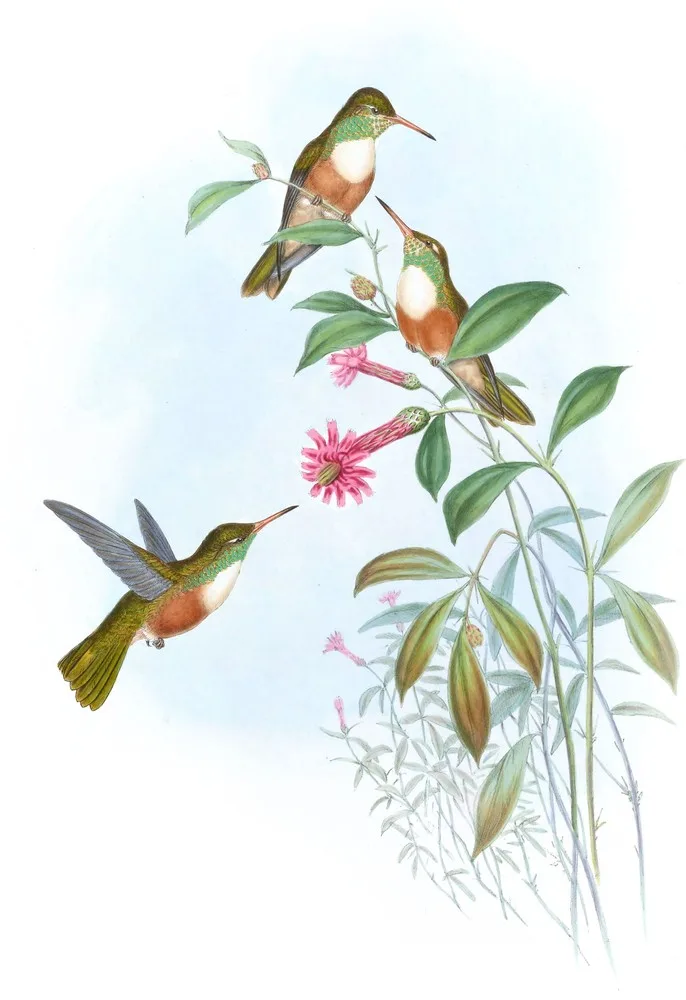
美洲蜂鸟属·Amazilia Dumerili
Amazilia Dumerili
Amazilia Dumerili
Dumeril’s Amazili
- 中文名
- 美洲蜂鸟属·Amazilia Dumerili
- 学名
- Amazilia Dumerili
- 合集
- 古尔德蜂鸟图谱
- 绘者
- John Gould(约翰·古尔德)
- 年代
- 1861
- 图版号
- Pl. 305, Vol. V
- 原书页码
- p.305
- 授权
- CC0 1.0 Universal (Public domain)
关于本图版
本图选自约翰·古尔德的《古尔德蜂鸟图谱》(Gould's Hummingbirds),原书 1849—1887 年间出版。画面主体是美洲蜂鸟(Amazilia Dumerili),在分类体系中列于蜂鸟科(Trochilidae)。
该合集全编共 421 幅图版,此图为其中之一,图版编号 Pl. 305, Vol. V,对应原书第 305 页,版式为纵幅。图像由公有领域原件扫描修复而来,细节在放大视图中仍清晰可辨。
原书文字(英文 / 法文)
Ecuador, on the coast in the neighbourhood of Guayaquil, and on the Isle of Puna. Found also at Babahoyo by Mr. Fraser, who states that the bill is red with a black tip.
I have but little doubt that the bird figured in the accompanying Plate is the “Ornismya Dumerili” of Lesson’s “Histoire Naturelle des Oiseaux-Mouches,” Supplement, p. 172, pl. 36; at the same time it is necessary to observe that, if so, Lesson’s figure is maccurate, inasmuch as, I believe, the red colouring on the sides of the neck and ear-coverts represented in his drawing is due to the wetting of the feathers in the process of mounting the specimen, which has converted the original shining green colour into red; the outer tail-feathers being tipped with rufous, also indicates that the figure was taken from an immature bird.
I am quite certain that the T. amazicula of Dr. Saucerotte’s MSS. has reference to this species, that gentleman having kindly sent me the epetal specimen from his Collection, which I find to be precisely identical with my own.
The true habitat of this bird, which may at all times be distinguished from its allies by the green colouring of the lower part of the back and tail, is Guayaquil and its neighbourhood. I have now before me four specimens, one of which is labelled “Isle of Puna,” a small island near the mouth of the river. It is well that I have been enabled to identify this bird with Lesson’s plate, since there are two or three species of the genus most nearly allied to each other, as may be seen on reference to the Plates in this work.
There seems to be little difference in the colouring of the sexes; and it is evident that the young at an early age acquire the adult livery, but while immature they have all the tail-feathers tipped with reddish buff; the adult female also has an indication of a lighter colouring on the same part.
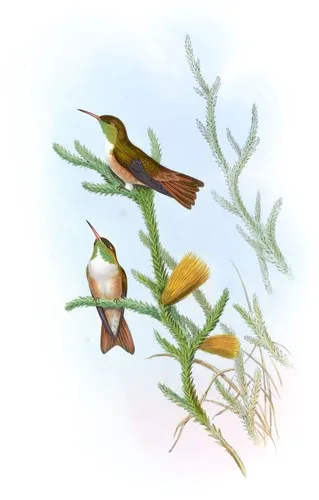
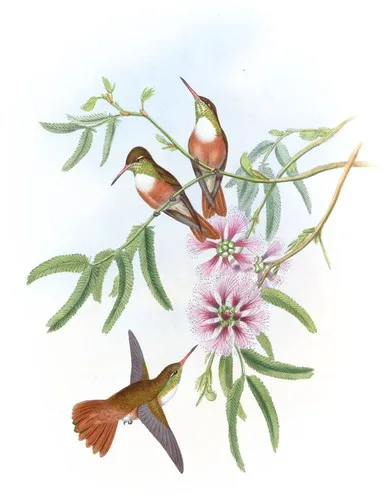
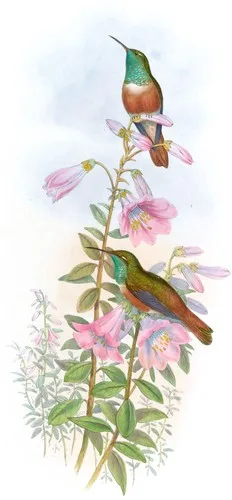
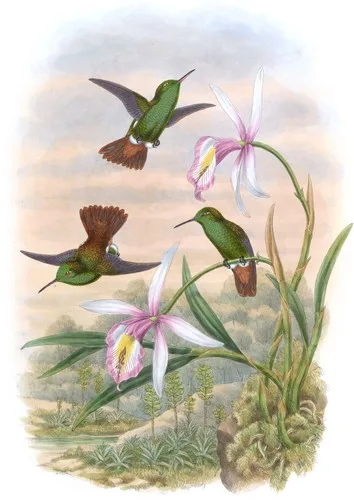
Crown of the head, back of the neck, all the upper surface and tail bronzy green; wings panei brown; chin and sides of the neck shining golden green; chest white; abdomen rufous or sandy red; under tailcoverts greyish white washed with buff in the centre of each feather; bill black at the tip, said to be fleshy white at the base.
The female or young is very similar in the distribution of the colouring, but is altogether paler; and ow the under surface the colours blend more into each other, and the tail is tipped with rufous.
The figures on the accompanying Plate are the size of life. The plant is the Barnardesia rosea.
References
- Ornismya Dumerilii, Less. Hist. Nat. des Ois. Mou. Supp., p. 172. pl. 36.—Ib. Ind. Gén. et Syn. des Ois. du Gen. Trochilus, p. xxvii.
- Trochilus amazicula, Sauc. MSS.
- Amazilia Amazilicula, Reich. Auf. der Col., p. 10.
- Polytmus Dumerilii, Gray and Mitch. Gen. of Birds, vol. 1. p. 109, Polytmus, sp. 79.
- Amazilia Dumerili, Reich. Auf. der Col., p. 10.
- Amazilius dumerili, Bonap. Consp. Gen. Av., p. 77, Amazilius, sp. 3.—Ib. Rev. Zool. 1854, p. 254.