瑰丽蜂鸟属·Calothorax Fanny
Calothorax Fanny
Calothorax Fanny
Fanny’s Wood Star
- 中文名
- 瑰丽蜂鸟属·Calothorax Fanny
- 学名
- Calothorax Fanny
- 合集
- 古尔德蜂鸟图谱
- 绘者
- John Gould(约翰·古尔德)
- 年代
- 1852
- 图版号
- Pl. 151, Vol. III
- 原书页码
- p.151
- 授权
- CC0 1.0 Universal (Public domain)
十观
- 纵幅 1.47∶1
第一眼
六法者何?一、气韵生动是也;二、骨法用笔是也;三、应物象形是也;四、随类赋彩是也;五、经营位置是也;六、传移模写是也。
—— 南齐·谢赫《古画品录》
一千五百年前的六条标准:气韵、用笔、形似、设色、构图、临摹。你在这幅图上一样样对过去,就是一次完整的读画。这一幅是竖的:眼睛从下往上走,落点在中段那只鸟身上。先别急着看羽毛,让姿态先立起来。第二步凑近一寸:看线与色的交界,色有没有压住线,线有没有断。第三步,把视线放到最深的那一小块:整幅的用色秩序,都是从那里排开的。
名与实
学名 Calothorax fanny:前一词是属,管它归在哪一类;后一词是种加词,管它在这一类里凭什么与众不同。双名制的好处是唯一:全世界叫这个名字的,只能是这一种。此幅尚无通行中文名,姑以学名相称;在没有本地名字的地方,学名就是它唯一的身份证。
形与色
蜂鸟为美洲最小之鸟,喙细长如针,舌分叉成管,可伸入花心吸蜜;翼小而振频极高,能悬停、能倒飞。此幅未作色相归档,只能就形制论。没有解剖图,就靠主株一处一处看过去:叶怎么排,花怎么着生,果在哪里。
构图与呼吸
画幅高而窄,鸟栖在枝的中段,上下留白多——十九世纪鸟谱的标准版式,留给它飞走的余地。全幅只画一只,不作解剖附图——这类图更近于“观赏”,而非“鉴定”。老图谱爱把主株摆在偏中线的位置,左右留得不一样多:这一点偏心,正是画面活起来的原因。
一刀一色
十九世纪后半叶,石版与彩色石印渐成主流:颜色可以直接印出,不再依赖手工,线条反倒退居其次。图像的“准确”提高了,手性却淡了。先判断它是“印”的还是“画”的,再谈好不好看——这是看老版画最实用的一条规矩。想动笔临它的人记住一句:先铺大块的形与色,干后再收细部;石印的柔和层次来自薄涂与网点,水彩分两三遍淡铺即可逼近。
诗境
夫列子御风而行,泠然善也,旬有五日而后反。
—— 《庄子·逍遥游》
蜂鸟悬停于空,不落不飞,最近于“御风”。庄子说的是一种自由的姿态,蜂鸟把它做成了生理事实。古人写到这一层,已不只是赏花,是借花说人;画面则只负责把那朵花留住。
花语
阿兹特克以蜂鸟为战神与太阳的化身;欧洲维多利亚时代则以蜂鸟为收藏与装饰的极致,百万只羽毛被做成胸饰。中国旧籍无此鸟,故无象征——这空白本身,就是一部博物学交流史。象征多半来自形状与气味:像杯的、像泪的、香的、臭的——先有形状,后有意义。
时与地
温带种类的蜂鸟则随花北迁,一年往返数千公里。仅产美洲,自阿拉斯加南部至火地岛,以安第斯山最为繁盛。中土无蜂鸟,汉籍不载,晚清海外游记始见其名。图上所记的 1852 年是刊行之年,不是采到那只鸟的年份;真正的观察记录通常比出版早一两年。看叶的老嫩、花与果是否同在枝上,季节便八九不离十;看题名里藏着的地名,来路也猜得出七分。
书与人
《古尔德蜂鸟图谱》只署了约翰·古尔德一个人的名字。版画是集体工程:绘图、刻版、上色各有其人,真正决定这幅图好不好看的,常是没留下名字的刻工与上色师。
带走一双眼睛
鉴赏力不是知识,是习惯:每次多看一眼,十年之后你看什么都和别人不一样。二百年后,这只鸟的后代或许仍在某处活着;而纸上这一只,永远停在 1852 年的那个季节。
关于本图版
这幅图版出自《古尔德蜂鸟图谱》(Gould's Hummingbirds),由约翰·古尔德绘制,1849—1887 年间出版。画面主体是瑰丽蜂鸟,归入蜂鸟科(Trochilidae)。
全编共收录 421 幅图版,本图是其中一幅,原书将其列为 Pl. 151, Vol. III,见第 151 页,版式为纵幅。图为公有领域原件的修复扫描,构图与设色未经改动。
原书文字(英文 / 法文)
Ecuador and Peru
That Humming Birds, like other beauties of a higher type in creation, have their ardent admirers, is evident from the attention which has been lavished by ornithologists upon the one here represented, to which no less than six generic and two specific appellations have been assigned by five authors.
Of the former I have retained that of Calothorax; of the latter I select the living name of Fanny, as it appears to have precedence over the dead one of Labrador, which was given to it by M. Bourcier on account of the colouring of its throat resembling the hues of the spar of that name. Now where does this bird find a natural habitat? Not in Mexico, as stated by M. Bourcier in the “Annals of the Scientific Society of Lyons,” but in the districts bordering the sea, in Peru and Bolivia, where several of my specimens were collected and sent to me direct by M. Warszewicz.
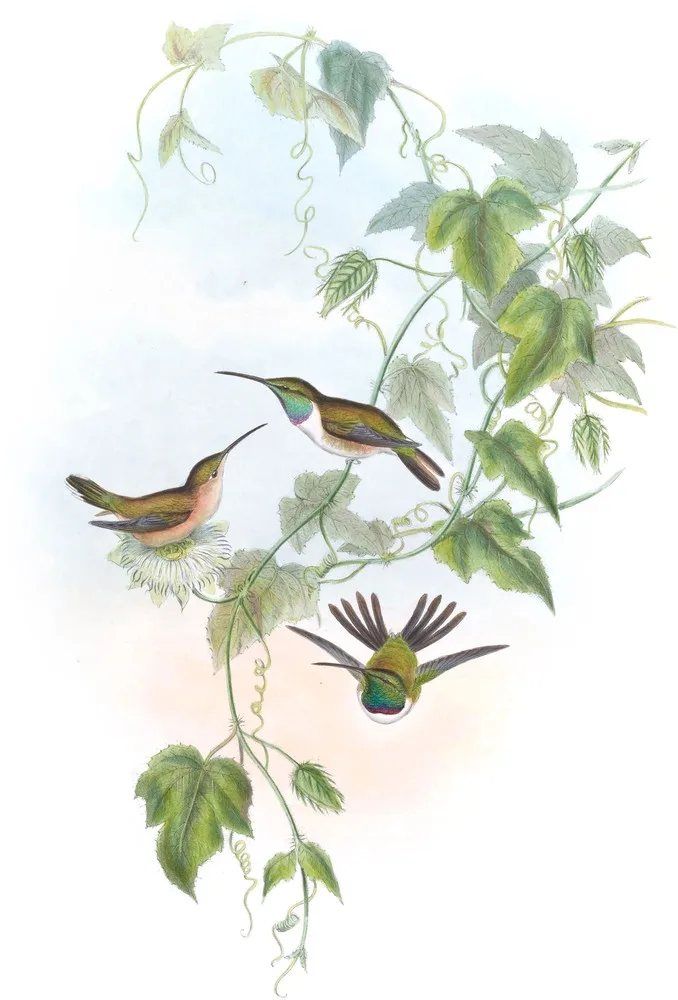
The Calothorax Fanny is a very beautiful species, and is rendered remarkable by the singular construction of its tail, which, when outspread, looks as if it had been deprived of, or had lost all its middle feathers; such, however, is not the case, for, like all Humming Birds, it possesses the full complement of ten; the central ones must, however, be regarded as mere. apologies, for, although they are perfectly formed, they are so short that they are nearly hidden by the coverts—a circumstance which has obtained for it the name of ‘half-tail’ among the dealers.
The female of this species, like the female of C. Yarrelli, differs considerably from her mate in her colouring, as will be seen on reference to the Plate or to the following descriptions.
The male has the head, upper surface and wing-coverts golden bronzé, becoming of a greener hue on the upper tail-coverts; wings purplish brown; tail brownish black, glossed with bronze; lores and throat metallic glaucous-green, changing to blue and then to violet on the lower margin of these feathers; across the breast a broad band of greyish white; upper part of the flanks bronzy; lower part fawn-colour; upper part of the abdomen dusky; lower part and under tail-coverts white; bill and feet dark brown.
The female has the upper surface and wings as in the male; central tail-feathers of the ordinary form, not abbreviated as in the opposite sex, and of a bronzy green; next on each side bronzy green, tipped with black; the remainder grey at the base, black in the middle, and largely tipped with white; all the under surface deep greyish buff or fawn-colour.
The Plate represents two males and a female of the size of life. The plant is the Passifora nigrelliflora.
References
- Ornismya Fanny, Less. Ann. Sci. Nat. 1838, tom. ix. p. 170.—Ib. Rev. Zool. 1838, p: 314.
- Trochilus Labrador, Boure. Ann. de la Soc. Sci. de Lyons, 1839, p. 389. pl. viii.—De Latt. Rev. Zool. 1846, p. 311.
- Calothorax Fanny, Gray and Mitch. Gen. of Birds, vol. i. p. 110, Calothorax, sp. 14.
- Thaumastura fanny, Bonap. Consp. Gen. Av., p. 85, Thaumastura, sp. 3.
- Lucifer labrador, Bonap. Rev. et Mag. de Zool. 1854, p. 257.
- Lucifer Labrador, Reichenb. Troch. enumer., p. 10.
- Myrtis Fanny, Reichenb. Aufz. der Colibris, p. 13.