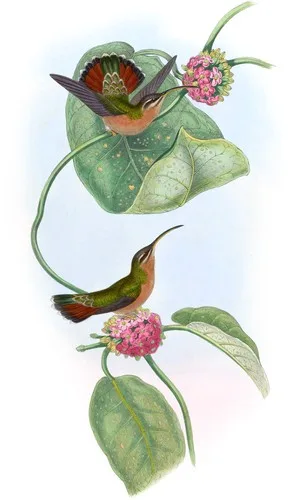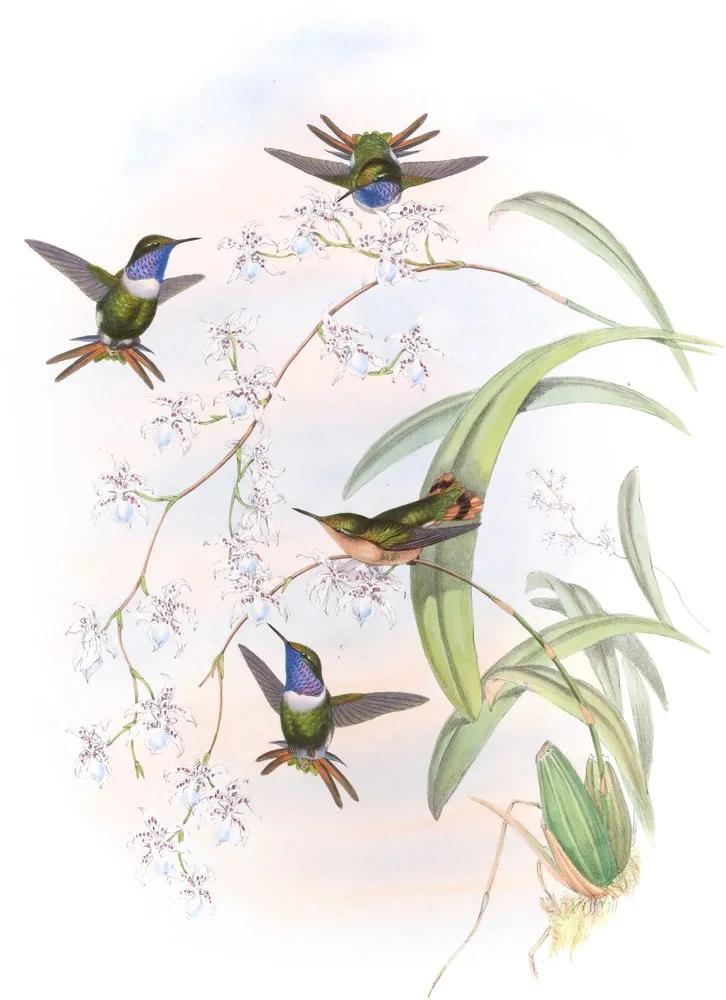
瑰丽蜂鸟属·Calothorax Jourdani
Calothorax Jourdani
Calothorax Jourdani
Jourdan’s Wood-star
- 中文名
- 瑰丽蜂鸟属·Calothorax Jourdani
- 学名
- Calothorax Jourdani
- 合集
- 古尔德蜂鸟图谱
- 绘者
- John Gould(约翰·古尔德)
- 年代
- 1852
- 图版号
- Pl. 150, Vol. III
- 原书页码
- p.150
- 授权
- CC0 1.0 Universal (Public domain)
关于本图版
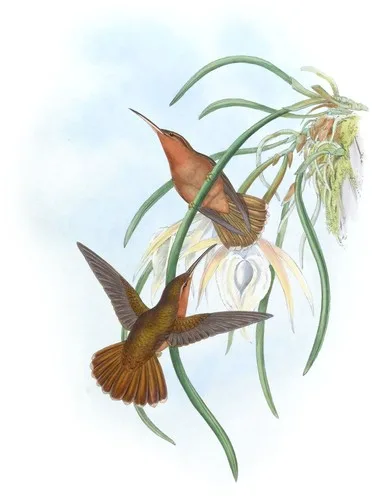
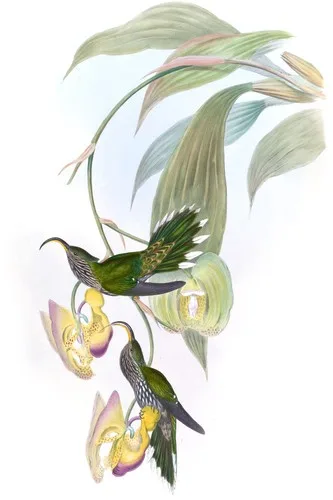
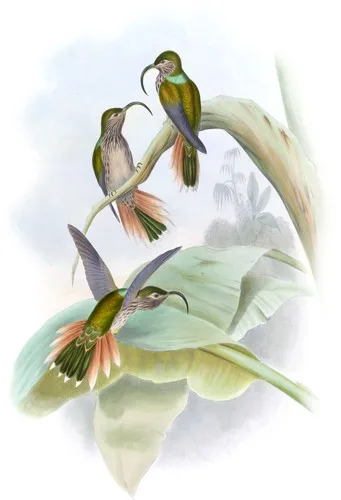
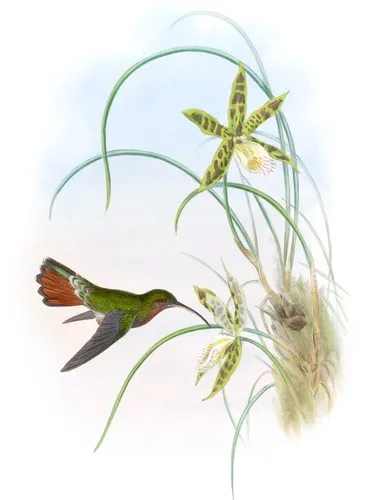
此图原刊于《古尔德蜂鸟图谱》(Gould's Hummingbirds),绘者为约翰·古尔德,成书于 1849—1887 年间。画面主体是瑰丽蜂鸟,归入蜂鸟科(Trochilidae)。
全编共收录 421 幅图版,本图是其中一幅,原书将其列为 Pl. 150, Vol. III,见第 150 页,版式为纵幅。图像由公有领域原件扫描修复而来,细节在放大视图中仍清晰可辨。
原书文字(英文 / 法文)
The Island of Trinidad, where Mr. Tucker states that it frequents the chainae but is very rare.
If the Calothorax Jourdani and C. Rosæ are not one and the same species, they are certainly most nearly allied, the principal, if not the only difference between them being a slight variation in the colouring of their throat-marks, which in the latter is crimson, and in the former deep lilac or puce; in size and form, and in the colouring of their tails, the two birds are precisely similar.
This latter organ (the tail) is very peculiar, and differs from that of all other Humming-Birds, although there is a tendency to the same form among the other true members of the genus Calothorax. All the Humming-Birds I have ever seen have had ten tail-feathers; in some instances, however, certain of these feathers are so extremely small as to be almost obsolete; these are generally the central ones. In the present bird, and in Calothorax Rosæ, the outer feather is very short and sharp-pointed; the two next on each side are much longer and of equal length, while the four central ones are so short as to be almost hidden by the tail-coverts. In my specimens of these two nearly allied species, the bill of the C. Jourdani is rather longer than that of C. Rosæ; but whether this difference be constant or not Iam unable to say, having seen but a limited number of the former.
The Calothorax Jourdani has been named by M. Bourcier in honour of that very able zoologist, M. Jourdan, the Director of the Museum of Natural History at Lyons. It is a pity, however, that, if the practice of naming species after individuals, of which, as I have remarked in my account of C. Rosæ, I very much disapprove, is to be continued, so pretty a bird had not been named in honour of some lady who merited such a compliment; still in this instance it is very well bestowed, and I have much pleasure in transcribing the passage in which it is conferred in M. Bourcier’s own words:—
“Le nom de cette nouvelle espece rappelle celui d’un de nos collègues et compatriotes, M. Jourdan, qui vient de rendre d’importants services à la science. C’est a lui que notre ville doit organisation de sa belle galerie de zoologie, disposée d’après sa savante classification, qui a pour base le systeme nerveux. Plusieurs naturalistes nous ont déjà précédés dans l’hommage que nous nous plaisons a lui adresser aujourd’hui.
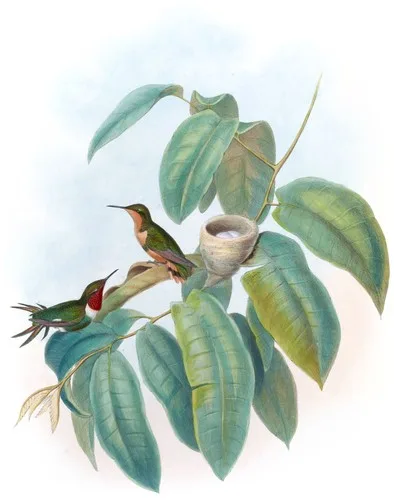
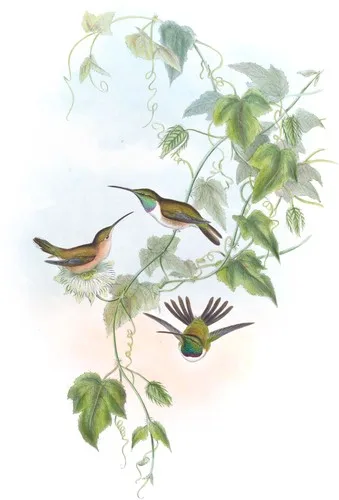
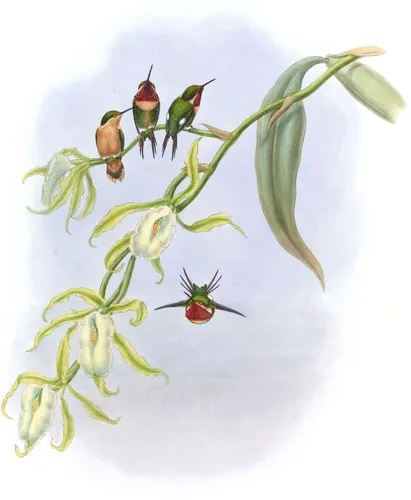
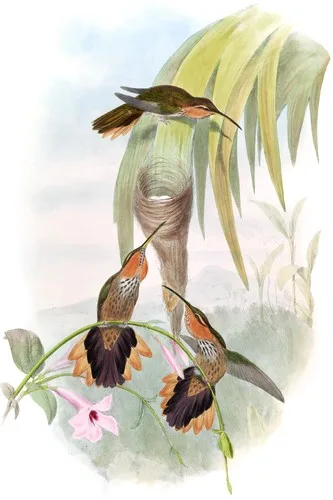
The male has the head, all the upper surface, wing- and tail-coverts, four centre tail-feathers, flanks and abdomen bronzy green; wings purple-brown; lateral tail-feathers purplish brown, with a stripe of sandy red down the centre of the basal half of the four longer ones; on the chin and throat a gorget of the richest deep lilac or puce, below which is a band of greyish white; bill black; feet brownish black.
The female has the whole of the upper surface, centre tail-feathers, wing-coverts and upper part of the flanks golden green; wings purplish brown; three outer tail-feathers on each side sandy buff, crossed obliquely by a broad mark of black; under surface buffy white, becoming of a deeper hue on the flanks.
The Plate represents both sexes of the size of life. The plant is the Oncidium incurvum.
References
- Ornismya Jourdanii, Boure. Rev. Zool. 1839, p. 295.
- Ornismya Jordani, Bourc. Ann. Soc. Sei. Phys. et Nat. Lyon, 1840, p. 227. pls. 5, 6.
- Mellisuga Jourdani, Gray and Mitch. Gen. of Birds, vol. i. p. 118, Mellisuga, sp. 65.
- Calothorax jourdani, Bonap. Consp. Gen. Av., p. 85, Calothorax, sp. 6.
- Calothorax Jourdani, Reich. Auf. der Col., p. 13.—Ib. Troch. Enum., p. 10.
- Callothorax jourdani, Bonap. Rev. et Mag. de Zool. 1854, p. 257.
- Chætocercus Jourdani, Gray, Cat. of Gen. and Sub-Gen. of Birds in Brit. Mus., p. 22, no. 349.
十二观
- 纵幅 1.38∶1
- 1852 年刊
- 图版 150, Vol. III
这不是词条,是一条看画的次序:先站定看整体,再看名字与形色、构图与刀工,然后问它几时开、从哪里来、经了谁的手;最后是中国诗文——同一朵花,中国古人是怎么看的。十二观读完,这幅图就打开了。
-
第一眼
凡画山水,意在笔先。
—— 唐·王维《山水论》
下笔之前,心里已经有了整幅画。看画时可以反过来推:画家先定了什么,后添了什么。这一幅是竖的:眼睛从下往上走,落点在中段那只鸟身上。先别急着看羽毛,让姿态先立起来。第二步凑近一寸:看线与色的交界,色有没有压住线,线有没有断。第三步,把视线放到最深的那一小块:整幅的用色秩序,都是从那里排开的。
-
名与实
学名 Calothorax jourdani:前一词是属,管它归在哪一类;后一词是种加词,管它在这一类里凭什么与众不同。名字是通行证,也是懒办法——记住两个词,就抓住了一整个物种。此幅尚无通行中文名,姑以学名相称;在没有本地名字的地方,学名就是它唯一的身份证。
-
形与色
翼小而振频极高,能悬停、能倒飞;羽色非颜料所致,是羽枝结构折射的光,随角度而变。此幅未作色相归档,只能就形制论。看形制不必求全:记住喙形、翼式与栖姿,这一类的骨架就立住了。
-
构图与呼吸
画幅高而窄,鸟栖在枝的中段,上下留白多——十九世纪鸟谱的标准版式,留给它飞走的余地。(高宽比约 1.38∶1)全幅只画一只,不作解剖附图——这类图更近于“观赏”,而非“鉴定”。试着用拇指遮住空白处——画面立刻变闷;放开,它才重新“喘上气”。留白,是给主体让出的气口。
-
一刀一色
十九世纪后半叶,石版与彩色石印渐成主流:颜色可以直接印出,不再依赖手工,线条反倒退居其次。图像的“准确”提高了,手性却淡了。还有一种证据在纸背:铜版压进纸里的那道痕、上色处微微凸起的颜料、再版时磨浅的线。扫描件里也能看出七分。
-
时序
热带美洲几乎全年可见,花期即其季节;温带种类的蜂鸟则随花北迁,一年往返数千公里。图上所记的 1852 年是刊行之年,不是采到那只鸟的年份;真正的观察记录通常比出版早一两年。记下这一季:物候是最好用的鉴赏工具,见过一次活的花,再看图就不会只看颜色。
-
故土
仅产美洲,自阿拉斯加南部至火地岛,以安第斯山最为繁盛。中土无蜂鸟,汉籍不载,晚清海外游记始见其名。今天再看,图上的产地已是一百多年前的产地;植物会迁徙,地方也会改名字。
-
书与人
《古尔德蜂鸟图谱》(Gould's Hummingbirds)由约翰·古尔德绘,成于1849-1887。此幅为其中图版 150, Vol. III,见原书第 150 页。图谱是集体工程:绘图、刻版、上色、编纂各有其人,署名的往往只有第一个。
-
诗境
夫列子御风而行,泠然善也,旬有五日而后反。
—— 《庄子·逍遥游》
蜂鸟悬停于空,不落不飞,最近于“御风”。庄子说的是一种自由的姿态,蜂鸟把它做成了生理事实。把这一句放回画面:画面就是诗句的落点——诗先写气,画后写形,两者在此处接上了。
-
文心
竖划三寸,当千仞之高;横墨数尺,体百里之迥。
—— 南朝宋·宗炳《画山水序》
三寸的竖线可当千仞高山,几尺横墨能容百里之远。一只蜂鸟只有拇指大,画家却要在几厘米里放下整片花丛——尺度从来不是障碍。古尔德《蜂鸟图谱》(1849—1887)以石版手工上色,金箔衬底,使羽色在纸上仍有金属光;这套图册本身就是十九世纪印刷与收藏狂热合流的产物。中外的分别不在谁高明,而在问的问题不同:欧洲问它是什么,中国问它像谁。两个问题都答了,一幅图才算读完。
-
花语
阿兹特克以蜂鸟为战神与太阳的化身;欧洲维多利亚时代则以蜂鸟为收藏与装饰的极致,百万只羽毛被做成胸饰。中国旧籍无此鸟,故无象征——这空白本身,就是一部博物学交流史。花语是给人与人的关系用的;植物自己只关心有没有传粉的虫。这两套语言,可以并行不悖。
-
带走一双眼睛
把这三件事带走:先整体后细节;先线后色;先看画再翻书。任何一张老图版,都可以用这三条读。图谱的用意是“以备查考”,看久了却会忘记查考:1852 年的一个人,为一只鸟花了整整一天。