瑰丽蜂鸟属·Calothorax Yarrelli
Calothorax Yarrelli
Calothorax Yarrelli
Yarrell’s Wood-star
- 中文名
- 瑰丽蜂鸟属·Calothorax Yarrelli
- 学名
- Calothorax Yarrelli
- 合集
- 古尔德蜂鸟图谱
- 绘者
- John Gould(约翰·古尔德)
- 年代
- 1852
- 图版号
- Pl. 152, Vol. III
- 原书页码
- p.152
- 授权
- CC0 1.0 Universal (Public domain)
关于本图版
这幅图版出自《古尔德蜂鸟图谱》(Gould's Hummingbirds),由约翰·古尔德绘制,1849—1887 年间出版。画面主体是瑰丽蜂鸟,归入蜂鸟科(Trochilidae)。
全编共收录 421 幅图版,本图是其中一幅,原书将其列为 Pl. 152, Vol. III,见第 152 页,版式为纵幅。图像由公有领域原件扫描修复而来,细节在放大视图中仍清晰可辨。
原书文字(英文 / 法文)
Western Peru, eats the neighbourhood of Ari
Several undescribed species of Humming-Birds in the collection of the late Mr. Loddiges, at Hackney, having been submitted to M. Bourcier during one of his recent visits to this country, that gentleman took the opportunity of complimenting several naturalists by giving their names to some of these new species: one of the most interesting of them he called Yarrellii, in honour of William Yarrell, Esq., so well known as one of the truest friends of natural history, and so celebrated for his valuable works on British Fishes, British Birds, &c.
That the compliment in this instance, at least, is a just and well-deserved one, will be admitted by all who take an interest in natural science, but especially by those who, like myself, are honoured by his friendship; a happiness I have now enjoyed for upwards of twenty years: it affords me therefore peculiar pleasure to perpetuate it in the present work.
The figures in the accompanying Plate were not taken from the specimens in the Loddigesian collection, but from others lately received from Arica on the west coast of South America by M. Bourcier, to whom I am indebted for the loan of them. It is scarcely necessary for me to say that this is a species of the greatest rarity; and I am sure every one will admit that it is a bird of considerable beauty, and singularly interesting on account of its peculiarly formed tail; a peculiarity which no doubt influences its actions and mode of flight.
I believe the true habitat of this singular bird will be the southern parts of Peru and Bolivia, and that it will be limited to the districts lying between the mountain ranges and the sea.
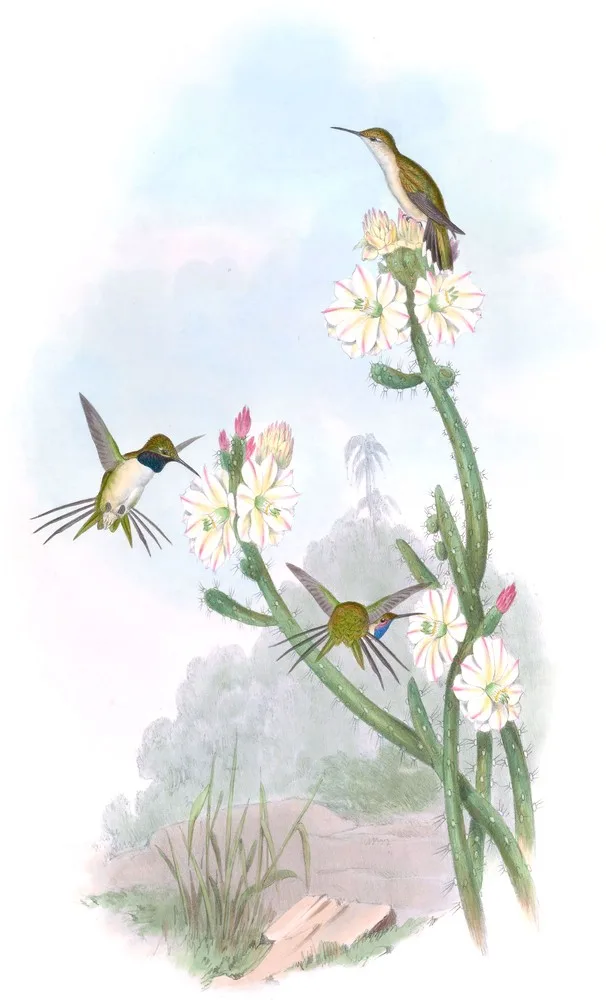
The male has the crown of the head, all the upper surface, flanks, and four centre tail-feathers light yellowish green; chest, centre of the abdomen and under tail-coverts greyish white; on the throat a gorget of purplish-blue with lilac reflexions, the blue tint predominating in the centre; wing greyish brown; lateral tail-feathers dark brown; bill and feet blackish brown.
The female differs, in being destitute of the gorget; in having the lateral tail-feathers grey at the base, black in the centre, and white at the apex: in other respects she resembles her mate.
The Plate represents two males and a female on the Opuntia Salmiana, of the natural size.
References
- Trochilus Yarrellii, Boure. in Proc. of Zool. Soc., Part XV. p. 45.
十二观
- 纵幅 1.65∶1
- 1852 年刊
- 图版 152, Vol. III
这不是词条,是一条看画的次序:先站定看整体,再看名字与形色、构图与刀工,然后问它几时开、从哪里来、经了谁的手;最后是中国诗文——同一朵花,中国古人是怎么看的。十二观读完,这幅图就打开了。
-
第一眼
六法者何?一、气韵生动是也;二、骨法用笔是也;三、应物象形是也;四、随类赋彩是也;五、经营位置是也;六、传移模写是也。
—— 南齐·谢赫《古画品录》
一千五百年前的六条标准:气韵、用笔、形似、设色、构图、临摹。你在这幅图上一样样对过去,就是一次完整的读画。这一幅是竖的:眼睛从下往上走,落点在中段那只鸟身上。先别急着看羽毛,让姿态先立起来。第二步凑近一寸:看线与色的交界,色有没有压住线,线有没有断。第三步,把视线放到最深的那一小块:整幅的用色秩序,都是从那里排开的。
-
名与实
学名 Calothorax yarrelli:前一词是属,管它归在哪一类;后一词是种加词,管它在这一类里凭什么与众不同。一百多年前的命名者,把一种植物的来历压进了两个词。此幅尚无通行中文名,姑以学名相称;在没有本地名字的地方,学名就是它唯一的身份证。
-
形与色
翼小而振频极高,能悬停、能倒飞;羽色非颜料所致,是羽枝结构折射的光,随角度而变。此幅未作色相归档,只能就形制论。此幅只画一个种,形制的每一处都摊在纸面上,没有遮掩。
-
构图与呼吸
画幅高而窄,鸟栖在枝的中段,上下留白多——十九世纪鸟谱的标准版式,留给它飞走的余地。(高宽比约 1.65∶1)全幅只画一只,不作解剖附图——这类图更近于“观赏”,而非“鉴定”。老图谱爱把主株摆在偏中线的位置,左右留得不一样多:这一点偏心,正是画面活起来的原因。
-
一刀一色
十九世纪后半叶,石版与彩色石印渐成主流:颜色可以直接印出,不再依赖手工,线条反倒退居其次。图像的“准确”提高了,手性却淡了。工艺留下的破绽比题跋更诚实:刻工不会撒谎,上色的人赶时间的时候会。
-
时序
热带美洲几乎全年可见,花期即其季节;温带种类的蜂鸟则随花北迁,一年往返数千公里。图上所记的 1852 年是刊行之年,不是采到那只鸟的年份;真正的观察记录通常比出版早一两年。看这一类图最好的时候,是它的花期:文字说不清的“开得正盛”,在树下站三分钟就懂了。
-
故土
仅产美洲,自阿拉斯加南部至火地岛,以安第斯山最为繁盛。中土无蜂鸟,汉籍不载,晚清海外游记始见其名。这类植物的旅程比图版本身更长:从一座山到另一座山,从一种语言换到另一种语言。
-
书与人
《古尔德蜂鸟图谱》(Gould's Hummingbirds)由约翰·古尔德绘,成于1849-1887。此幅为其中图版 152, Vol. III,见原书第 152 页。图版今属公有领域,可以自由取用;但纸上那层手工上色,仍是两百年前某一个人的手。
-
诗境
穿花蛱蝶深深见,点水蜻蜓款款飞。
—— 唐·杜甫《曲江二首》
中土无蜂鸟,然“穿花”之态,杜甫早已写过:贴着花心走,是采蜜者的共同姿态。诗以气行,画以形立;两种“看”叠在一起,才是看画的意思。
-
文心
竖划三寸,当千仞之高;横墨数尺,体百里之迥。
—— 南朝宋·宗炳《画山水序》
三寸的竖线可当千仞高山,几尺横墨能容百里之远。一只蜂鸟只有拇指大,画家却要在几厘米里放下整片花丛——尺度从来不是障碍。古尔德《蜂鸟图谱》(1849—1887)以石版手工上色,金箔衬底,使羽色在纸上仍有金属光;这套图册本身就是十九世纪印刷与收藏狂热合流的产物。读古文不必求全解,先认下这一句:它把“看花”换成了“看人”,你再看这幅图,眼里就多了一层。
-
花语
阿兹特克以蜂鸟为战神与太阳的化身;欧洲维多利亚时代则以蜂鸟为收藏与装饰的极致,百万只羽毛被做成胸饰。中国旧籍无此鸟,故无象征——这空白本身,就是一部博物学交流史。象征多半来自形状与气味:像杯的、像泪的、香的、臭的——先有形状,后有意义。
-
带走一双眼睛
下次看鸟,别急着认名:先看它停的姿态,再看羽色在哪一段最深,最后才翻图鉴——顺序一换,看鸟就从“对答案”变成了“看画”。二百年后,这只鸟的后代或许仍在某处活着;而纸上这一只,永远停在 1852 年的那个季节。