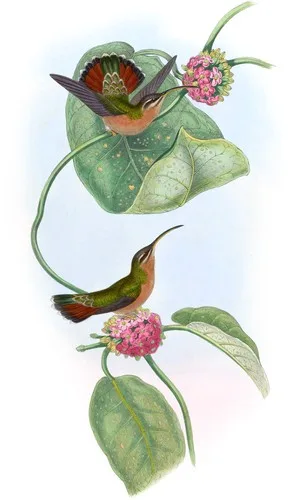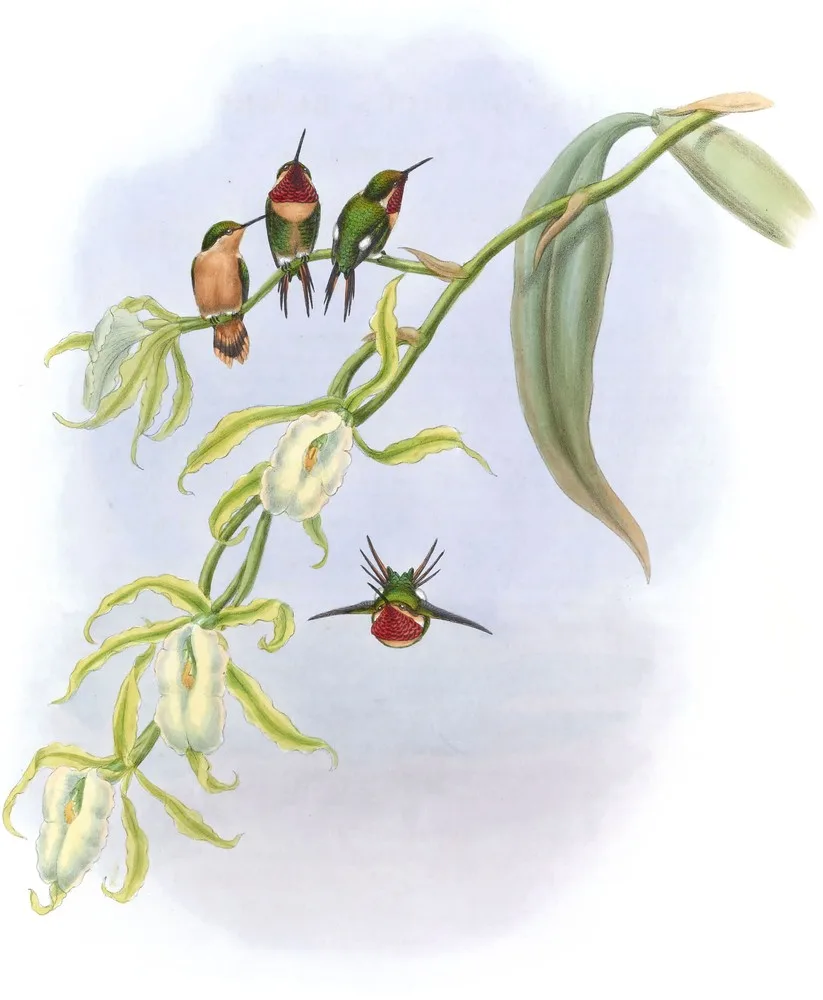
Chætocercus bombus
Chætocercus bombus
Little Wood-Star
- 合集
- 古尔德蜂鸟图谱
- 绘者
- John Gould(约翰·古尔德)
- 年代
- 1887
- 图版号
- Pl. 392, Suppl. Vol.
- 原书页码
- p.392
- 授权
- CC0 1.0 Universal (Public domain)
关于本图版
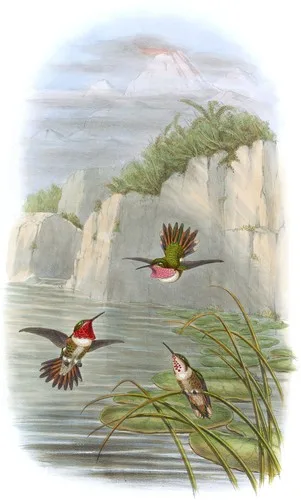
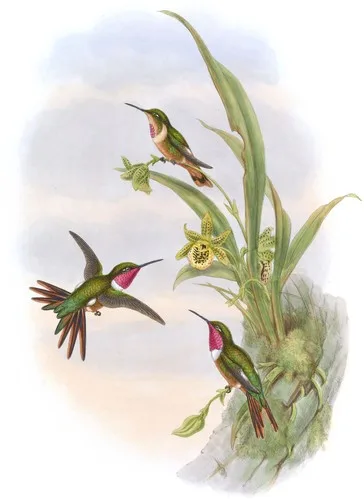
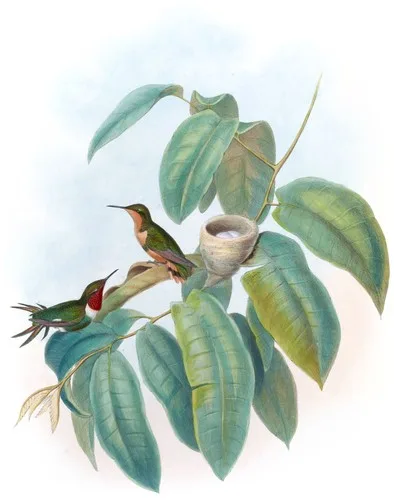
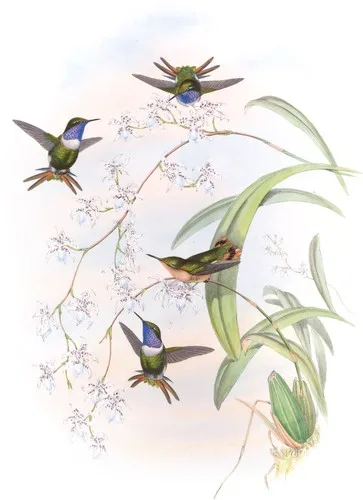
此图原刊于《古尔德蜂鸟图谱》(Gould's Hummingbirds),绘者为约翰·古尔德,成书于 1849—1887 年间。图中描绘的是 Chætocercus bombus,归入蜂鸟科(Trochilidae)。
全编共收录 421 幅图版,本图是其中一幅,原书将其列为 Pl. 392, Suppl. Vol.,见第 392 页,版式为纵幅。图像由公有领域原件扫描修复而来,细节在放大视图中仍清晰可辨。
原书文字(英文 / 法文)
The beautiful little Wood-Star of which I am now attempting a description is the smallest Humming-bird known.
I have seen enough of it to see that it is a charming little gem that will please every one. A few years ago I received four specimens—three dried males, and one female. I soon made my drawing and commenced the description, both generic and specific. The former was easy; but a specific appellation was not so readily determined upon. At last I hit upon the specific name of bombus.
This little Wood-Star has a beautiful puce-coloured throat. The wings are very diminutive, and must be moved with the greatest rapidity to carry even this little bird through the air. The outer tail-feathers are a sort of hair-like spines, such as are seldom seen in a bird. I may state that this Humming-bird looking like a great humble-bee suggested to me the specific name of bombus.
The following description was given by me at the meeting of the Zoological Society, December 6th, 1870:—
This species must be classed with the most diminutive of the Trochilidæ. In its general appearance and in its coloration it strongly reminds one of Chætocercus rosæ, while in some parts of its structure, particularly in the form of its two hair-like outer tail-feathers, it resembles Acestura mulsanti; its wing is even smaller and shorter than that of the little A. heliodori. It must, however, be placed, as I believe it is correctly, in the genus Chætocercus.
The following is a more minute description and admeasurement of this little bird.
Male.—Crown of the head, upper surface, and abdomen bronzy green; throat brilliant crimson-red, nearly surrounded by a mark of buff, forming a conspicuous band across the chest (a feature distinguishing it from Chætocercus rosæ, in which the band occupying the same space is white); wings purplish black; the tail-feathers the same, with the exception of the third or longest on each side, on which there is a very narrow edging of buff near the base of the inner margin; the two outer tail-feathers very fine and hair-like, the four central ones extremely small, so much so as to be hidden beneath the tail-coverts; bill and legs black.
Total length 2
inches, bill , wing 1 , longest tail-feathers , tarsi . Female.—Larger than the male. Crown and upper surface green; throat and under surface chestnutbrown; tail, which is extremely short and even, deep chestnut-brown, banded with black across the centre of each feather.
Total length 2
inches, bill , wing 1 , tail , tarsi . Hab. Citado in Ecuador.
References
- Chætocercus bombus, Gould, Proc. Zool. Soc. 1870, p.. 804.—Elliot, Synopsis, 1879, p. 121.
- Polyxemus bombus, Muls. Hist. Nat. Oiseaux-Mouches, tom. iv. p. 123 (1879).