燕尾刀翅蜂鸟·Campylopterus Cuvieri
Campylopterus Cuvieri
Campylopterus Cuvieri
Cuvier’s Sabre-wing
- 中文名
- 燕尾刀翅蜂鸟·Campylopterus Cuvieri
- 学名
- Campylopterus Cuvieri
- 合集
- 古尔德蜂鸟图谱
- 绘者
- John Gould(约翰·古尔德)
- 年代
- 1850
- 图版号
- Pl. 52, Vol. II
- 原书页码
- p.52
- 授权
- CC0 1.0 Universal (Public domain)
关于本图版
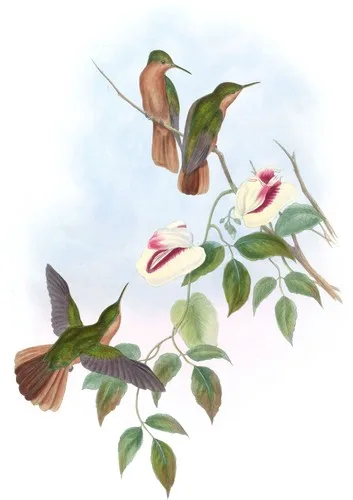
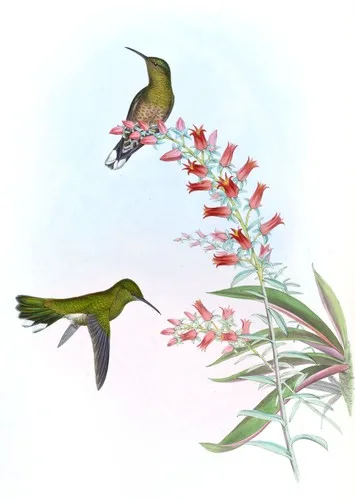
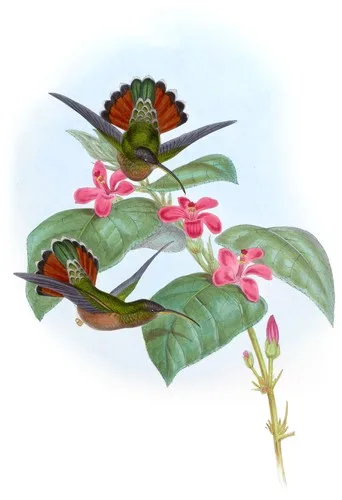
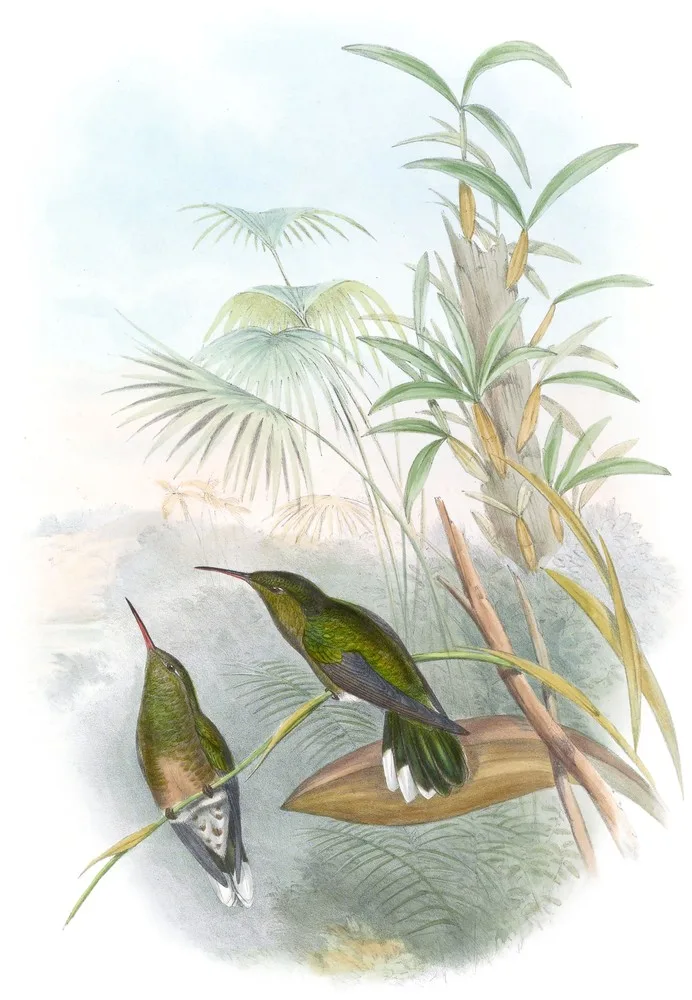
这幅图版出自《古尔德蜂鸟图谱》(Gould's Hummingbirds),由约翰·古尔德绘制,1849—1887 年间出版。画面主体是燕尾刀翅蜂鸟,归入蜂鸟科(Trochilidae)。
全编共收录 421 幅图版,本图是其中一幅,原书将其列为 Pl. 52, Vol. II,见第 52 页,版式为纵幅。扫描件取自公有领域原件,经高分辨率修复与色彩校正,可按原大放大查看线条与设色。
原书文字(英文 / 法文)
Venezuela, New Granada, Panama, and Veragua
In naming this species of Humming Bird after the late Baron Cuvier, I am certain that MM. Bourcier and De Lattre felt assured that they could not add to the fame of that highly gifted and celebrated naturalist.
France may indeed be proud of so great a man; and I must confess that I should have been much better pleased if some finer species of this fine family of birds had been selected for dedication to his memory; still, although it is one of the most plainly coloured species of the whole of the Trochilidæ, it plays a part in the economy of nature quite equal to that of the most glittering and gaily attired, and is none the less important or interesting because of its lesser degree of adornment.
All that we know respecting this species is, that it inhabits the northern parts of Columbia, the Caraccas, the Isthmus of Panama, and Veragua; and that the sexes and the young birds from the nest are all attired in a precisely similar style of plumage; in proof of which I may mention, that a little fledgeling I possess, taken from a nest near David in Veragua, is exactly of the same colour as a fully adult male. This latter specimen has the shaft of the first primary considerably dilated, showing clearly the group to which it belongs: its dull colouring and the large white tipping of its outer tail-feathers, too, are in unison with several others of the Campylopteri, such as C. longipennis, C. obscurus, &c. These modestly coloured species form a section which some Trochilidist may hereafter be induced to separate generically from the more gaily adorned C. Delattrei, C. lazulus, &c., but for the present I should prefer to retain them all in the same genus.
Crown of the head brownish green; all the upper surface and wing-coverts bronzy green; wings dark purplish brown; two centre tail-feathers greenish bronze, the remainder greenish bronze at the base, passing into greenish black, and tipped with white, the extent of the white increasing as the feathers recede from the centre ones; under surface dull bronzy green, each feather fringed with grey; centre of the abdomen washed with buff; under tail-coverts brown, broadly fringed with white; upper mandible dark brown; the under mandible appears to have been flesh-coloured; feet fleshy brown.
The figures are the size of life.
References
- Trochilus Cuvierii, De Latt. et Bourc. Rey. Zool. 1846, p. 310.
- Polytmus Cuviert, Gray and Mitch. Gen. of Birds, vol. i. p. 107, Polytmus, sp. 8.
- Campylopterus cuvieri, Bonap. Consp. Gen. Av., p. 71, Campylopterus, sp. 9.—Reichenb. Troch. enumer., p. 9. pl. dccciv. fig. 4871.
- Aphantochroa Cuvieri, Bonap. Rev. et Mag. de Zool.1854, p. 250.—Reichenb. Aufz. der Colibris, p. 17.