阔嘴蜂鸟属
Cynanthus bolivianus
Cynanthus bolivianus
Bolivian Sylph
- 中文名
- 阔嘴蜂鸟属
- 学名
- Cynanthus bolivianus
- 合集
- 古尔德蜂鸟图谱
- 绘者
- John Gould(约翰·古尔德)
- 年代
- 1887
- 图版号
- Pl. 400, Suppl. Vol.
- 原书页码
- p.400
- 授权
- CC0 1.0 Universal (Public domain)
十观
- 纵幅 1.31∶1
第一眼
搜尽奇峰打草稿。
—— 清·石涛《苦瓜和尚画语录》
走遍山川,才有资格落笔。博物画的画家也一样:先在温室与山野里看够了活的花,纸上那一朵才不虚。这一幅是竖的:眼睛从下往上走,落点在中段那只鸟身上。先别急着看羽毛,让姿态先立起来。第二步凑近一寸:看线与色的交界,色有没有压住线,线有没有断。第三步,把视线放到最深的那一小块:整幅的用色秩序,都是从那里排开的。
名与实
学名 Cynanthus bolivianus:前一词是属,管它归在哪一类;后一词是种加词,管它在这一类里凭什么与众不同。一百多年前的命名者,把一种植物的来历压进了两个词。中文名“阔嘴蜂鸟属”是后人据学名回译的通行叫法,与古书里的旧名未必对得上——名与物之间,总隔着一层翻译。
形与色
翼小而振频极高,能悬停、能倒飞;羽色非颜料所致,是羽枝结构折射的光,随角度而变。此幅未作色相归档,只能就形制论。此幅只画一个种,形制的每一处都摊在纸面上,没有遮掩。
构图与呼吸
画幅高而窄,鸟栖在枝的中段,上下留白多——十九世纪鸟谱的标准版式,留给它飞走的余地。全幅只画一只,不作解剖附图——这类图更近于“观赏”,而非“鉴定”。老图谱爱把主株摆在偏中线的位置,左右留得不一样多:这一点偏心,正是画面活起来的原因。
一刀一色
十九世纪后半叶,石版与彩色石印渐成主流:颜色可以直接印出,不再依赖手工,线条反倒退居其次。图像的“准确”提高了,手性却淡了。还有一种证据在纸背:铜版压进纸里的那道痕、上色处微微凸起的颜料、再版时磨浅的线。扫描件里也能看出七分。想动笔临它的人记住一句:先铺大块的形与色,干后再收细部;石印的柔和层次来自薄涂与网点,水彩分两三遍淡铺即可逼近。
诗境
穿花蛱蝶深深见,点水蜻蜓款款飞。
—— 唐·杜甫《曲江二首》
中土无蜂鸟,然“穿花”之态,杜甫早已写过:贴着花心走,是采蜜者的共同姿态。诗以气行,画以形立;两种“看”叠在一起,才是看画的意思。
花语
阿兹特克以蜂鸟为战神与太阳的化身;欧洲维多利亚时代则以蜂鸟为收藏与装饰的极致,百万只羽毛被做成胸饰。中国旧籍无此鸟,故无象征——这空白本身,就是一部博物学交流史。花语是给人与人的关系用的;植物自己只关心有没有传粉的虫。这两套语言,可以并行不悖。
时与地
热带美洲几乎全年可见,花期即其季节。仅产美洲,自阿拉斯加南部至火地岛,以安第斯山最为繁盛。中土无蜂鸟,汉籍不载,晚清海外游记始见其名。图上所记的 1887 年是刊行之年,不是采到那只鸟的年份;真正的观察记录通常比出版早一两年。图上的产地常是“据说来自”,图上的花期常是“盛开那十日”——两处都要打个折扣读。
书与人
《古尔德蜂鸟图谱》只署了约翰·古尔德一个人的名字。图版今属公有领域,可以自由取用;但纸上那层手工上色,仍是两百年前某一个人的手。
带走一双眼睛
鉴赏力不是知识,是习惯:每次多看一眼,十年之后你看什么都和别人不一样。二百年后,这只鸟的后代或许仍在某处活着;而纸上这一只,永远停在 1887 年的那个季节。
关于本图版
这幅图版出自《古尔德蜂鸟图谱》(Gould's Hummingbirds),由约翰·古尔德绘制,1849—1887 年间出版。阔嘴蜂鸟(Cynanthus bolivianus)是本图的主角,归入蜂鸟科(Trochilidae)。
全编共收录 421 幅图版,本图是其中一幅,原书将其列为 Pl. 400, Suppl. Vol.,见第 400 页,版式为纵幅。扫描件取自公有领域原件,经高分辨率修复与色彩校正,可按原大放大查看线条与设色。
原书文字(英文 / 法文)
All the species of this genus inhabit the high lands of tropical districts, such as the temperate regions of Columbia, Ecuador, Peru, and Bolivia.
These flying gems neither ascend to the summit of the mountains nor descend to the hot plains below, but keep to the hills and secluded valleys. In such situations vegetation reigns supreme, and insect life, both in genera and species, is lavishly bestowed.
The present species, according to Mr. Buckley, goes further south than any other of the Sylphs. It is a bird (delicate as it may appear) which braves the cold of the mountains—so severe, in fact, that it was with difficulty he succeeded in procuring specimens. He obtained, however, examples of both sexes in fine condition, these birds having just completed their moult. Mr. Buckley, about five years ago, offered me the green-tailed Sylphs which he had collected in Bolivia, and I was pleased to find in them a species I had not met with before.
I described the bird, therefore, in the ‘Annals of Natural History’ for June 1880, and I have no doubt that the species will be found to be a perfectly distinct one. The following is the description which I contributed to the ‘Annals’:—
Mr. Clarence Buckley, who has distinguished himself by his zoological researches in South America, passed, as is well known, some considerable time in Bolivia some few years ago. On his return to this country I became the fortunate possessor of many of his specimens of Humming-birds; but, owing to the illness which has afflicted me for a considerable time, I have not been able, till lately, to incorporate Mr. Buckley’s specimens in my collection of Trochilidæ. Having now been able to examine my series more closely, I have come to the conclusion that two species, at least, are new to science.
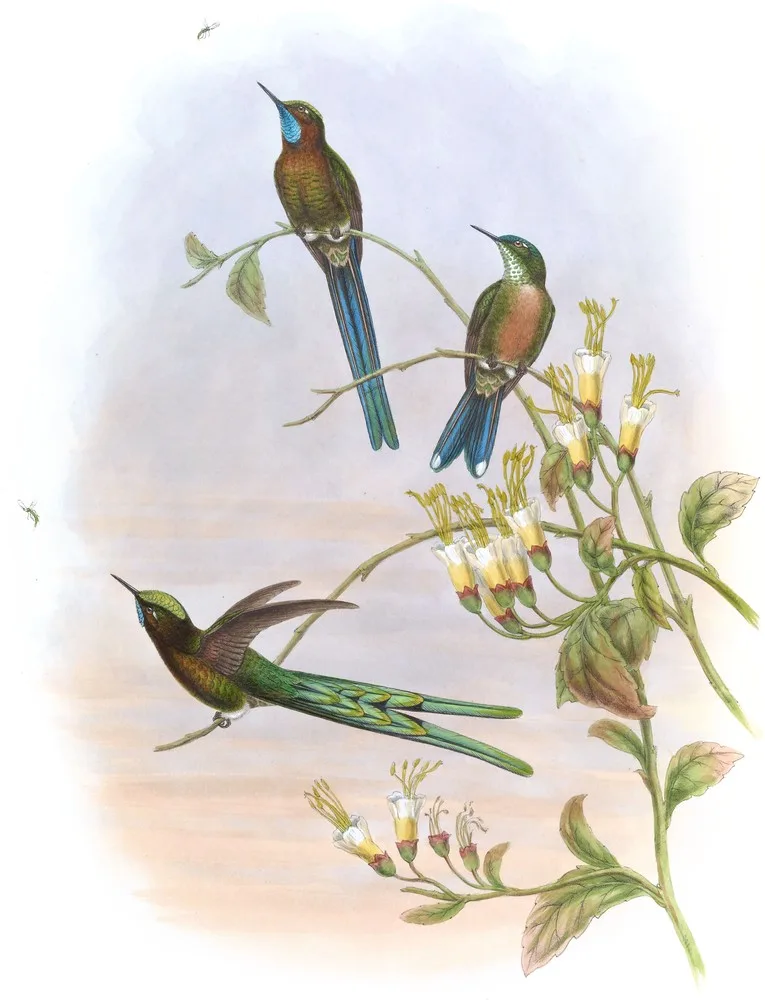
Cynanthus bolivianus, sp. n.—Similar to C. mocoa from Ecuador, but much smaller and of a brighter metallic green, and with the tail more of a brilliant steel-blue than a vivid green. Total length 6·3 inches, culmen 0·7, wing 2·6, tail 4·1, tarsus 0·2.
I possess several males of this new species, as well as of the allied C. mocoa; so that it is not without ample material before me that I describe the Bolivian bird as new to science.
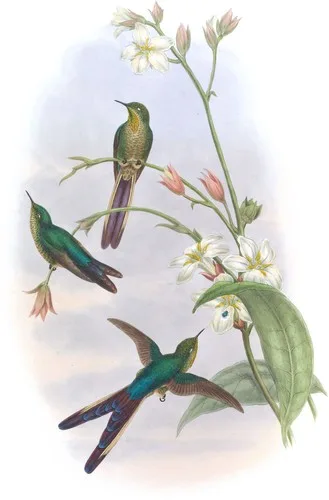
The Plate represents two males and one female.
References
- Cynanthus bolivianus, Gould, Annals of Nat. Hist., vol. v., June 1880.