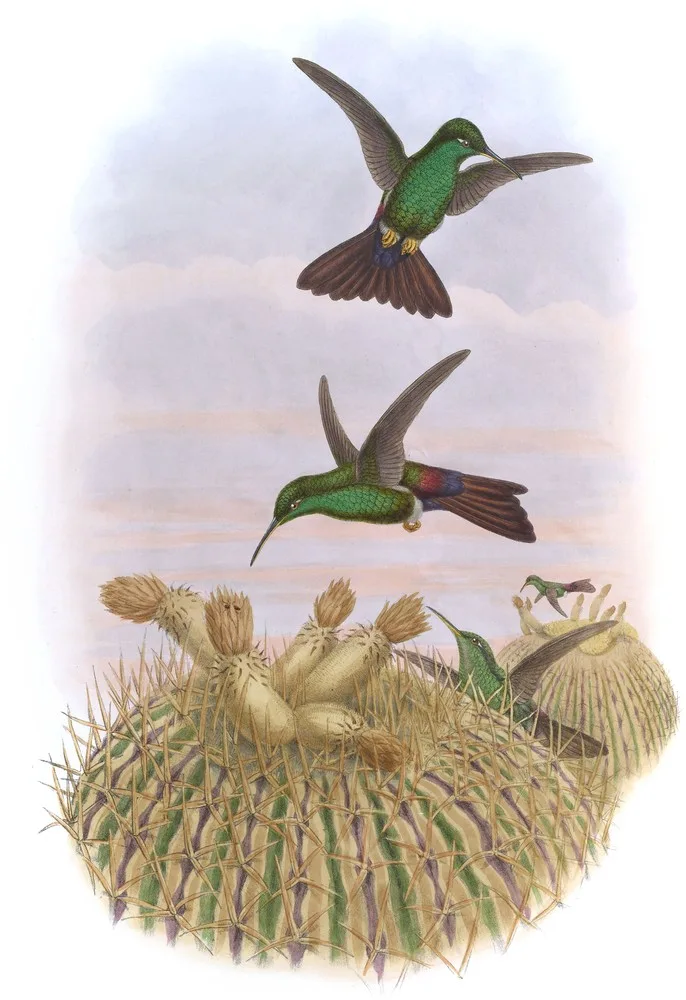
Hypuroptila melanorrhoa
Hypuroptila melanorrhoa
Black-vented Plumeleteer
- 学名
- Hypuroptila melanorrhoa
- 合集
- 古尔德蜂鸟图谱
- 绘者
- John Gould(约翰·古尔德)
- 年代
- 1887
- 图版号
- Pl. 370, Suppl. Vol.
- 原书页码
- p.370
- 授权
- CC0 1.0 Universal (Public domain)
十观
- 纵幅 1.46∶1
第一眼
竖划三寸,当千仞之高;横墨数尺,体百里之迥。
—— 南朝宋·宗炳《画山水序》
三寸的竖线可当千仞高山,几尺横墨能容百里之远。尺幅从来不是障碍,取舍才是本事。这一幅是竖的:眼睛从下往上走,落点在中段那只鸟身上。先别急着看羽毛,让姿态先立起来。第二步凑近一寸:看线与色的交界,色有没有压住线,线有没有断。第三步,把视线放到最深的那一小块:整幅的用色秩序,都是从那里排开的。
名与实
学名 Hypuroptila melanorrhoa:前一词是属,管它归在哪一类;后一词是种加词,管它在这一类里凭什么与众不同。一百多年前的命名者,把一种植物的来历压进了两个词。此幅尚无通行中文名,姑以学名相称;在没有本地名字的地方,学名就是它唯一的身份证。
形与色
蜂鸟为美洲最小之鸟,喙细长如针,舌分叉成管,可伸入花心吸蜜;翼小而振频极高,能悬停、能倒飞。此幅未作色相归档,只能就形制论。别只看花:叶脉的走向、萼片的长短、甚至茎上的毛,都是画家用来区分物种的证据。
构图与呼吸
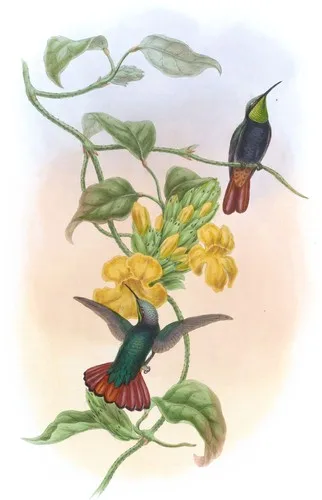
画幅高而窄,鸟栖在枝的中段,上下留白多——十九世纪鸟谱的标准版式,留给它飞走的余地。全幅只画一只,不作解剖附图——这类图更近于“观赏”,而非“鉴定”。老图谱爱把主株摆在偏中线的位置,左右留得不一样多:这一点偏心,正是画面活起来的原因。
一刀一色
十九世纪后半叶,石版与彩色石印渐成主流:颜色可以直接印出,不再依赖手工,线条反倒退居其次。图像的“准确”提高了,手性却淡了。拿放大镜(或手机微距)看三处:喙缘、覆羽、题名。线若连续不断,是刻的;色若越过轮廓半毫米,是手涂的。想动笔临它的人记住一句:先铺大块的形与色,干后再收细部;石印的柔和层次来自薄涂与网点,水彩分两三遍淡铺即可逼近。
诗境
穿花蛱蝶深深见,点水蜻蜓款款飞。
—— 唐·杜甫《曲江二首》
中土无蜂鸟,然“穿花”之态,杜甫早已写过:贴着花心走,是采蜜者的共同姿态。把这一句放回画面:画面就是诗句的落点——诗先写气,画后写形,两者在此处接上了。
花语
阿兹特克以蜂鸟为战神与太阳的化身;欧洲维多利亚时代则以蜂鸟为收藏与装饰的极致,百万只羽毛被做成胸饰。中国旧籍无此鸟,故无象征——这空白本身,就是一部博物学交流史。象征会随世道改口:同一只鸟,在一个世纪里可以说完全相反的话。
时与地
温带种类的蜂鸟则随花北迁,一年往返数千公里。仅产美洲,自阿拉斯加南部至火地岛,以安第斯山最为繁盛。中土无蜂鸟,汉籍不载,晚清海外游记始见其名。图上所记的 1887 年是刊行之年,不是采到那只鸟的年份;真正的观察记录通常比出版早一两年。图上的产地常是“据说来自”,图上的花期常是“盛开那十日”——两处都要打个折扣读。
书与人
《古尔德蜂鸟图谱》只署了约翰·古尔德一个人的名字。图版今属公有领域,可以自由取用;但纸上那层手工上色,仍是两百年前某一个人的手。
带走一双眼睛
把这三件事带走:先整体后细节;先线后色;先看画再翻书。任何一张老图版,都可以用这三条读。图谱的用意是“以备查考”,看久了却会忘记查考:1887 年的一个人,为一只鸟花了整整一天。
关于本图版
这幅图版出自《古尔德蜂鸟图谱》(Gould's Hummingbirds),由约翰·古尔德绘制,1849—1887 年间出版。图中描绘的是 Hypuroptila melanorrhoa,归入蜂鸟科(Trochilidae)。
全编共收录 421 幅图版,本图是其中一幅,原书将其列为 Pl. 370, Suppl. Vol.,见第 370 页,版式为纵幅。扫描件取自公有领域原件,经高分辨率修复与色彩校正,可按原大放大查看线条与设色。
原书文字(英文 / 法文)
The first discoverer of this species was the well-known collector Enrique Arcé, who procured it at Tucurrique in Costa Rica; and shortly after, Mr. Lawrence found specimens in the Smithsonian Institution, collected by Mr. Carmiol at Angostura, in Costa Rica, which he described as Chalybura carmioli.
Though nearly allied to C. isauræ, it is easily distinguished by the black vent, which is white in the firstnamed bird; and there can be no doubt that the two species are quite distinct. Mr. Salvin remarks that his C. melanorrhoa, with C. isauræ, forms a somewhat abnormal section of the genus; “but the differences, as seen from our present materials, are hardly of sufficient importance to warrant a generic separation. They may be briefly stated as follows:—The plumage in the Chalybura is generally more brilliant; the uropygium is nearly the same colour as the back; in the Costa-Rica bird it is clearly defined. The plumed feathers of the crissum, in the former, are much more developed.”
This species, as at present known, is only found in Central America, where it occurs in Costa Rica and Veragua.
The diagnosis given by Mr. Elliot for this species is as follows:—
Male. Head and upper parts dark grass-green; rump purplish bronze; wings purplish brown; underparts very dark shining grass-green; abdomen dark brown glossed with green; under tail-coverts black; tail dark bronzy purple; maxilla black; mandible flesh-colour. Total length 4
inches, wing 2 , tail 1 , culmen .
The principal figures in the Plate represent two males, of the size of life.
References
- Chalybura melanorrhoa, Salvin, P.Z.S8. 1864, p: 585.—Scel. & Salv. Nomencl. Av. Neotr. p. 82.—Elliot, Synopsis Trochil. p. 47.
- Chalybura carmioli, Lawr. Proc. Acad. Nat. Sci. Philad. 1865, p. 39.
- Lampornis melanorrhoa, Mulsant, Hist. Nat. Oiseaux-Mouches, vol. i. p. 174.
- Polytmus melanorrhous, Gray, Hand-l. B. vol. i. p. 126.