宝石蜂鸟属
Lampornis calosoma
Lampornis calosoma
Elliot’s Topaz
- 中文名
- 宝石蜂鸟属
- 学名
- Lampornis calosoma
- 合集
- 古尔德蜂鸟图谱
- 绘者
- John Gould(约翰·古尔德)
- 年代
- 1887
- 图版号
- Pl. 369, Suppl. Vol.
- 原书页码
- p.369
- 授权
- CC0 1.0 Universal (Public domain)
十观
- 纵幅 1.56∶1
第一眼
竖划三寸,当千仞之高;横墨数尺,体百里之迥。
—— 南朝宋·宗炳《画山水序》
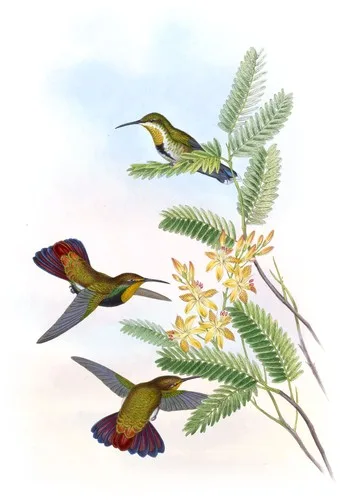
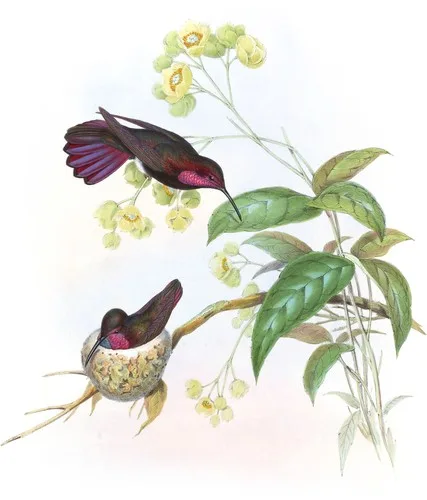
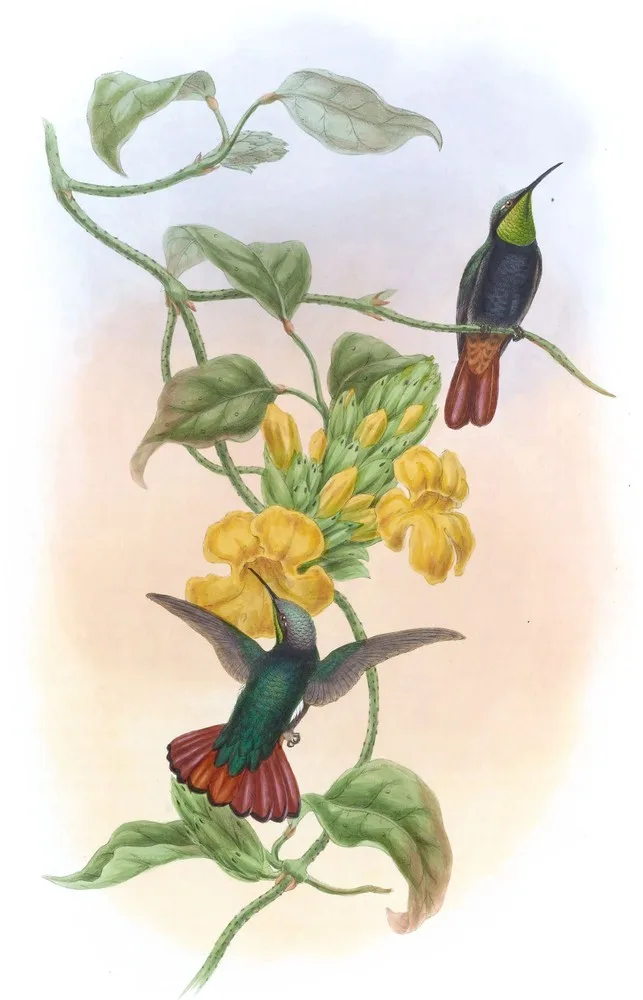
三寸的竖线可当千仞高山,几尺横墨能容百里之远。尺幅从来不是障碍,取舍才是本事。这一幅是竖的:眼睛从下往上走,落点在中段那只鸟身上。先别急着看羽毛,让姿态先立起来。第二步凑近一寸:看线与色的交界,色有没有压住线,线有没有断。第三步,把视线放到最深的那一小块:整幅的用色秩序,都是从那里排开的。
名与实
学名 Lampornis calosoma:前一词是属,管它归在哪一类;后一词是种加词,管它在这一类里凭什么与众不同。一百多年前的命名者,把一种植物的来历压进了两个词。中文名“宝石蜂鸟属”是后人据学名回译的通行叫法,与古书里的旧名未必对得上——名与物之间,总隔着一层翻译。
形与色
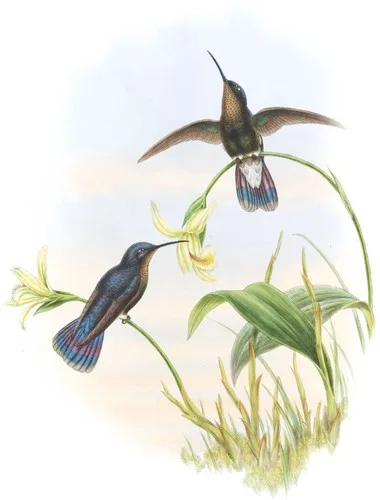
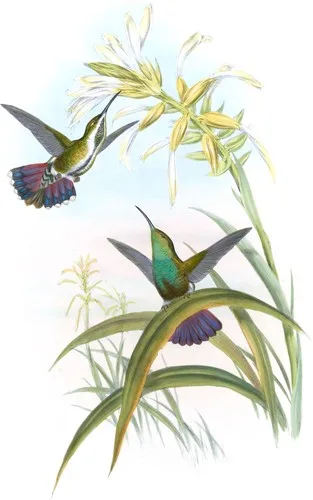
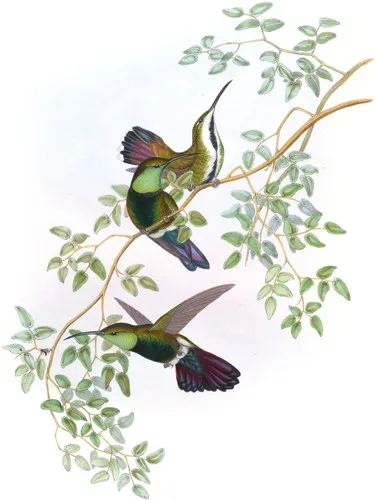
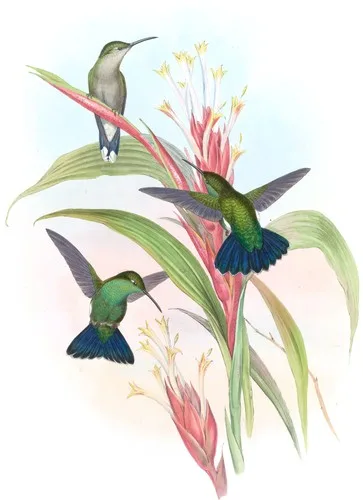
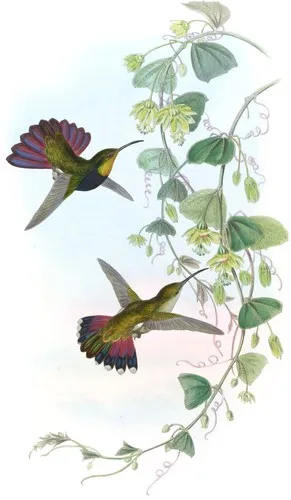
蜂鸟为美洲最小之鸟,喙细长如针,舌分叉成管,可伸入花心吸蜜;翼小而振频极高,能悬停、能倒飞。此幅未作色相归档,只能就形制论。看羽:先看覆羽的层次,再看飞羽的排列,最后才看颜色——颜色是最后才被注意到的部分。
构图与呼吸
画幅高而窄,鸟栖在枝的中段,上下留白多——十九世纪鸟谱的标准版式,留给它飞走的余地。全幅只画一只,不作解剖附图——这类图更近于“观赏”,而非“鉴定”。试着用拇指遮住空白处——画面立刻变闷;放开,它才重新“喘上气”。留白,是给主体让出的气口。
一刀一色
十九世纪后半叶,石版与彩色石印渐成主流:颜色可以直接印出,不再依赖手工,线条反倒退居其次。图像的“准确”提高了,手性却淡了。拿放大镜(或手机微距)看三处:喙缘、覆羽、题名。线若连续不断,是刻的;色若越过轮廓半毫米,是手涂的。想动笔临它的人记住一句:先铺大块的形与色,干后再收细部;石印的柔和层次来自薄涂与网点,水彩分两三遍淡铺即可逼近。
诗境
夫列子御风而行,泠然善也,旬有五日而后反。
—— 《庄子·逍遥游》
蜂鸟悬停于空,不落不飞,最近于“御风”。庄子说的是一种自由的姿态,蜂鸟把它做成了生理事实。把这一句放回画面:画面就是诗句的落点——诗先写气,画后写形,两者在此处接上了。
花语
阿兹特克以蜂鸟为战神与太阳的化身;欧洲维多利亚时代则以蜂鸟为收藏与装饰的极致,百万只羽毛被做成胸饰。中国旧籍无此鸟,故无象征——这空白本身,就是一部博物学交流史。在图谱里,它首先是一个物种,其次才是一种象征——这个次序值得记住。
时与地
热带美洲几乎全年可见,花期即其季节。仅产美洲,自阿拉斯加南部至火地岛,以安第斯山最为繁盛。中土无蜂鸟,汉籍不载,晚清海外游记始见其名。图上所记的 1887 年是刊行之年,不是采到那只鸟的年份;真正的观察记录通常比出版早一两年。看叶的老嫩、花与果是否同在枝上,季节便八九不离十;看题名里藏着的地名,来路也猜得出七分。
书与人
《古尔德蜂鸟图谱》只署了约翰·古尔德一个人的名字。图版今属公有领域,可以自由取用;但纸上那层手工上色,仍是两百年前某一个人的手。
带走一双眼睛
下次看鸟,别急着认名:先看它停的姿态,再看羽色在哪一段最深,最后才翻图鉴——顺序一换,看鸟就从“对答案”变成了“看画”。二百年后,这只鸟的后代或许仍在某处活着;而纸上这一只,永远停在 1887 年的那个季节。
关于本图版
《古尔德蜂鸟图谱》(Gould's Hummingbirds)由约翰·古尔德绘制,1849—1887 年间印行,本图即其中一幅。宝石蜂鸟(Lampornis calosoma)是本图的主角,在分类体系中列于蜂鸟科(Trochilidae)。
该合集全编共 421 幅图版,此图为其中之一,图版编号 Pl. 369, Suppl. Vol.,对应原书第 369 页,版式为纵幅。图为公有领域原件的修复扫描,构图与设色未经改动。
原书文字(英文 / 法文)
It is now ten years ago since this beautiful species was described by my friend Mr. Elliot; and the specimen still remains unique in the collection of the latter gentleman.
As he observes, I gave him my opinion at the time that the species ought to be placed in the genus Chrysolampis; and although in deference to the judgment of Mr. Salvin and Mr. Elliot I go so far as to follow them in the present work and place it in the genus Lampornis, I believe in my innermost heart that they are mistaken, and that the bird is a true Chrysolamps—if, indeed, it should not be placed in a genus by itself. I would ask any body to compare the figures which I have drawn in order to show both the back and front views of the bird, and to say which form the present species most resembles, Lampornis or Chrysolampis. It has not the long bill nor the forked tail of the former genus, characters in my opinion quite sufficient to separate it from that; but, on the other hand, let it be compared with Chrysolampis moschitus, in how many characters they agree ! First, there is the small bill, the metallic crown, the darker back, and the rounded tail, with the copperybrown central tail-feathers, though it is true that in L. calosoma the remainder of the rectrices are purple; still the general character of the plumage is like that of C. moschitus; and, again, on the under surface the metallic throat, the dark belly, the chestnut under tail-coverts, and the under surface of the tail all remind us of the last-named species. If, therefore, as I anticipate, the bird should be one day replaced in the genus Chrysolampis, the specific name of chlorolæmus will have to be restored as well.
Mr. Elliot writes:—
The habitat of this species is unknown; but it is not unlikely that it may be a native of the West-Indian Islands, of whose ornithology we at present know nothing. If this supposition should prove to be correct, a fine field still remains unexplored for some enterprising naturalist; for among the members of the genus Lampornis the present species is one of the very handsomest, and doubtless many equally fine birds in this and other families are still unknown to science to reward the researches of the explorer.
The following description is given by Mr. Elliot in his ‘Synopsis:’—
Male. Top of head and neck pale metallic silvery green, in some lights purplish; a black band across the back; rest of upper parts dark green; tail fiery copper-colour, the feathers margined with blackish purple; throat brilliant emerald-green; underparts purplish black; spot of white on the flanks; under tailcoverts chestnut; bill black.
Total length 4 inches, wing 2
, tail 1 , culmen .
The Plate contains two figures of the unique type, and shows both back and front views of the bird, for reasons specified above. Iam indebted to Mr. Elliot for the loan of the specimen from which the figures are drawn.
References
- Chrysolampis chlorolemus, Elliot, Ann. & Mag. Nat. Hist. (4) vi. p. 846 (1870).
- Lampornis calosoma, Sclater & Salvin, Ibis, 1871, p. 429.—Elliot, Ibis, 1872, p. 351.— Mulsant, Hist. Nat. Ois.-Mouches, i. p. 177.—Elliot, Synops. Humming-birds, p. 41.