极乐冠蜂鸟
Lophornis chalybeus
Lophornis chalybeus
Festive Coquette
- 中文名
- 极乐冠蜂鸟
- 学名
- Lophornis chalybeus
- 合集
- 古尔德蜂鸟图谱
- 绘者
- John Gould(约翰·古尔德)
- 年代
- 1852
- 图版号
- Pl. 124, Vol. III
- 原书页码
- p.124
- 授权
- CC0 1.0 Universal (Public domain)
十观
- 略纵 1.22∶1
第一眼
论画以形似,见与儿童邻。
—— 宋·苏轼《书鄢陵王主簿所画折枝》
只求画得像,是小孩的眼光。苏轼不是不要形似,是说形似之后还有一层:神。这一幅略高于宽,落点在中央偏上那只鸟的头部。第二步凑近一寸:看线与色的交界,色有没有压住线,线有没有断。第三步,把视线放到最深的那一小块:整幅的用色秩序,都是从那里排开的。
名与实
学名 Lophornis chalybeus:前一词是属,管它归在哪一类;后一词是种加词,管它在这一类里凭什么与众不同。双名制的好处是唯一:全世界叫这个名字的,只能是这一种。中文名“极乐冠蜂鸟”是后人据学名回译的通行叫法,与古书里的旧名未必对得上——名与物之间,总隔着一层翻译。
形与色
蜂鸟为美洲最小之鸟,喙细长如针,舌分叉成管,可伸入花心吸蜜;翼小而振频极高,能悬停、能倒飞。此幅未作色相归档,只能就形制论。此幅只画一个种,形制的每一处都摊在纸面上,没有遮掩。
构图与呼吸
画幅略高于宽,鸟身居中偏上,视线落在头部与喙。全幅只画一只,不作解剖附图——这类图更近于“观赏”,而非“鉴定”。老图谱爱把主株摆在偏中线的位置,左右留得不一样多:这一点偏心,正是画面活起来的原因。
一刀一色
十九世纪后半叶,石版与彩色石印渐成主流:颜色可以直接印出,不再依赖手工,线条反倒退居其次。图像的“准确”提高了,手性却淡了。拿放大镜(或手机微距)看三处:喙缘、覆羽、题名。线若连续不断,是刻的;色若越过轮廓半毫米,是手涂的。想动笔临它的人记住一句:先铺大块的形与色,干后再收细部;石印的柔和层次来自薄涂与网点,水彩分两三遍淡铺即可逼近。
诗境
穿花蛱蝶深深见,点水蜻蜓款款飞。
—— 唐·杜甫《曲江二首》
中土无蜂鸟,然“穿花”之态,杜甫早已写过:贴着花心走,是采蜜者的共同姿态。诗以气行,画以形立;两种“看”叠在一起,才是看画的意思。
花语
阿兹特克以蜂鸟为战神与太阳的化身;欧洲维多利亚时代则以蜂鸟为收藏与装饰的极致,百万只羽毛被做成胸饰。中国旧籍无此鸟,故无象征——这空白本身,就是一部博物学交流史。象征多半来自形状与气味:像杯的、像泪的、香的、臭的——先有形状,后有意义。
时与地
热带美洲几乎全年可见,花期即其季节。仅产美洲,自阿拉斯加南部至火地岛,以安第斯山最为繁盛。中土无蜂鸟,汉籍不载,晚清海外游记始见其名。图上所记的 1852 年是刊行之年,不是采到那只鸟的年份;真正的观察记录通常比出版早一两年。图上的产地常是“据说来自”,图上的花期常是“盛开那十日”——两处都要打个折扣读。
书与人
《古尔德蜂鸟图谱》只署了约翰·古尔德一个人的名字。版画是集体工程:绘图、刻版、上色各有其人,真正决定这幅图好不好看的,常是没留下名字的刻工与上色师。
带走一双眼睛
鉴赏力不是知识,是习惯:每次多看一眼,十年之后你看什么都和别人不一样。1852 年的那只鸟早已化作尘土,它留在纸上的样子,却比任何一只活着的同类都长寿。
关于本图版
此图原刊于《古尔德蜂鸟图谱》(Gould's Hummingbirds),绘者为约翰·古尔德,成书于 1849—1887 年间。极乐冠蜂鸟(Lophornis chalybeus)是本图的主角,归入蜂鸟科(Trochilidae)。
全编共收录 421 幅图版,本图是其中一幅,原书将其列为 Pl. 124, Vol. III,见第 124 页,版式为纵幅。扫描件取自公有领域原件,经高分辨率修复与色彩校正,可按原大放大查看线条与设色。
原书文字(英文 / 法文)
Brazil
The climate of the rich province of Rio de Janeiro, so favourable to the production of a luxuriant vegetation, would seem to be equally propitious to animal life, for in few countries of the world are the quadrupeds, birds and insects more varied in character, or more remarkable for their beauty, and the interest which attaches to them: it is in this highly favoured region that the present elegant little Humming-Bird is to be found, its chief abode being the districts to the southward of the capital.
It is a species which has attracted the notice of many naturalists, especially of those whose attention has been directed to the birds of Brazil; yet, strange to say, neither Vieillot, T’emminck, Lesson, Jardine nor Spix have said anything more respecting it than that it is from ‘such and such a locality; the following brief account of it will therefore be read with interest. Mons. A. Deyrolle of Paris, who has had ample opportunities of observing the bird in a state of nature, informs me that it is “abundant in the province of Santa Catharina, in Brazil, and is especially numerous in the environs of San Franciseo do Sul, and at Palmitar, 30 miles from the mouth of the Rio San Francisco, in about 26
Mr. Reeves tells me that it is found at St. Paul’s, and occasionally, but very rarely, in Rio de Janeiro and Santa Catharina.
It will be seen that I have made the Ornismya Audenetii of Lesson synonymous with the present species; and as a proof that I am correct in so doing, I may mention, that, having written to M. Edouard Verreaux on the subject, he has favoured me with a reply, in which he says, “You could not have written to any one better able to answer your inquiry respecting the T. Audeneti. The example from which Lesson took his figure and description, was sold by my father to M. Audinet in 1827: after my return from the Cape of Good Hope, that gentleman’s collection came into my possession; and upon reference to the specimen in question, I am at a loss to conceive what could have induced M. Lesson to figure it as distinct; for on comparison, I find that it is nothing more than an immature example of his O. Vieilloti,” which is the T. chalybeus of Vieillot. M. Verreaux adds, that his father had received the bird from Brazil. The T. mystax of Spix is certainly identical with the bird here represented; and although this author considers it distinct, and points out some features in which he believes it to differ, I decidedly affirm that they constitute but one species.
The usual differences occur in the sexes that are found in the other members of the genus; the female being destitute at all ages of the ornamental ruff so conspicuous in the male, and having the tail shorter and more largely tipped with buff.
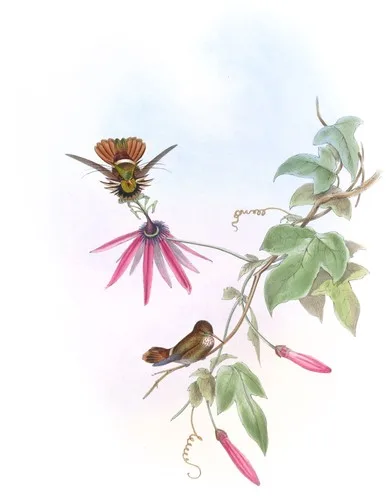
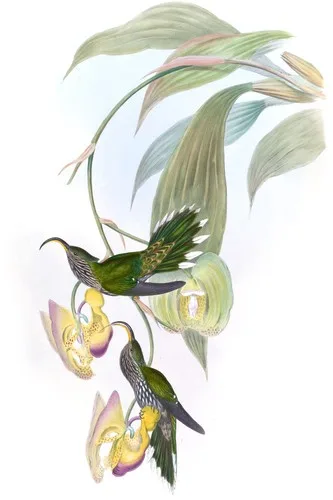
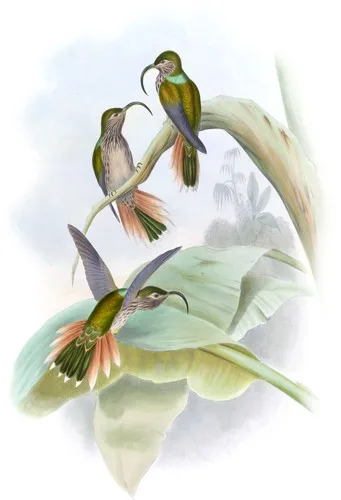
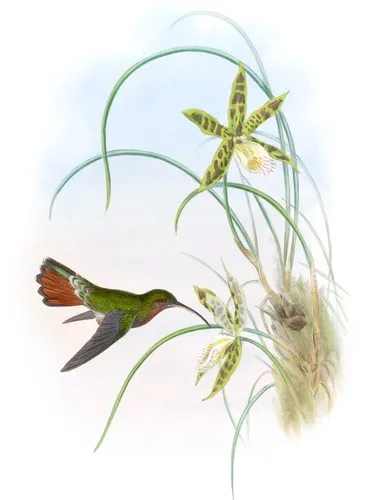
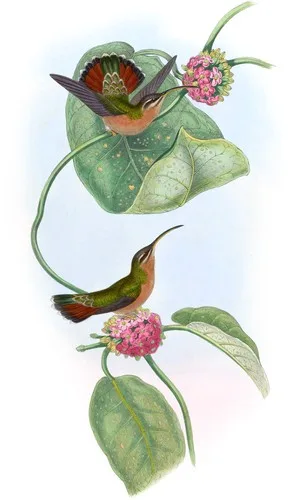
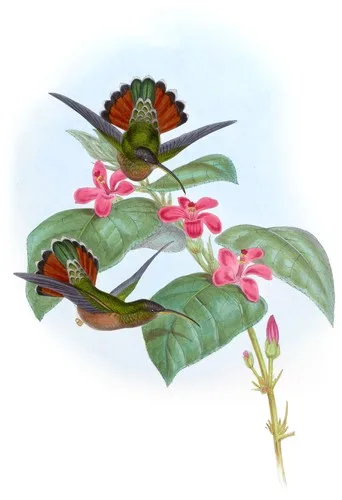
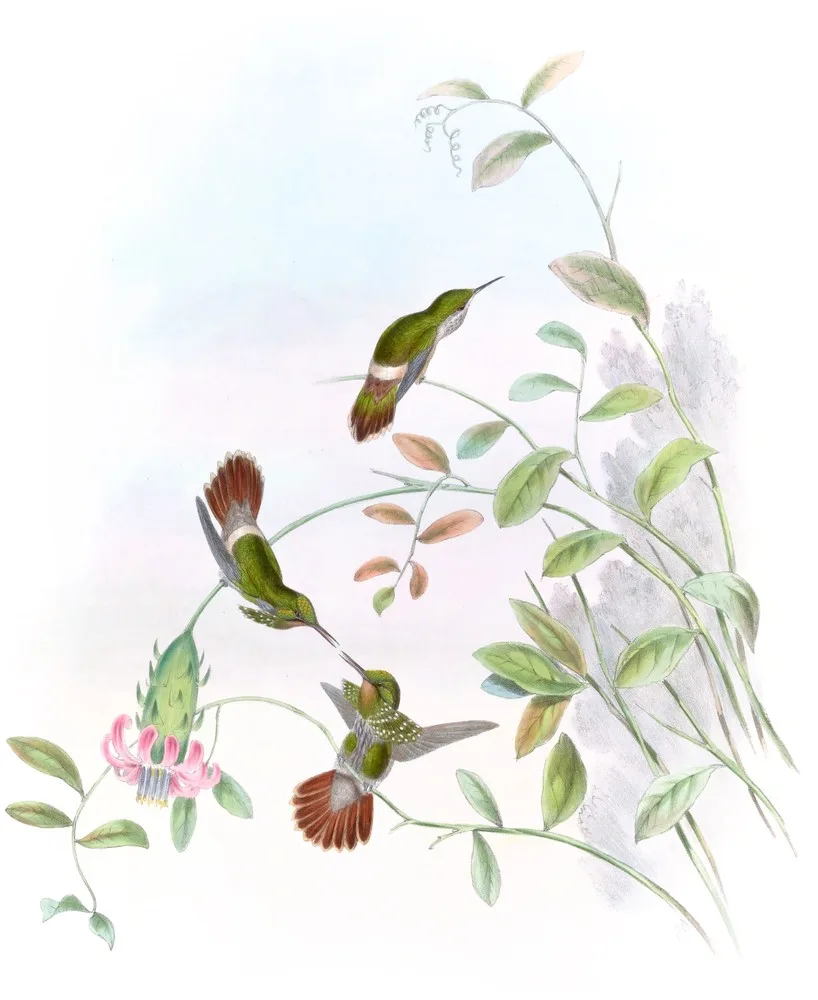
The male has the forehead, line beneath the eye and the lengthened ear-coverts brilliant metallic green, with, in some lights, a golden lustre; back of the head, upper surface and wing-coverts bronzy green; across the rump-a broad band of buffy white, below which is another band of chestnut-brown; wing’s purplish brown; upper tail-coverts bronzy green; tail purplish bronze, each feather narrowly margined with black and narrowly tipped with buffy white; throat glossy grass-green; lengthened plumes on each side of the neck olive-green, with a small spot of white at the extremity of each; under surface dark brown, with bronzy reflexions; centre of the breast ornamented with a number of greyish white plumes; across the lower part.of the abdomen a mark of white; bill black; feet brownish black.
The female has the upper surface greenish bronze, inclining to brown on the crown; the under surface greyish white; the feathers of the throat streaked with brown; tail bronzy at the base, deepening into deep bronzy brown towards the extremity; the lateral feathers largely, and the central ones narrowly tipped with buff; back crossed by a band of buffy white, below which is another of chestnut-brown as in the male; the wings, bill and feet are also of the same hue as in that sex.
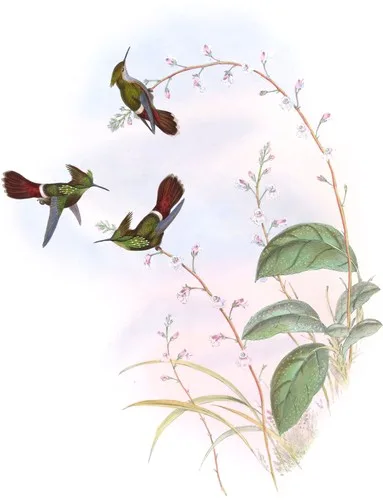
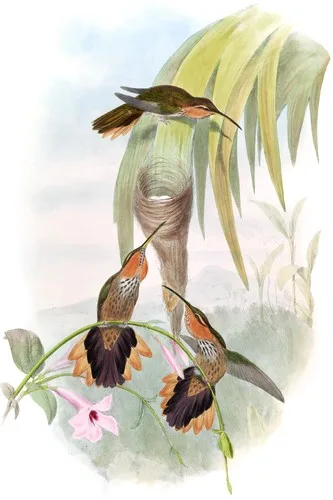
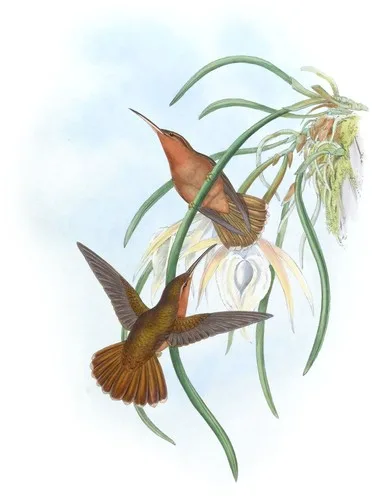
The Plate represents a male and a female of the natural size, on a Brazilian plant, of which a drawing was sent me by Mr. Reeves.
References
- Trochilus chalybeus, Vieill. Ency. Méth. Orn., part 1. p. 574.—Temm. Pl. Col. 66. fig. 2.— Jard. Nat. Lib. Humming-Birds, vol. 1. p. 129. pl. 18.
- Trochilus festivus, Licht. Verz. der Doubl., p. 14. No. 122.
- Ornismya Vieillotii, Less. Hist. Nat. des Ois. Mou., p. 186. pl. 64.—Ib. Les Troch., p. 37. pl. 8, p. 41. pl. 9, p. 44. pl. 10, p. 46. pl. 11.
- Mellisuga chalybea, Gray and Mitch. Gen. of Birds, vol. 1. p. 118, Mellisuga, sp. 90.
- Lophornis chalybeus, Bonap. Consp. Gen. Av., p. 84, Lophornis, sp. 9.
- Ornismya Audenetii, Less. Hist. Nat. des Ois. Mou. Supp., p. 102. pl. 2.
- Trochilus Audenetii, Jard. Nat. Lib. Humming-Birds, vol. 1. p. 127. pl. 17.
- Colibri mystax, Spix, Av. Bras., tom. i. p. 82. Tab. LXXXII. fig. 3.
- Mellisuga Audenetii, Gray and Mitch. Gen. of Birds, vol. i. p. 118, Mellisuga, sp. 89.
- Lophornis Audeneti, Bonap. Consp. Gen. Av., p. 84, Lophornis, sp. 6.