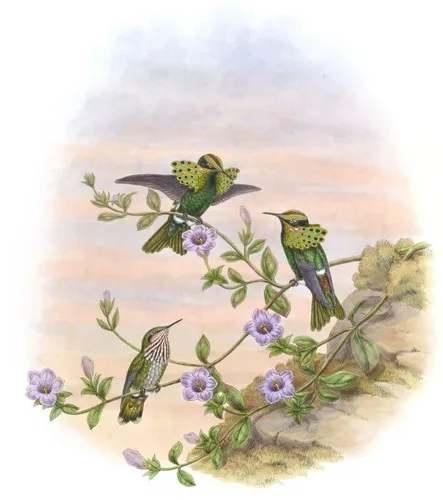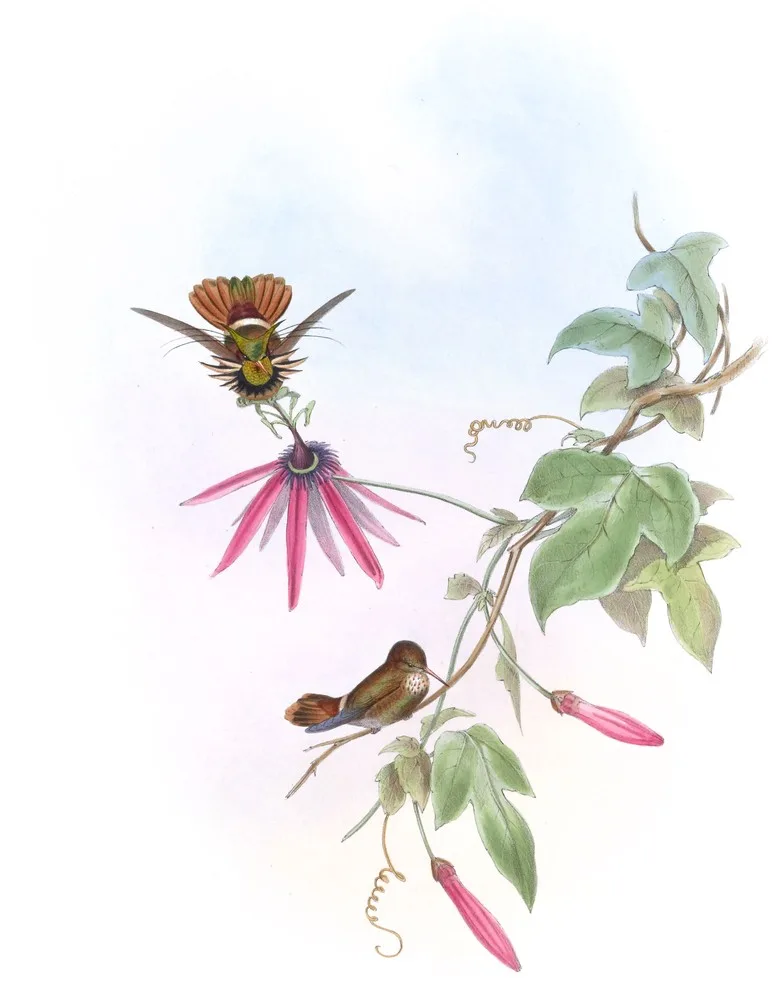
Lophornis Helenæ
Lophornis Helenæ
Princess Helena’s Coquette
- 合集
- 古尔德蜂鸟图谱
- 绘者
- John Gould(约翰·古尔德)
- 年代
- 1852
- 图版号
- Pl. 123, Vol. III
- 原书页码
- p.123
- 授权
- CC0 1.0 Universal (Public domain)
十观
- 略纵 1.29∶1
第一眼
搜尽奇峰打草稿。
—— 清·石涛《苦瓜和尚画语录》
走遍山川,才有资格落笔。博物画的画家也一样:先在温室与山野里看够了活的花,纸上那一朵才不虚。这一幅略高于宽,落点在中央偏上那只鸟的头部。第二步凑近一寸:看线与色的交界,色有没有压住线,线有没有断。第三步,把视线放到最深的那一小块:整幅的用色秩序,都是从那里排开的。
名与实
图上只标属名 Lophornis,未定种;这一时期的图谱常以一属数种合绘,种名要等后来的专著补齐。此幅尚无通行中文名,姑以学名相称;在没有本地名字的地方,学名就是它唯一的身份证。
形与色
蜂鸟为美洲最小之鸟,喙细长如针,舌分叉成管,可伸入花心吸蜜;翼小而振频极高,能悬停、能倒飞。此幅未作色相归档,只能就形制论。画幅略高,形与色的关系因此看得格外清楚:先读轮廓,再读色层,最后才看笔触。
构图与呼吸
画幅略高于宽,鸟身居中偏上,视线落在头部与喙。全幅只画一只,不作解剖附图——这类图更近于“观赏”,而非“鉴定”。老图谱爱把主株摆在偏中线的位置,左右留得不一样多:这一点偏心,正是画面活起来的原因。
一刀一色
十九世纪后半叶,石版与彩色石印渐成主流:颜色可以直接印出,不再依赖手工,线条反倒退居其次。图像的“准确”提高了,手性却淡了。先判断它是“印”的还是“画”的,再谈好不好看——这是看老版画最实用的一条规矩。想动笔临它的人记住一句:先铺大块的形与色,干后再收细部;石印的柔和层次来自薄涂与网点,水彩分两三遍淡铺即可逼近。
诗境
穿花蛱蝶深深见,点水蜻蜓款款飞。
—— 唐·杜甫《曲江二首》
中土无蜂鸟,然“穿花”之态,杜甫早已写过:贴着花心走,是采蜜者的共同姿态。诗以气行,画以形立;两种“看”叠在一起,才是看画的意思。
花语
阿兹特克以蜂鸟为战神与太阳的化身;欧洲维多利亚时代则以蜂鸟为收藏与装饰的极致,百万只羽毛被做成胸饰。中国旧籍无此鸟,故无象征——这空白本身,就是一部博物学交流史。在图谱里,它首先是一个物种,其次才是一种象征——这个次序值得记住。
时与地
温带种类的蜂鸟则随花北迁,一年往返数千公里。仅产美洲,自阿拉斯加南部至火地岛,以安第斯山最为繁盛。中土无蜂鸟,汉籍不载,晚清海外游记始见其名。图上所记的 1852 年是刊行之年,不是采到那只鸟的年份;真正的观察记录通常比出版早一两年。图上的产地常是“据说来自”,图上的花期常是“盛开那十日”——两处都要打个折扣读。
书与人
《古尔德蜂鸟图谱》只署了约翰·古尔德一个人的名字。从画稿到成图要过好几双手:转刻的人求准,上色的人求快——快与准之间,就是各幅之间深浅不一的来历。
带走一双眼睛
鉴赏力不是知识,是习惯:每次多看一眼,十年之后你看什么都和别人不一样。图谱的用意是“以备查考”,看久了却会忘记查考:1852 年的一个人,为一只鸟花了整整一天。
关于本图版
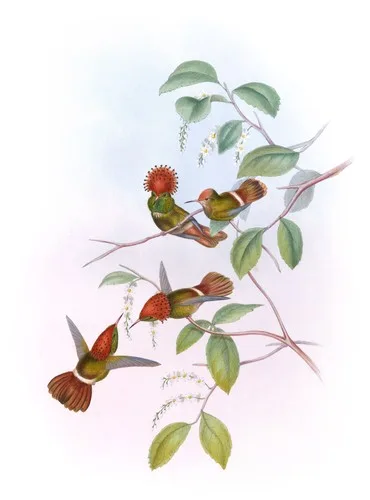
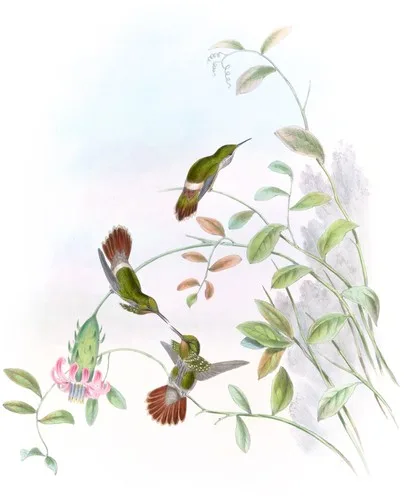
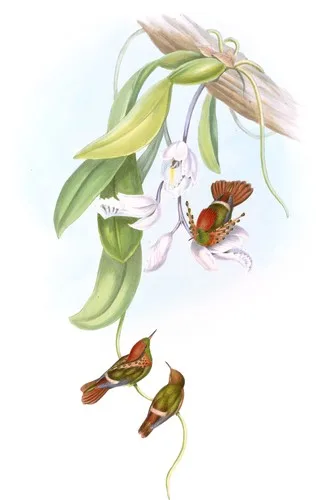
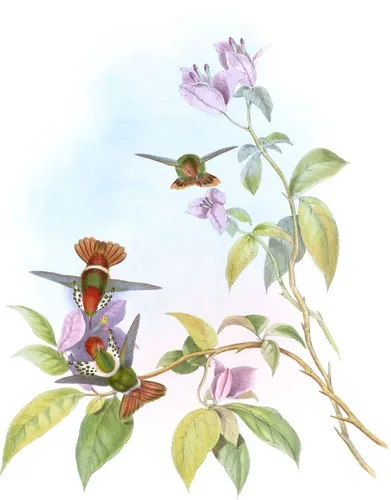
本图选自约翰·古尔德的《古尔德蜂鸟图谱》(Gould's Hummingbirds),原书 1849—1887 年间出版。原书题作“Lophornis Helenæ”,在分类体系中列于蜂鸟科(Trochilidae)。
该合集全编共 421 幅图版,此图为其中之一,图版编号 Pl. 123, Vol. III,对应原书第 123 页,版式为纵幅。扫描件取自公有领域原件,经高分辨率修复与色彩校正,可按原大放大查看线条与设色。
原书文字(英文 / 法文)
Guatemala and Southern Mexico
It will be seen that the bird figured in the accompanying Plate exhibits many extraordinary and peculiar features,—such a combination, in fact, as is not to be found in any other species; it is, moreover, as beautiful as it is outré, and these circumstances, combined with its great rarity, render it a highly desirable species to all collectors; the small number of specimens, however, that have been transmitted to Europe, and the high price they bear, have confined them to but few collections.
The native country of the Lophornis Helenæ is “Vera Paz near Petinck in the Republic of Guatemala,” where I believe all the specimens that have yet been sent to Europe were obtained by M. De Lattre. Would that that gentleman had, prior to his sudden and untimely death, given to the world some account of the habits and manners of this curious bird, as well as of the many other interesting species which must have come under his notice during his lengthened sojourn among the Andean Humming Birds!
The female is so extremely rare, that, so far as I am aware, only two examples have been sent to Europe; one of these is in the collection of Mr. Leadbeater, who kindly lent it to me to complete my illustration of the species, and to whom I am also indebted for many other similar favours connected with my various works.
M. De Lattre named this species Helenæ, in honour of the Princesse Helene d’Orleans: “Cette noble princesse, protectrice des arts, qu’elle encourage et qu’elle cultive avec tant de goût, et dont la grande infortune rehausse le beau caractère. Puisse la Princesse Hélèene accueillir avec bonté cette hommage d’un voyageur, heureux, dans les contrées lointaines, de conquérir cette rarissime espèce pour lui donner le nom d’une épouse et d’une mere si chère a la France!”
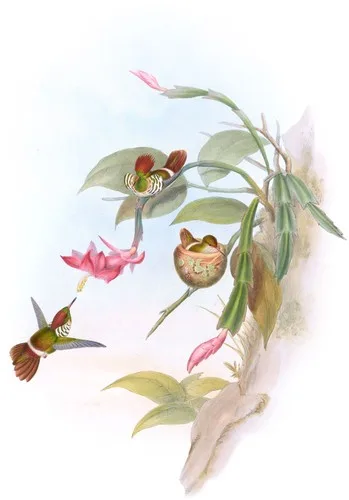
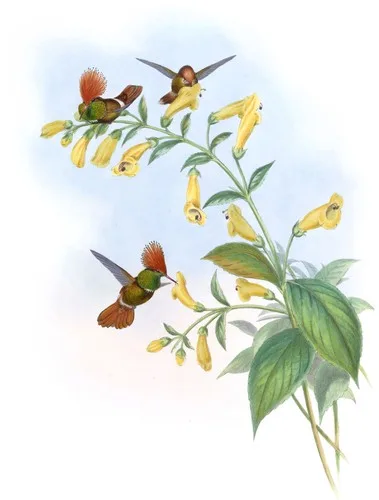
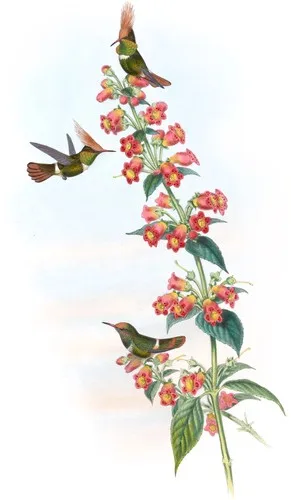
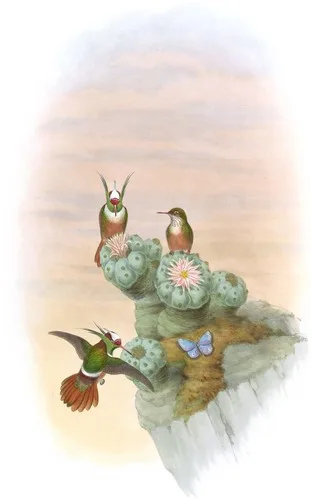
The male has the face and bifurcated crest green; throat luminous golden green; the luminous throat-mark surrounded by a series of elongated feathers, those on the sides of the neck, which are the longest, being buff streaked with bluish black, while those of the centre are wholly black; from the occiput, on either side, three very long, narrow, pointed and hair-like black feathers; upper surface and wing-coverts coppery bronze; wings purplish brown; rump deep bronzy brown, separated from the general hue of the upper surface by a narrow band of white; tail deep rufous, the central feathers glossed with bronzy green, and the remainder margined externally with dark brown; chest golden bronze; the remainder of the under surface white, with a spot of golden bronze at the tip of each feather; bill flesh-colour, darker at the point.
The female has the head, upper surface, wing-coverts and abdomen bronzy green; throat white, with a spot of bronzy green at the tip of each feather; rump dark brown, crossed by a band of white; tail buff, crossed by a dusky band near the tip.
The figures on the accompanying Plate represent a male and a female of the natural size.
References
- Ornismya Helenæ, De Latt. Rev. Zool. 1843, p. 133.
- Mellisuga Helenæ, Gray and Mitch. Gen. of Birds, vol. i. p. 113, Mellisuga, sp. 86.
- Lophornis helenae, Bonap. Consp. Gen. Av., p. 83, Lophornis, sp. 4.
- Lophornis helena, Ib. Rev. et Mag. de Zool. 1854, p. 257.
- Lophornis Helenae, Reichenb. Aufz. der Colibris, p. 12.