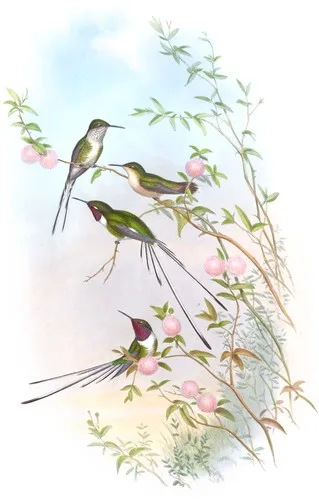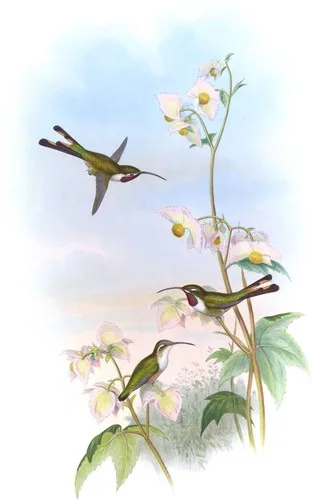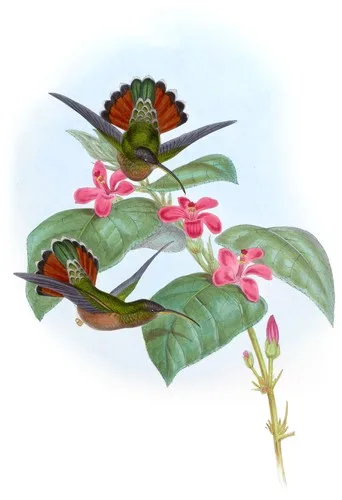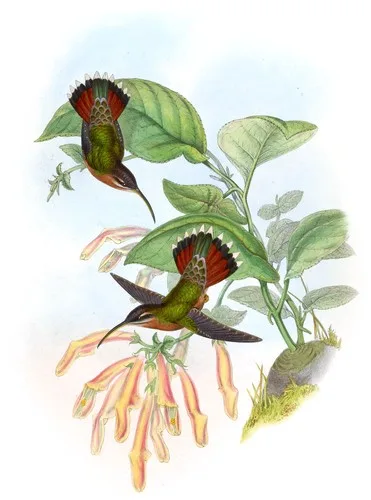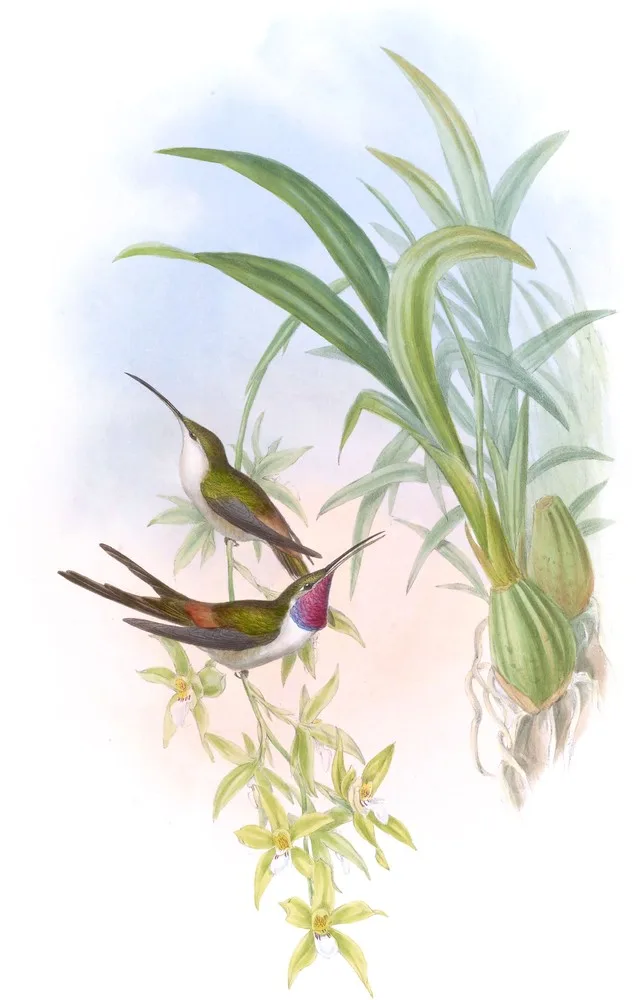
绿洲蜂鸟属
Rhodopis vespera
Rhodopis vespera
Evening Humming Bird
- 中文名
- 绿洲蜂鸟属
- 学名
- Rhodopis vespera
- 合集
- 古尔德蜂鸟图谱
- 绘者
- John Gould(约翰·古尔德)
- 年代
- 1852
- 图版号
- Pl. 154, Vol. III
- 原书页码
- p.154
- 授权
- CC0 1.0 Universal (Public domain)
关于本图版
本图选自约翰·古尔德的《古尔德蜂鸟图谱》(Gould's Hummingbirds),原书 1849—1887 年间出版。绿洲蜂鸟(Rhodopis vespera)是本图的主角,在分类体系中列于蜂鸟科(Trochilidae)。
该合集全编共 421 幅图版,此图为其中之一,图版编号 Pl. 154, Vol. III,对应原书第 154 页,版式为纵幅。图为公有领域原件的修复扫描,构图与设色未经改动。
原书文字(英文 / 法文)
Peru
It will be seen, on reference to the synonyms given above, that this species has been honoured with no less than seven generic names: happily, the specific appellation has been permitted to remain unchanged.
The name of Evening Humming Bird was doubtless assigned to it by M. Lesson, from an impression that it only flies at that period of the day, but I do not think that its habits differ at all from those of the other members of the family, which generally avoid the mid-day sun, and seek their insect food in the morning and evening; still the name is pretty, and there is no great objection to it. As to the bird itself, it may rank among the most beautiful and elegant members of its family, the lovely amethystine hues of its throat vieing in delicacy with any of them. Lesson states that it is a native of Chili, but as I have never seen any specimens from that country, or heard of its occurring there, I very much question if it ever goes so far south; if it does, it is only to its northern confines. That it inhabits Southern Peru is certain, numerous examples having been forwarded to me direct from thence by M. Warszewicz and other collectors. I believe it is found in the neighbourhood of the Arica, or that portion of the country lying between the sea and the Cordilleras. It is possible that it is also to be met with in Bolivia, but of this I have no direct evidence. The great length of its wings, the forked form of its tail, and the smallness of its feet, all indicate that it possesses great powers of flight.
The male has the centre of the throat fine amethystine red, changing on the margin to purplish blue, producing an iridescence it is impossible accurately to describe; all the upper surface bronzy greenish brown, the brown hue prevailing on the crown; wings purple-brown; central tail-feathers olive-grey, outer tailfeathers dark brown; rump crossed by an indistinct band of rusty red; under surface greyish white, washed with dusky on the flanks; bill and feet blackish brown.
The female has the upper surface of a similar but paler hue than that of the male; a wash of rufous on the upper tail-coverts; two centre tail-feathers and basal portion of the lateral ones bronzy green; the feather on each side the two central ones tipped with black, the remainder crossed obliquely with black, and largely tipped with white; under surface greyish white.
The Plate represents the two sexes of the size of life. The plant is the Zygopetalon Murrayanum.
References
- Ormsmya vesper, Less. Hist. Nat. des Ois. Mou., p. 85. pl. 19.—Ib. Hist. Nat. des Troch., p. 33. pl. vi.—Ib. Rey. Zool. 1838, p. 14.—Ib. Traité d’Orn., p. 273.
- Trochilus vesper, Jard. Nat. Lib. Humming Birds, vol. i. p. 127. pl. 24.
- Calothorax vesper, Gray and Mitch. Gen. of Birds, vol. i. p. 110, Calothorax, sp. 13.
- Thaumastura vesper, Bonap. Consp. Gen. Av., p: 85, Thaumastura, sp. 2.
- Lucifer vesper, Bonap. Rev. et Mag. de Zool. 1854, p. 257.
- Rhodopis vespera, Reichenb. Aufz. der Colibris, p. 13.
- Calliphlox vespera, Reichenb. Troch. enumer., p. 10.