Spathura Peruana
Spathura Peruana
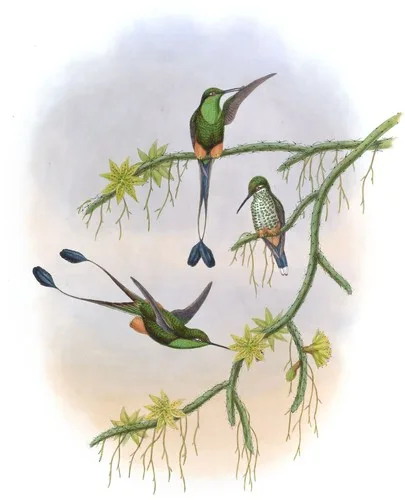
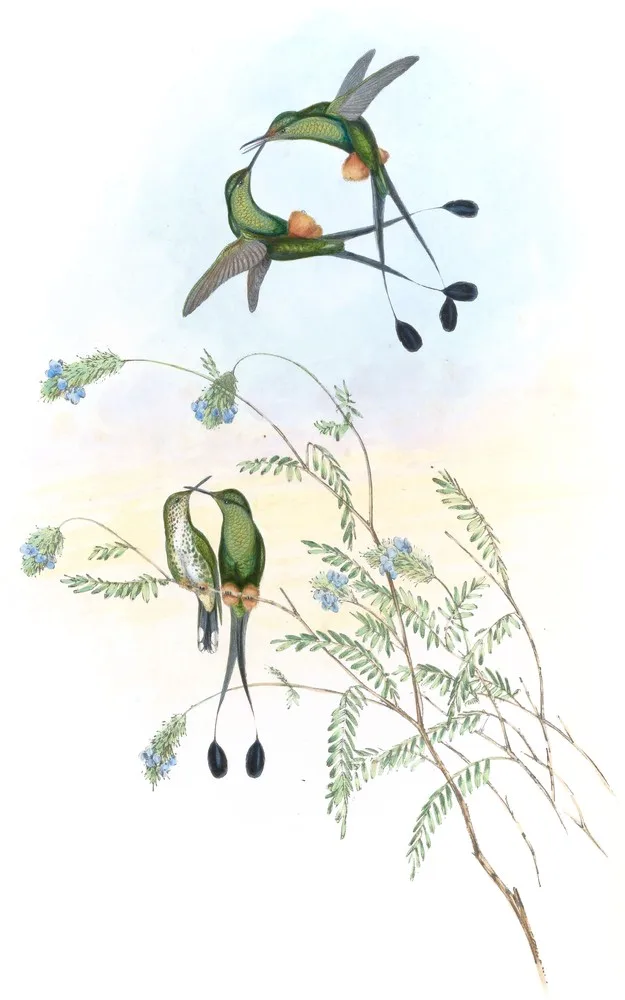
Peruvian Racket-tail
- 学名
- Spathura Peruana
- 合集
- 古尔德蜂鸟图谱
- 绘者
- John Gould(约翰·古尔德)
- 年代
- 1852
- 图版号
- Pl. 164, Vol. III
- 原书页码
- p.164
- 授权
- CC0 1.0 Universal (Public domain)
关于本图版
《古尔德蜂鸟图谱》(Gould's Hummingbirds)由约翰·古尔德绘制,1849—1887 年间印行,本图即其中一幅。画面主体为 Spathura Peruana,在分类体系中列于蜂鸟科(Trochilidae)。
该合集全编共 421 幅图版,此图为其中之一,图版编号 Pl. 164, Vol. III,对应原书第 164 页,版式为纵幅。扫描件取自公有领域原件,经高分辨率修复与色彩校正,可按原大放大查看线条与设色。
原书文字(英文 / 法文)
Moyobamba in Peru
This fine species is at present so rare that few examples have come under my notice; of these, one brought from Peru by Dr. Tschudi is in the Museum at Neufchatel, and another, procured at Moyabamba, in the same country, by the late Mr. Mathews, graces the Loddigesian collection at Hackney.
Dr. Tschudi informs me that he procured three examples of this beautiful species during his travels in Peru: the first between the 11th and 12 degrees of south latitude, on the mountain of Moyabamba, where it was fluttering around the flowers of a new species of Cactus; the second on the road from Santa Maria de Cruces to Andamarca in the province of Tanja, on the banks of the little river Ancasyacu; and the third at Chilpes on the mountain of Veloe, in the province of Parma, at an elevation of more than 3000 feet: he adds that it is a rare species, and was not even known to the Indian hunters of Moyabamba; upon examining their stomachs he found them to contain the remains of small hymenopterous insects.
The S. Peruana differs from the S. rufocaligata in the greater length of the lateral tail-feathers and in their terminal spatules being of a more oval shape; the ruffs of red feathers clothing the tarsi are also of a larger size and of a somewhat deeper tint; it is, in fact, a species intermediate in form between S. rufocaligata and S. Underwoodi.
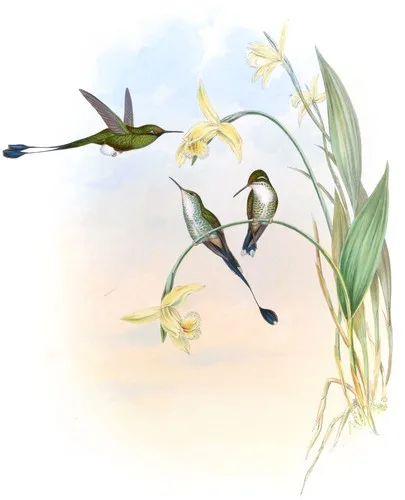
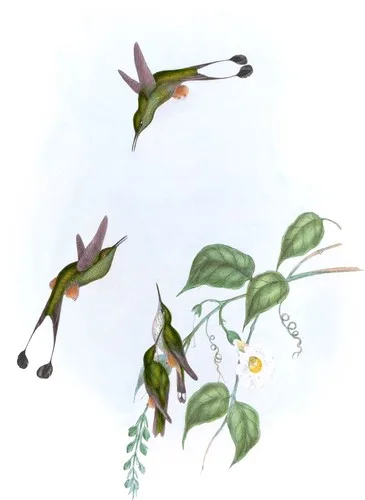
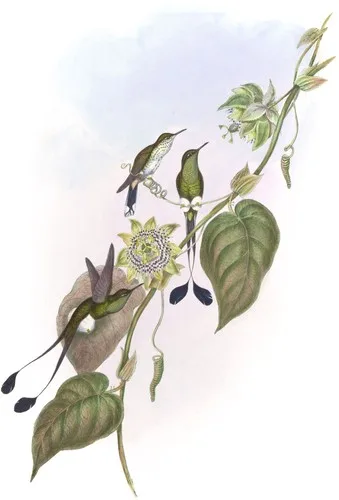
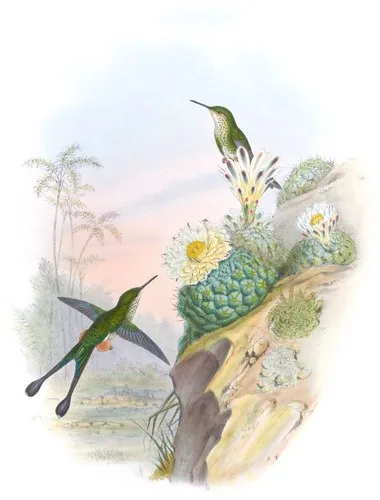
The male has all the upper and under surface bronzy green; throat and chest rich lustrous metallic green; wings and tail brown, the spatules of the lateral feathers black with green reflexions; ruff clothing the tarsi rufous; bill black; feet yellow.
Total length, 5 inches; bill,
The female has the upper surface bronzy green, the green predominating on the two central tail-feathers; lateral tail-feathers brown, the outer one on each side tipped with white, the remainder washed with green at the tip; under surface white, spotted on the throat, sides of the neck and flanks with pale shining green; ruff clothing the tarsi and the under tail-coverts deep buff; bill black; feet yellowish brown.
Total length, 3
The figures represent three males and a female on a species of Dadea from Peru, obligingly lent me by Mr. Cuming.
References
- Spathura Peruana, Gould in Proc. of Zool. Soc. 1849.
十二观
- 纵幅 1.60∶1
- 1852 年刊
- 图版 164, Vol. III
这不是词条,是一条看画的次序:先站定看整体,再看名字与形色、构图与刀工,然后问它几时开、从哪里来、经了谁的手;最后是中国诗文——同一朵花,中国古人是怎么看的。十二观读完,这幅图就打开了。
-
第一眼
搜尽奇峰打草稿。
—— 清·石涛《苦瓜和尚画语录》
走遍山川,才有资格落笔。博物画的画家也一样:先在温室与山野里看够了活的花,纸上那一朵才不虚。这一幅是竖的:眼睛从下往上走,落点在中段那只鸟身上。先别急着看羽毛,让姿态先立起来。第二步凑近一寸:看线与色的交界,色有没有压住线,线有没有断。第三步,把视线放到最深的那一小块:整幅的用色秩序,都是从那里排开的。
-
名与实
学名 Spathura peruana:前一词是属,管它归在哪一类;后一词是种加词,管它在这一类里凭什么与众不同。一百多年前的命名者,把一种植物的来历压进了两个词。此幅尚无通行中文名,姑以学名相称;在没有本地名字的地方,学名就是它唯一的身份证。
-
形与色
翼小而振频极高,能悬停、能倒飞;羽色非颜料所致,是羽枝结构折射的光,随角度而变。此幅未作色相归档,只能就形制论。别只看花:叶脉的走向、萼片的长短、甚至茎上的毛,都是画家用来区分物种的证据。
-
构图与呼吸
画幅高而窄,鸟栖在枝的中段,上下留白多——十九世纪鸟谱的标准版式,留给它飞走的余地。(高宽比约 1.60∶1)全幅只画一只,不作解剖附图——这类图更近于“观赏”,而非“鉴定”。试着用拇指遮住空白处——画面立刻变闷;放开,它才重新“喘上气”。留白,是给主体让出的气口。
-
一刀一色
十九世纪后半叶,石版与彩色石印渐成主流:颜色可以直接印出,不再依赖手工,线条反倒退居其次。图像的“准确”提高了,手性却淡了。先判断它是“印”的还是“画”的,再谈好不好看——这是看老版画最实用的一条规矩。
-
时序
热带美洲几乎全年可见,花期即其季节;温带种类的蜂鸟则随花北迁,一年往返数千公里。图上所记的 1852 年是刊行之年,不是采到那只鸟的年份;真正的观察记录通常比出版早一两年。看这一类图最好的时候,是它的花期:文字说不清的“开得正盛”,在树下站三分钟就懂了。
-
故土
仅产美洲,自阿拉斯加南部至火地岛,以安第斯山最为繁盛。中土无蜂鸟,汉籍不载,晚清海外游记始见其名。《古尔德蜂鸟图谱》成于1849-1887,那一代人对这类鸟的知识,多半来自标本与笼养,而不是野地。
-
书与人
《古尔德蜂鸟图谱》(Gould's Hummingbirds)由约翰·古尔德绘,成于1849-1887。此幅为其中图版 164, Vol. III,见原书第 164 页。图版今属公有领域,可以自由取用;但纸上那层手工上色,仍是两百年前某一个人的手。
-
诗境
夫列子御风而行,泠然善也,旬有五日而后反。
—— 《庄子·逍遥游》
蜂鸟悬停于空,不落不飞,最近于“御风”。庄子说的是一种自由的姿态,蜂鸟把它做成了生理事实。把这一句放回画面:画面就是诗句的落点——诗先写气,画后写形,两者在此处接上了。
-
文心
写气图貌,既随物以宛转;属采附声,亦与心而徘徊。
—— 南朝梁·刘勰《文心雕龙·物色》
摹物要跟着物走,设色又要跟着心走。写景与写心,得同时进行。古尔德《蜂鸟图谱》(1849—1887)以石版手工上色,金箔衬底,使羽色在纸上仍有金属光;这套图册本身就是十九世纪印刷与收藏狂热合流的产物。记住这一句,下次在别处见到同类,它会自己浮上来——鉴赏力就是这样一句一句攒出来的。
-
花语
阿兹特克以蜂鸟为战神与太阳的化身;欧洲维多利亚时代则以蜂鸟为收藏与装饰的极致,百万只羽毛被做成胸饰。中国旧籍无此鸟,故无象征——这空白本身,就是一部博物学交流史。象征多半来自形状与气味:像杯的、像泪的、香的、臭的——先有形状,后有意义。
-
带走一双眼睛
鉴赏力不是知识,是习惯:每次多看一眼,十年之后你看什么都和别人不一样。1852 年的那只鸟早已化作尘土,它留在纸上的样子,却比任何一只活着的同类都长寿。