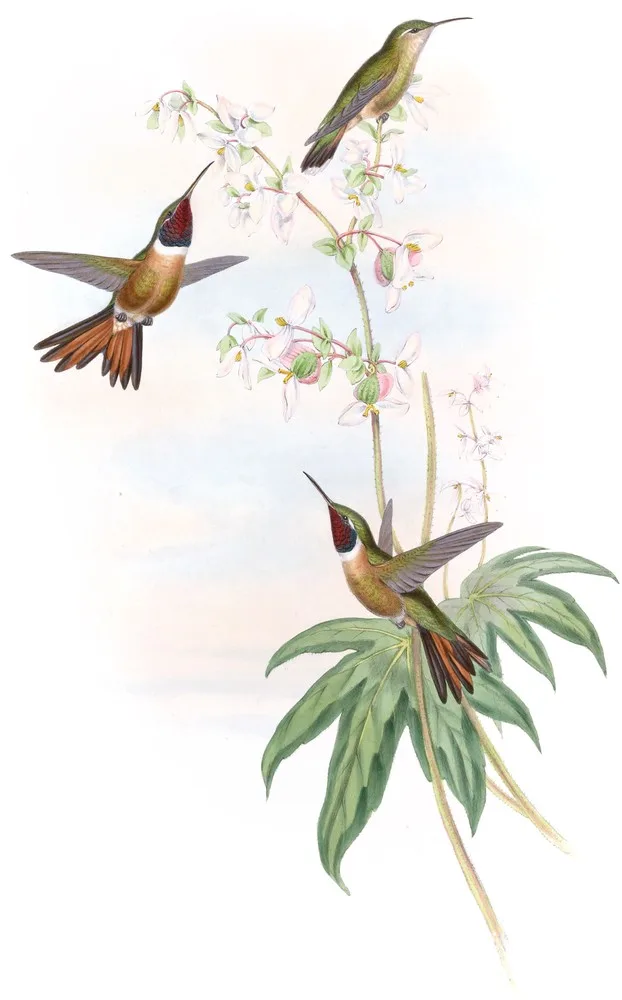
Thaumastura Evelynæ / Calothorax Evelynæ
Thaumastura Evelynæ / Calothorax Evelynæ
Bahama Wood-star
- 合集
- 古尔德蜂鸟图谱
- 绘者
- John Gould(约翰·古尔德)
- 年代
- 1852
- 图版号
- Pl. 156, Vol. III
- 原书页码
- p.156
- 授权
- CC0 1.0 Universal (Public domain)
十观
- 纵幅 1.61∶1
第一眼
凡画山水,意在笔先。
—— 唐·王维《山水论》
下笔之前,心里已经有了整幅画。看画时可以反过来推:画家先定了什么,后添了什么。这一幅是竖的:眼睛从下往上走,落点在中段那只鸟身上。先别急着看羽毛,让姿态先立起来。第二步凑近一寸:看线与色的交界,色有没有压住线,线有没有断。第三步,把视线放到最深的那一小块:整幅的用色秩序,都是从那里排开的。
名与实
图上只标属名 Calothorax,未定种;这一时期的图谱常以一属数种合绘,种名要等后来的专著补齐。此幅尚无通行中文名,姑以学名相称;在没有本地名字的地方,学名就是它唯一的身份证。
形与色
蜂鸟为美洲最小之鸟,喙细长如针,舌分叉成管,可伸入花心吸蜜;翼小而振频极高,能悬停、能倒飞。此幅未作色相归档,只能就形制论。没有解剖图,就靠主株一处一处看过去:叶怎么排,花怎么着生,果在哪里。
构图与呼吸
画幅高而窄,鸟栖在枝的中段,上下留白多——十九世纪鸟谱的标准版式,留给它飞走的余地。全幅只画一只,不作解剖附图——这类图更近于“观赏”,而非“鉴定”。空白不是没画完,是给眼睛留的落脚处:一张图若四边都塞满,花反而会闷。
一刀一色
十九世纪后半叶,石版与彩色石印渐成主流:颜色可以直接印出,不再依赖手工,线条反倒退居其次。图像的“准确”提高了,手性却淡了。还有一种证据在纸背:铜版压进纸里的那道痕、上色处微微凸起的颜料、再版时磨浅的线。扫描件里也能看出七分。想动笔临它的人记住一句:先铺大块的形与色,干后再收细部;石印的柔和层次来自薄涂与网点,水彩分两三遍淡铺即可逼近。
诗境
夫列子御风而行,泠然善也,旬有五日而后反。
—— 《庄子·逍遥游》
蜂鸟悬停于空,不落不飞,最近于“御风”。庄子说的是一种自由的姿态,蜂鸟把它做成了生理事实。古人写到这一层,已不只是赏花,是借花说人;画面则只负责把那朵花留住。
花语
阿兹特克以蜂鸟为战神与太阳的化身;欧洲维多利亚时代则以蜂鸟为收藏与装饰的极致,百万只羽毛被做成胸饰。中国旧籍无此鸟,故无象征——这空白本身,就是一部博物学交流史。花语是给人与人的关系用的;植物自己只关心有没有传粉的虫。这两套语言,可以并行不悖。
时与地
温带种类的蜂鸟则随花北迁,一年往返数千公里。仅产美洲,自阿拉斯加南部至火地岛,以安第斯山最为繁盛。中土无蜂鸟,汉籍不载,晚清海外游记始见其名。图上所记的 1852 年是刊行之年,不是采到那只鸟的年份;真正的观察记录通常比出版早一两年。那一代人对这类鸟的知识,多半来自标本与笼养。看这一类图,不妨把产地和季节都当“据说”来读。
书与人
《古尔德蜂鸟图谱》只署了约翰·古尔德一个人的名字。从画稿到成图要过好几双手:转刻的人求准,上色的人求快——快与准之间,就是各幅之间深浅不一的来历。
带走一双眼睛
鉴赏力不是知识,是习惯:每次多看一眼,十年之后你看什么都和别人不一样。图谱的用意是“以备查考”,看久了却会忘记查考:1852 年的一个人,为一只鸟花了整整一天。
关于本图版
此图原刊于《古尔德蜂鸟图谱》(Gould's Hummingbirds),绘者为约翰·古尔德,成书于 1849—1887 年间。原书题作“Thaumastura Evelynæ / Calothorax Evelynæ”,归入蜂鸟科(Trochilidae)。
全编共收录 421 幅图版,本图是其中一幅,原书将其列为 Pl. 156, Vol. III,见第 156 页,版式为纵幅。扫描件取自公有领域原件,经高分辨率修复与色彩校正,可按原大放大查看线条与设色。
原书文字(英文 / 法文)
Bahama Islands
To be aware of the existence of a Humming-Bird on the principal of the Bahama Islands, and to fail in every attempt to procure a specimen of it during a period of thirty long years, seems scarcely possible, nevertheless such has been the case.
Through the instrumentality of a friend at Liverpool, the late Mr. Swainson procured a male from New Providence about thirty years ago, and presented it to the late Mr. George Loddiges; from that date the bird appears not to have been noticed by any traveller or naturalist until 1859, when it was observed by Dr. Bryant during his four months’ sojourn in the neighbourhood of Nassau in New Providence. It will be seen from the following note that it is by no means rare on at least the principal island of the Bahama group; indeed it would seem to be even more numerous than is usual with the other members of the group. I am very much indebted to my friend George N. Lawrence, Esq., of New York, for the loan of the two specimens of each sex for the purpose of the accompanying illustration, both of which were collected by Dr. Bryant, to whom much credit is due for the masterly manner in which he has described the birds of that little-known group of islands, the Bahamas. I regret exceedingly to be obliged to reduce the specific name of Bahamensis assigned to the bird by this gentleman to the rank of a synonym; but I have no alternative, that of Evelynæ having been given to it some years before by M. Bourcier, when describing some of the rarities contained in the Loddigesian collection.
The Bahama Wood-star may be ranked among the most beautiful members of its genus; but few of them possessing greater elegance of form, and certainly none a more lovely-coloured throat.
I append Dr. Bryant’s observations on the bird, together with his description:—
This species of Humming-Bird is the only one found at Nassau and neighbouring islands. It is quite abundant there, and a constant resident. All the specimens I procured, seven in number, were killed in February and the early part of March; at that time its food consisted almost entirely of a small green aphis, found abundantly on the West Indian vervain (V. Stachytarpheta), a small blue flower that grows in all the dry pastures. Gosse calls the least Humming-Bird of Jamaica the Vervain Humming-Bird, from its hovering round this plant; but the name would apply equally as well to the present species. I saw nothing in its habits differing from those of the common ruby-throated species, with the exception that it was more quarrelsome in its disposition, chasing the ‘fighter,’ as the Tyrannus caudifasciatus is called, whenever it came near him, and that its note is louder and shriller, and much more frequently uttered. Incubation commences by the 1st of March. I saw three nests of this bird: one, found on the 3rd of March, contained two egos partly hatched; a second, April 10th, one egg; and another in May, two eggs. The nests are all composed of the same materials, principally the cotton from the silk cotton-tree, with a few downy masses that looked as if derived from some species of Asclepias; this was felted and matted together, and the outside stuck over with bits of lichen and little dry stalks or fibres of vegetable matter: one now before me measures ·030 in diameter and ·033 in height externally, and the inside ·018 in depth and ·025 in diameter. The eggs, like those of all the other members of the family, are two in number, snow-white when blown, and slightly rosy before, and measure ·012 in length by ·008 in breadth.
Description.—Adult male:—Above, green with metallic reflexions, slightly golden on the back, and with the tips of some of the feathers in some specimens bluish; the head darker and more sombre; wings brownish purple, with dull greenish reflexions in some lights; tail dark purple, almost black, also with greenish reflexions; the outer feather on each side with an almost obsolete terminal spot of rufous, the next with the whole of the inner web bright cinnamon, the next again with the whole of the inner and the basal half of the outer web of the same colour, this colour then running nearly to the tip in a diagonal manner, leaving the part next the shaft purple; the basal half of all the shafts, except the two outer, cinnamon; throat magnificent purple-violet; immediately below this a broad gorget of white; abdomen green mixed with rufous; thighs white; crissum pale rufous white; bill and tarsi black.
Adult female:—Upper parts less lustrous than in the male, the feathers margined more or less with rufous grey; wings as in the male; tail with the middle feathers brilliant green, the rest cinnamon, with a purplish-black band running from the outer feather obliquely downward and inward to the tips of the fourth on each side, forming a broadly-shaped mark; between the black band and the cinnamon there is a spot of bright green, most conspicuous in the feather next the central ones, and growing gradually indistinct towards the outer ones; throat pale rufous white, the centre of the feathers darkest, and on the sides and posteriorly a little green; abdomen entirely rufous; legs and crissum pale rufous. The dimensions do not differ from those of the male.
Young male in winter:—Upper parts intermediate in brightness between the male and female; throat white, with a few feathers beginning to show the violet; tail as in the male.
All the males procured by me, four in number, had but eight tail-feathers; while all the females, three in number, had ten. It can hardly be supposed that in four specimens, the same two feathers, and but two, should have been lost from every specimen. In form the tail-feathers are rather narrow, and the inner webs of the two outer slightly falciform or emarginated. The two outer feathers are slightly shorter than the next, which are the longest; the next two again are rather shorter, and the central ones considerably shorter. The feathers composing the tail of the female are broader than those of the male; the third from the outside is the longest; the first, second, and central one as in the male; and the fourth slightly shorter than the third.
Dr. Bryant has deceived himself as to the number of the tail-feathers in the male: all Humming-Birds have ten; but in some instances the middle feathers are so short as to be entirely hidden by the coverts, and this is precisely the case in the male of Calothorax Evelynæ.
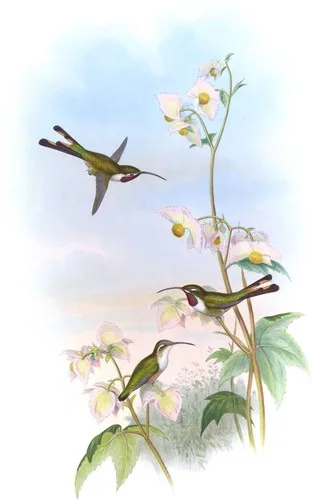
The Plate represents both sexes of the natural size. The plant is the Begonia heracleifolia, var, nigricans.
References
- Trochilus Evelynæ, Boure. Proc. Zool. Soc., part xv. p. 44.—Ib. Rev. Zool. 1847, p. 256.
- Calothorax Evelynæ, Gray and Mitch. Gen. of Birds, vol. i. p. 110, Calothorax, sp. 9.
- Calothorax Eveline, Reich. Auf. der Col., p. 18.—Ib. Troch. Enum., p. 10.
- Callothorax evillina, Bonap. Rey. et Mag. de Zool. 1854, p. 257.
- Trochilus Bahamensis, Bryant, List of Birds seen at the Bahamas, &c., p. 5.