中美剪尾蜂鸟属
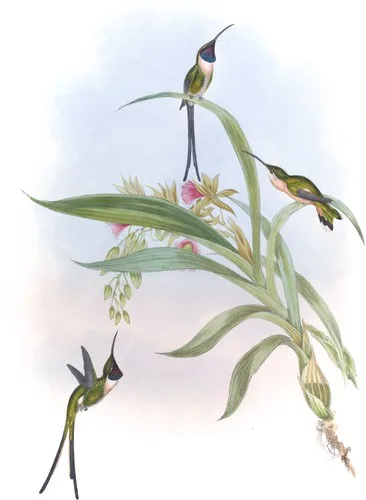
Doricha lyrura
Doricha lyrura
Lyre-shaped Wood-Star
- 中文名
- 中美剪尾蜂鸟属
- 学名
- Doricha lyrura
- 合集
- 古尔德蜂鸟图谱
- 绘者
- John Gould(约翰·古尔德)
- 年代
- 1887
- 图版号
- Pl. 394, Suppl. Vol.
- 原书页码
- p.394
- 授权
- CC0 1.0 Universal (Public domain)
十观
- 纵幅 1.53∶1
第一眼
凡画山水,意在笔先。
—— 唐·王维《山水论》
下笔之前,心里已经有了整幅画。看画时可以反过来推:画家先定了什么,后添了什么。这一幅是竖的:眼睛从下往上走,落点在中段那只鸟身上。先别急着看羽毛,让姿态先立起来。第二步凑近一寸:看线与色的交界,色有没有压住线,线有没有断。第三步,把视线放到最深的那一小块:整幅的用色秩序,都是从那里排开的。
名与实
学名 Doricha lyrura:前一词是属,管它归在哪一类;后一词是种加词,管它在这一类里凭什么与众不同。双名制的好处是唯一:全世界叫这个名字的,只能是这一种。中文名“中美剪尾蜂鸟属”是后人据学名回译的通行叫法,与古书里的旧名未必对得上——名与物之间,总隔着一层翻译。
形与色
翼小而振频极高,能悬停、能倒飞;羽色非颜料所致,是羽枝结构折射的光,随角度而变。此幅未作色相归档,只能就形制论。此幅只画一个种,形制的每一处都摊在纸面上,没有遮掩。
构图与呼吸
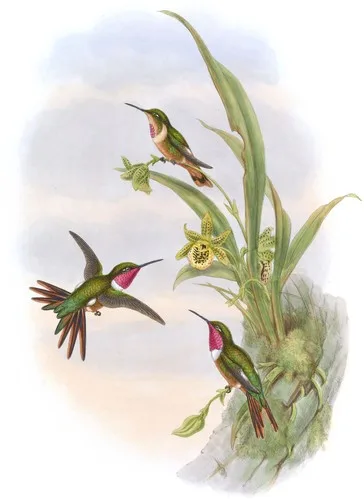
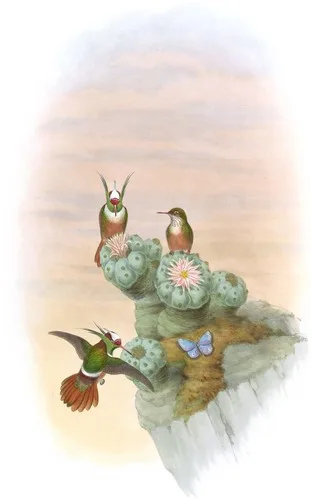
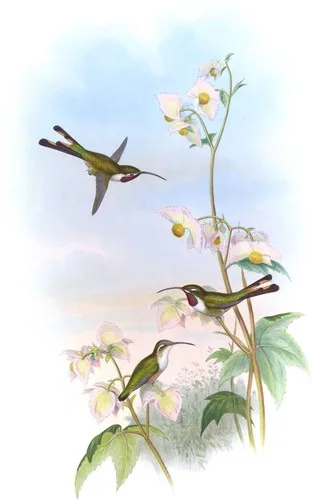
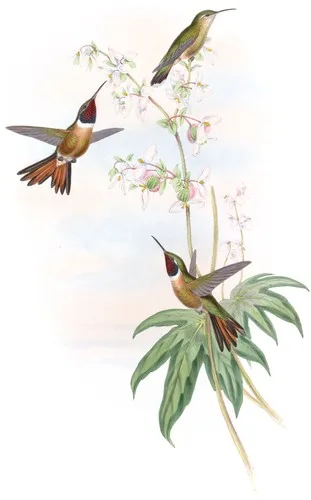
画幅高而窄,鸟栖在枝的中段,上下留白多——十九世纪鸟谱的标准版式,留给它飞走的余地。全幅只画一只,不作解剖附图——这类图更近于“观赏”,而非“鉴定”。试着用拇指遮住空白处——画面立刻变闷;放开,它才重新“喘上气”。留白,是给主体让出的气口。
一刀一色
十九世纪后半叶,石版与彩色石印渐成主流:颜色可以直接印出,不再依赖手工,线条反倒退居其次。图像的“准确”提高了,手性却淡了。还有一种证据在纸背:铜版压进纸里的那道痕、上色处微微凸起的颜料、再版时磨浅的线。扫描件里也能看出七分。想动笔临它的人记住一句:先铺大块的形与色,干后再收细部;石印的柔和层次来自薄涂与网点,水彩分两三遍淡铺即可逼近。
诗境
穿花蛱蝶深深见,点水蜻蜓款款飞。
—— 唐·杜甫《曲江二首》
中土无蜂鸟,然“穿花”之态,杜甫早已写过:贴着花心走,是采蜜者的共同姿态。诗以气行,画以形立;两种“看”叠在一起,才是看画的意思。
花语
阿兹特克以蜂鸟为战神与太阳的化身;欧洲维多利亚时代则以蜂鸟为收藏与装饰的极致,百万只羽毛被做成胸饰。中国旧籍无此鸟,故无象征——这空白本身,就是一部博物学交流史。花语是后人添上去的,花本身并不知道;但这层“不知道”,正是它最动人的地方。
时与地
温带种类的蜂鸟则随花北迁,一年往返数千公里。仅产美洲,自阿拉斯加南部至火地岛,以安第斯山最为繁盛。中土无蜂鸟,汉籍不载,晚清海外游记始见其名。图上所记的 1887 年是刊行之年,不是采到那只鸟的年份;真正的观察记录通常比出版早一两年。同一株植物,春秋两季像两种东西;同一座山,一百年前与今天叫两个名字。图把这两样都冻结在了纸上。
书与人
《古尔德蜂鸟图谱》只署了约翰·古尔德一个人的名字。图版今属公有领域,可以自由取用;但纸上那层手工上色,仍是两百年前某一个人的手。
带走一双眼睛
如果只能记一句,就记郭熙那八个字:远望取其势,近看取其质。看图、看花、看人,都一样。图谱的用意是“以备查考”,看久了却会忘记查考:1887 年的一个人,为一只鸟花了整整一天。
关于本图版
《古尔德蜂鸟图谱》(Gould's Hummingbirds)由约翰·古尔德绘制,1849—1887 年间印行,本图即其中一幅。画面主体是中美剪尾蜂鸟属(Doricha lyrura),在分类体系中列于蜂鸟科(Trochilidae)。
该合集全编共 421 幅图版,此图为其中之一,图版编号 Pl. 394, Suppl. Vol.,对应原书第 394 页,版式为纵幅。图为公有领域原件的修复扫描,构图与设色未经改动。
原书文字(英文 / 法文)
This is one of the most beautiful little gems that inhabit the Bahamas.
The whole form and the very graceful lyre-shaped tail, I believe, are not seen in any other Humming-bird; hence its specific name is very appropriate.
I make the following quotation from my paper in the ‘Annals of Natural History’ (vol. iv., fourth series, 1869).
Having lately received, through the kindness of his Excellency Sir James Walker, Governor of the Bahama Islands, four specimens of a Humming-bird, of which for the last twenty years I have been anxious to procure examples, I feel convinced that, as I had for some time supposed from a conversation I bad with the late Dr. Bryant, two species of this lovely family of birds inhabit those islands; and this conviction is strengthened by the circumstance that when in England, just prior to his lamented death, he informed me that the Humming-bird of the southern islands was supposed to be distinct from that killed in the neighbourhood of Nassau. He at the same time promised that I should have any examples that he could spare from his collection—a promise which has been partly performed by either Mrs. Bryant or her late husband’s executors sending me, through Mr. G. N. Lawrence of New York, a male, which I find is different from those sent me by Sir James Walker. As the birds killed round Nassau are identical with the type of the genus Doricha (D. evelynæ), which is still in the Loddigesian collection, the southern bird requires a specific appellation; and it would have given me great pleasure to name it after its discoverer, had not another species of the same section of the Trochilida been named bryantæ by Mr. Lawrence.
In size the new species, which I propose to call Doricha lyrura, is about the same as D. evelynæ; but the tail is distinctly forked, and its outer feathers are much longer, narrower, and outcurved at the apex, while the remainder regularly graduate towards the two central ones, which are very short. When the tail is raised and the feathers partially spread, they assume a lyre-like appearance; hence the specific appellation. Not wishing to depend upon my own judgment alone, I submitted this bird to the inspection of Mr. Salvin, who, after a careful examination, came to the same conclusion as myself, that the bird is distinct, and that the form of the feathers just described is the natural one. All my Nassau specimens, as well as others I have seen from that district, have the beautiful luminous lilaceous feathers confined to the throat, while in the specimen sent to me through Mr. Lawrence the whole face is luminous, the metallic lilaceous colour extending across the forehead.
Mr. Charles B. Cory, an American gentleman, has recently explored the Bahama Islands, and writes concerning the present species:—
Like many others of its family, the Lyre-tailed Humming-bird is restricted to a single island. It inhabits Inagua, and, although not rare, cannot be considered an abundant species. All the specimens which I procured were killed near Matherstome; and none were taken on any other part of the island. Its habits, as far as I was able to observe, were the same as those of Doricha evelynæ, from which it is impossible to distinguish it while darting from one flower to another. A negro brought me a fine male alive, which he had caught ina small net as it hovered over a flower. When living, the plumage shows somewhat brighter than in a dead specimen.
I find I have drawn three birds of this species, viz. two males and one female. Consequently a long description of the species is not required. I append, however, a brief diagnosis:—
The male has the forehead, throat, and breast beautiful shining lilac bordered with blue, the two colours blending at their juncture; immediately below the gorget is a band of greyish white, remainder of the abdomen bronzy brown; axillz rusty red; wings purplish brown; upper surface golden green; the narrow outer tail-feather on each side black; the next two black on the outer web, chestnut-red on the inner one, the next blackish brown with green reflections; the two middle ones green. Total length 3
Female. Bill black, a little curved; crown, back of the neck, and all the upper part green; ear, outer part of the throat, sides of the neck, centre of the belly, all white tinged with buffy white; under tail-coverts buff; four central tail-feathers, three outer on each side with a square band of black; a patch of buffy white on lower part of the back. Total length 3
References
- Doricha lyrura, Ann. & Mag. Nat. Hist. 1869, 4th series, vol. iv. pp. 111, 112.—Elliot, Ibis, 1872, p. 354.—Muls, Hist. Nat. Ois.-Mouches, 1877, vol. iv. p. 41.—Elliot, Synopsis, 1879, p. 126.—Cory, Birds of the Bahama Islands, p. 110.