Aceraceæ
Aceraceæ
The Maple Tribe
- 合集
- 植物自然目
- 绘者
- Elizabeth Twining(伊丽莎白·特温宁)
- 年代
- 1868
- 图版号
- Order 30
- 原书页码
- p.30
- 主色
- 绿
- 授权
- CC BY-SA 4.0
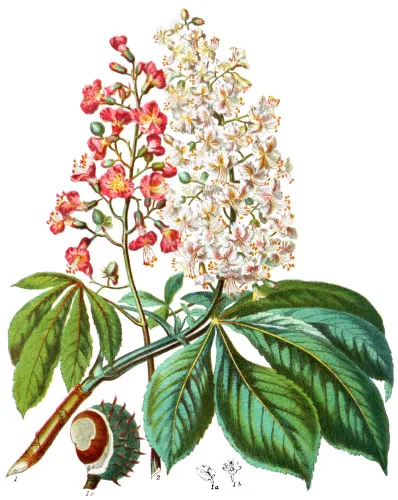
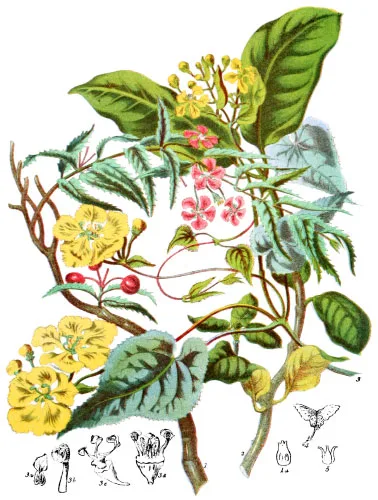
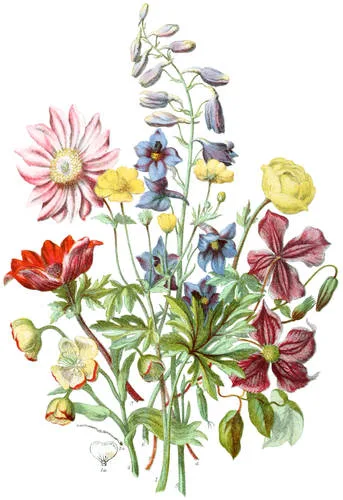
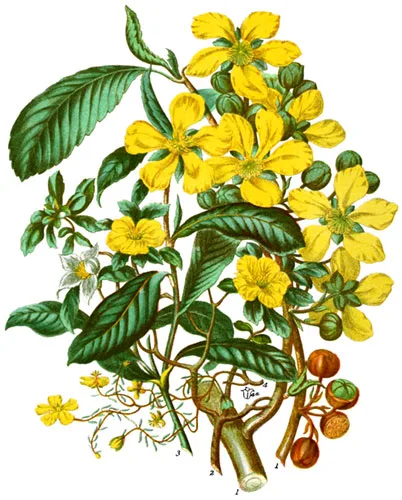
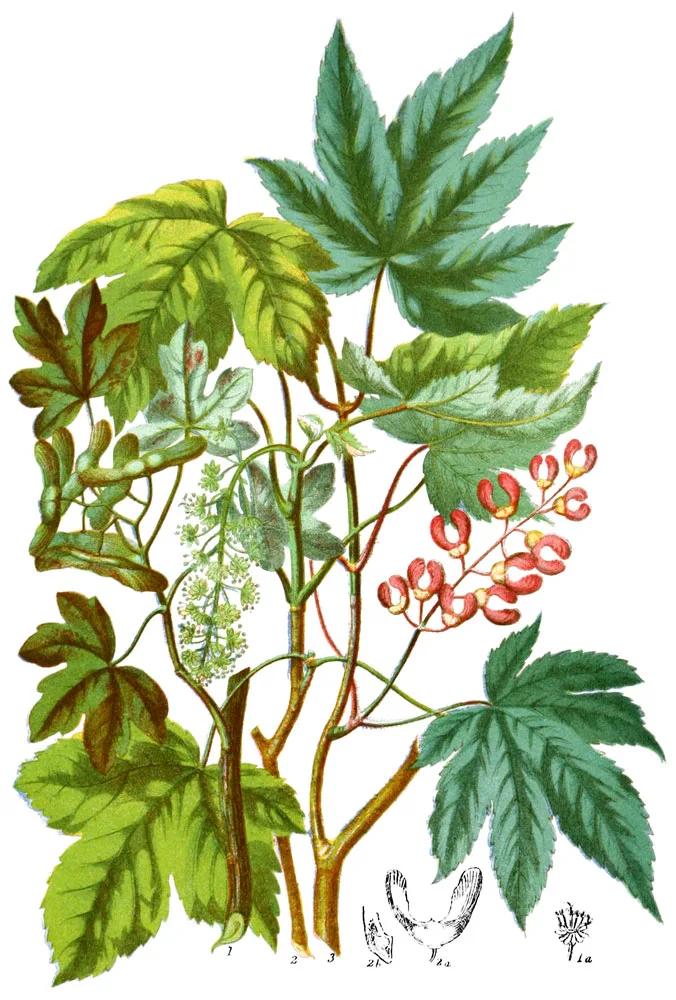
图中植物与部位
-
1.
Acer campestre
, Common Maple England
- 1a. Flower
-
2.
Acer Pseudo-platanus
, Sycamore Europe
- 2a. Winged Seed-vessel
- 2b. Seed within
- 3. Acer caudatum Nepal
关于本图版
此图原刊于《植物自然目》(Natural Orders of plants),绘者为伊丽莎白·特温宁,成书于 1849 年。原书题作“Aceraceæ”。这是该物种在早期博物学出版物中的图像记录之一。
全编共收录 160 幅图版,本图是其中一幅,原书将其列为 Order 30,见第 30 页,版式为纵幅,画面以黄绿为主色。此图由原件扫描修复而成,使用时请遵循页面标注的授权条款。
原书文字(英文 / 法文)
Key characteristics
Trees, with nodose branches, the leaves of which are opposite, simple, stalked, usually with palmate veins, rarely pinnate, without stipules. The flowers grow on branching stalks from the base of the leaf-stalk, either in upright or drooping clusters: sometimes the pistil and stamens are in different flowers, sometimes united. The calyx is divided into five lobes, rarely from six to nine, often coloured; the petals are equal to them in number, and agree with them in colour, they are inserted round a fleshy disk, in some instances they are wanting. The stamens are placed on the disk, are usually eight, rarely five or twelve; the filaments are free, anthers oblong, two-celled. The ovary is free, with two lobes, the styles single, bearing two stigmas. The fruit is a samara, or winged closed capsule, consisting of two connected carpels, each being one-celled, containing one or two erect seeds without albumen.
This Order has an affinity with Sapindaceæ and Malpighiaceæ, although the opposite leaves, and fruit with only two carpels distinguish it from the former, and the palmate-veined leaves and glandless calyx separate it from the latter.
A saccharine juice is the chief property of these trees; the astringent bark yields a brown and yellow dye.
Select plants in this order
Not all plants listed are illustrated and not all plants illustrated are listed.
- Acer campestre, the Maple (1) is a small tree very abundant in woods and hedges in most European countries, but becoming rare northwards; seldom seen in the northern part of England, or in Scotland; unknown in Iceland. It has been in all times esteemed for the fine grain and durability of the wood; Virgil describes the throne of Evander as made of maple, and the Romans made their tables of it, mahogany not being then introduced into Europe: it was formerly employed for pikes and lances, now for gunstocks and various musical and mathematical instruments; the old knotted parts, being much variegated, are also very useful in ornamental inlaid cabinet work; the bark is often of a thick corky nature, full of fissures.
- Acer Pseudo-platanus, the Sycamore (2), resembles the Plane in general aspect, and rivals it in beauty; it is a native of the principal Continental countries of Europe, but it is supposed to have been transplanted to England, where it flourishes vigorously, and can endure without injury the breezes from the sea. The wood is soft and used only for some agricultural implements. Its sap abounds in saccharine juice, which may be obtained in spring, and converted into wine or sugar.
- Acer caudatum (3) was discovered by Dr. Wallich, in the highest region of Nepal, where it is a noble tree, distinguished by the delicate colour of the winged seed-vessels.
- A. lævigatum belongs to the same country, grows to the height of forty feet, is remarkable for the oblong serrated leaves, the white flowers, and red-brown fruit; the timber is employed by the natives.
- A. cultratum is found at about 6500 feet on the mountain-ranges, its wood is white and fine-grained.
- A. oblongum grows at the lowest elevation between 2000 and 3000 feet.
- On the mountains of Bootan, north latitude, 27, east longitude, 91, A. sterculiaceum ascends to the height of 12,000 feet, nearly to the limit of woody vegetation.
- The most valuable tree of this tribe, Acer saccharinum, the Sugar Maple, belongs to the New World, but might in all probability be successfully cultivated in the valleys and slopes of the Himalaya, where it would be of great value to the poor natives who have not means of obtaining sugar. It attains sixty feet in height in North America, and a single tree is said to yield in the spring sufficient juice to produce five or six pounds of sugar by evaporation, it affords also a pleasant wine and an excellent vinegar.
- A. rubrum, the Swamp Maple of Pennsylvania, has a scarlet calyx, without petals, the stem furnishes useful timber, sugar, and treacle to the Canadians, the bark dyes a dark blue colour.
- The Italian Maple, A. Opalus, is much planted in avenues in public gardens in Italy for the sake of its spreading shade.
- The principal species found in the mountain districts of the more northern countries of Europe is A. platonoides, a quick-growing handsome tree, bearing yellow flowers in spring, and the foliage acquiring a fine golden tint in autumn; although usually growing on mountains, it descends to the sea-shore in some parts of Norway.
- Negundo fraxinifolium of North America has compound leaves like the ash.
- Dobinea, discovered in Nepal by Dr. Hamilton, differs from the rest of the tribe in having a campanulate four-toothed calyx, and eight stamens united into a column, it is besides of a shrubby character, about six feet high.
Locations
This small Tribe is dispersed over Europe, the Temperate parts of Asia, the mountain-ranges of northern India, and North America: it is unknown in Africa and the Southern Hemisphere.
Legend
- Acer campestre, Common Maple. England.
- Flower.
- Acer Pseudo-platanus, Sycamore. Europe.
- Winged Seed-vessel.
- Seed within.
- Acer caudatum. Nepal.
本图涉及的植物
- Acer campestre
- Acer Pseudo-platanus
- Acer caudatum
属索引
- Acer
- Dobinea
- Negundo