Hippocastanaceæ
Hippocastanaceæ
The Horse-Chesnut Tribe
- 合集
- 植物自然目
- 绘者
- Elizabeth Twining(伊丽莎白·特温宁)
- 年代
- 1868
- 图版号
- Order 29
- 原书页码
- p.29
- 主色
- 绿
- 授权
- CC BY-SA 4.0
图中植物与部位
-
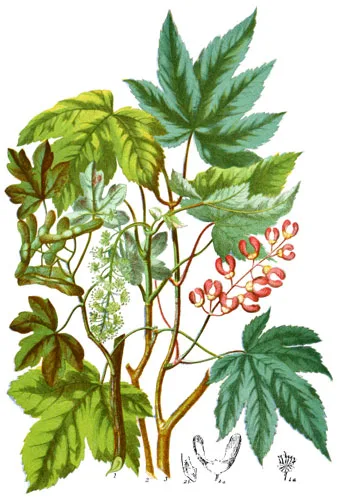
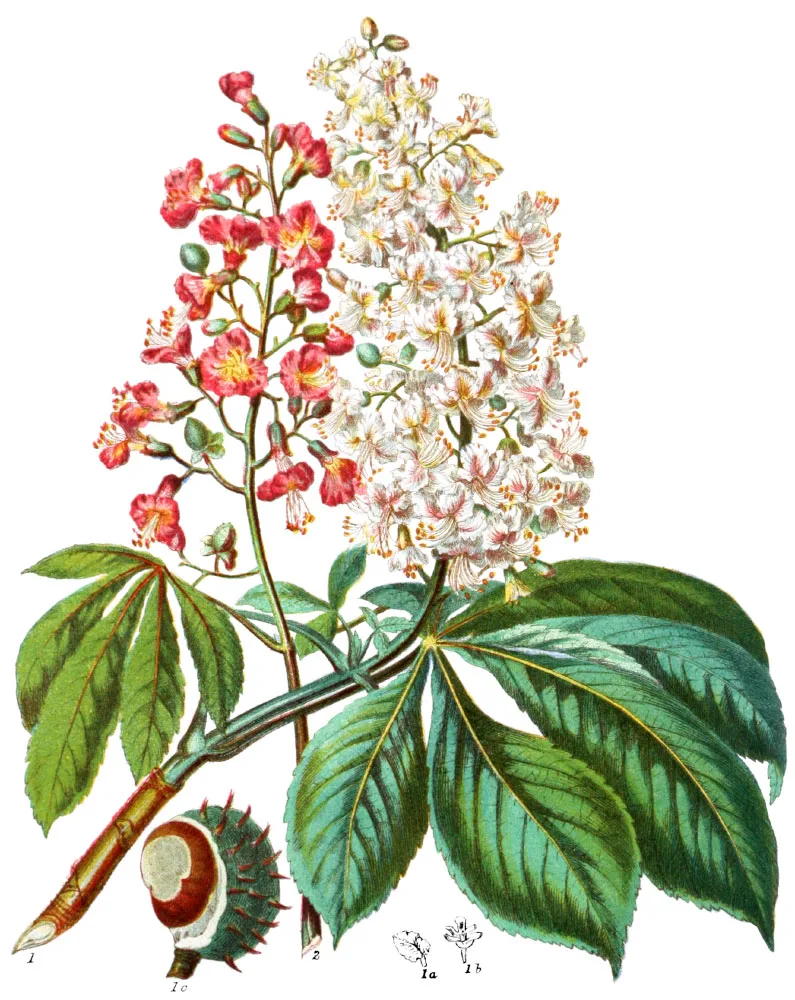
1.
Æsculus Hippocastanum
, Common Horse-Chesnut Asia
- 1a. Petal
- 1b. Calyx and Pistil
- 1c. Fruit
- 2. Pavia rubra , Red-flowered Pavia North America
关于本图版
本图选自伊丽莎白·特温宁的《植物自然目》(Natural Orders of plants),原书 1849 年出版。原书题作“Hippocastanaceæ”。原书为这一物种留下了成幅的彩色图像记录。
该合集全编共 160 幅图版,此图为其中之一,图版编号 Order 29,对应原书第 29 页,版式为纵幅,画面以绿为主色。图像自原件扫描修复,构图与设色未经改动,授权方式见页面下方。
原书文字(英文 / 法文)
Key characteristics
Trees and shrubs; the leaves of which are opposite, compound, with five or seven leaflets, without stipules; the racemes of flowers are terminal, somewhat panicled, the flower-stalks joined to the main-stalk. The calyx is campanulate, with five lobes. The petals are five, occasionally only four, unequal in size; the stamens are seven or eight, distinct, unequal, inserted on a disk. The anthers are turned inwards, and open longitudinally. The ovary is rounded, three-cornered, and three-celled; the style single, slender, conical, and acute; the fruit is coriaceous, one, two, or three valved, spiny or smooth, usually only ripening one seed. The seeds are large, smooth, and shining, with a broad pale hilum or scar; they contain no albumen.
This Order is very closely allied to Sapindaceæ, the Soap-tree tribe, in structure and properties; saponaceous principles existing in the seeds of both.
Select plants in this order
Not all plants listed are illustrated and not all plants illustrated are listed.
- Æsculus Hippocastanum, the Horse-Chesnut (1) was brought about 300 years ago from the mountains of Northern Asia to Constantinople, thence to Vienna, Italy, France, and England; in the two latter countries the regular and noble character of its form soon caused it to be adopted for avenues, one of the finest specimens of which in this country is that of Bushy Park, Middlesex. The flower-buds come forth at the ends of the branches, in winter, protected by several glutinous scales, which remain and grow for some weeks, until the warmth of the sun in spring dissolves the gummy substance, and the expansion of the flowers within causes them to fall off, when the cluster of upwards of sixty flowers which appear abundantly in May, and the massy foliage, place the Horse-Chesnut in the highest rank of our ornamental trees; it is besides extremely rapid in its growth, and well-suited to the English climate, even in the vicinity of towns. The wood is white and soft, and available for a few purposes; the bark is bitter and astringent, useful for tanning, and is supposed to possess febrifugal properties. The large seeds contain a considerable portion of starch and potash, and are capable of affording nutrition to animals; deer eat them readily when fallen out of the prickly covering; in Switzerland, they are given to sheep with good success, and it is said that horses are fed on them in Turkey. If the bitter acridity could be entirely extracted, they might probably be made into a kind of bread. In some parts of France and Switzerland, they are used in cleansing wool and bleaching linen, for which soapy properties are well fitted.
- It is asserted that the leaves and fruit of Æsculus ohiotensis, the Buck-eye or American Horse-Chesnut, are poisonous to man and animals.
- Pavia was named after Peter Paw, a Dutch botanist of Leyden in 1600.
- Pavia rubra (2) was introduced to this country from North America in the beginning of the last century; it is a tree of less magnitude than the Horse-Chesnut, but the spies of crimson flowers nearly rival in size those of the Horse-Chesnut. The fruit of this genus is smooth.
- P. indica is found on the mountains of Kemaon and Gurhwal in India, also near the sources of the Ganges; in growth and aspect it equals the common Æsculus; the large seed contains much starch, and although bitter to the taste, is occasionally eaten by the natives of the Himalayas in times of famine.
- P. flava and P. discolor are now both added to English shrubberies.
Locations
The few plants belonging to this Tribe are natives of India, Persia, and North America.
Legend
- Æsculus Hippocastanum, Common Horse-Chesnut. Asia.
- Petal.
- Calyx and Pistil.
- Fruit.
- Pavia rubra, Red-flowered Pavia. North America.
本图涉及的植物
- Æsculus Hippocastanum
- Pavia rubra
属索引
- Æsculus
- Ellisia
- Pavia