Apocynaceæ
Apocynaceæ
The Dog’s-Bane Tribe
- 合集
- 植物自然目
- 绘者
- Elizabeth Twining(伊丽莎白·特温宁)
- 年代
- 1868
- 图版号
- Order 92
- 原书页码
- p.92
- 主色
- 黄
- 授权
- CC BY-SA 4.0
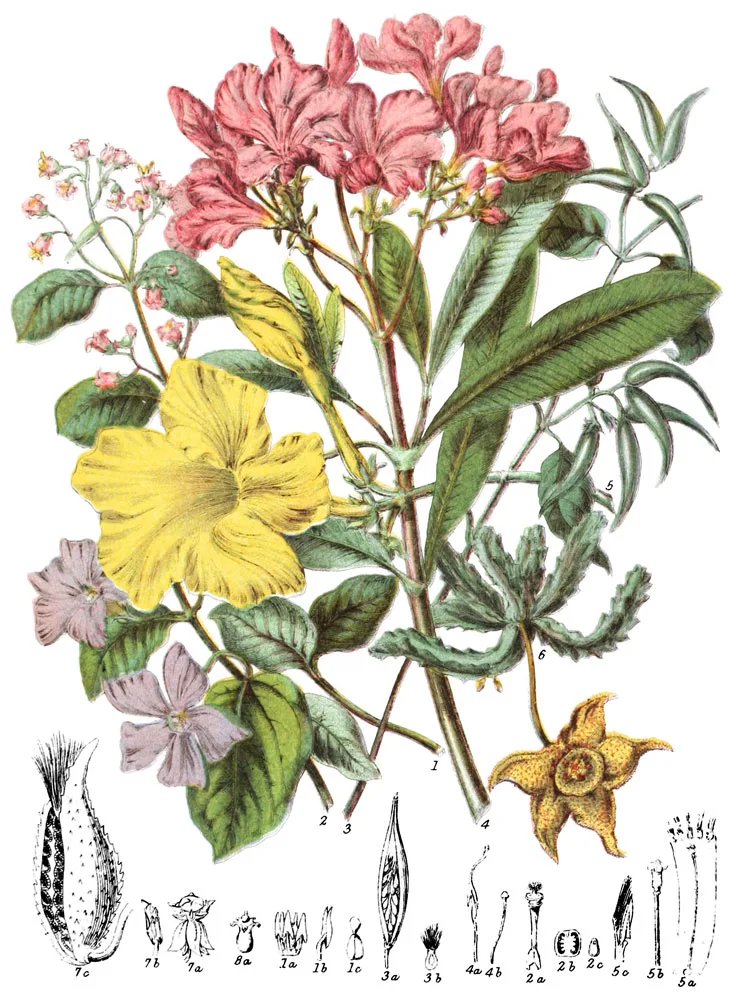
图中植物与部位
-
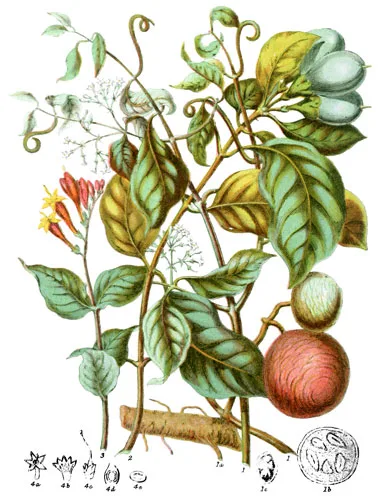
1.
Apocynum hypericifolium
, Hypericum-leaved Dog’s-bane North America
- 1a. Stamens, Pistil, and Glands
- 1b. Stamen
- 1c. Pistil
-
2.
Vinca major
, Greater Periwinkle England
- 2a. Pistil
- 2b. Section of Ovary
- 2c. Section of Seed
-
3.
Cynanchum nigrum
, Black Cynanchum South Europe
- 3a. Seed-vessel
- 3b. Seed
-
4.
Nerium Oleander
, Common Oleander South Europe and India
- 4a. Stamen
- 4b. Pistil
-
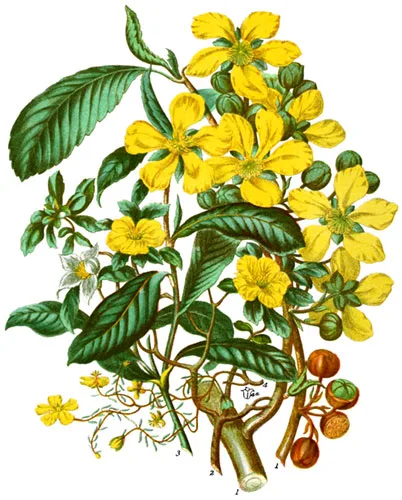
5.
Allamanda cathartica
Guiana
- 5a. Tube of Corolla, opened
- 5b. Pistil
- 5c. Stamen
- 6. Stapelia marginata Cape of Good Hope
-
- 7a. Asclepias Syriaca , Flower
- 7b. Stamen
- 7c. Seed-vessel
-
- 8a. Glossonema Boryanum , Stamens and Pistil
关于本图版
这幅图版出自《植物自然目》(Natural Orders of plants),由伊丽莎白·特温宁绘制,1849 年出版。原书题作“Apocynaceæ”。原书为这一物种留下了成幅的彩色图像记录。
全编共收录 160 幅图版,本图是其中一幅,原书将其列为 Order 92,见第 92 页,版式为纵幅,整幅以橙黄为主调。此图由原件扫描修复而成,使用时请遵循页面标注的授权条款。
原书文字(英文 / 法文)
Key characteristics
Trees, shrubs, and a few herbaceious plants, usually with milky juice, often of a climbing habit. The leaves are opposite, sometimes alternate, or in circles on the stem, entire at the edges, without stipules, but having hairs or glands upon or between the leaf-stalks. The flowers generally grow from between the leaf-stalks. The calyx is five-parted; the corolla of one petal is attached to the base of the ovary, often having scales at the throat, five-lobed, twisted or folded over in the bud. The stamens are five, placed on the corolla, alternate with its segments; the filaments of Apocynum are distinct; of Asclepias and others, combined; the grains of pollen are distinct in general, but double in masses in Asclepias; the ovaries are two, with two styles, and one stigma, contracted in the middle in Apocynum, five-cornered with glands at the angles in Asclepias. The fruit is a follicle, capsule, drupe, or berry, double or single; the seeds are numerous, usually hairy at the scar, with thin, fleshy, or cartilaginous albumen.
This Tribe has affinity with the Gentianaceæ, but the form of the stigma is an obvious distinction, as well as the milky juice.
An acrid juice, sometimes containing caoutchouc, often poisonous, exists in these plants.
A great variety is found in this tribe; some species are remarkable for brilliant flowers; others, for the succulent leafless stalks; some are slender herbs, others have a large twisted stem coiled on the ground before rising upwards.
Select plants in this order
Not all plants listed are illustrated and not all plants illustrated are listed.
- In the time of Pliny, Apocynum was supposed to be poisonous to dogs, whence its name.
- A. hypericifolium (1) contains, like other species, an acrid juice; the glutinous stigma attracts flies, and the irritable stamens close on them.
- The stalks of A. cannabinum yield a strong fibre, used by the North American Indians as hemp, making from it nets, fishing-lines, and garments.
- A. venetum belongs to the Isles of the Adriatic.
- Vinca (2) flouishes well in shrubberies under the shade and dripping of trees; if not really indiginous, it has become naturalized in many parts of England; the juice of the plant contains gallic acid, but is not milky.
- Cynanchum nigrum (3) has a singular aspect when the seed-vessels are formed, though the flowers are insignificant.
- Some of the most ornamental plants of this tribe have poisonous properties.
- Nerium (4), so beautiful in its native countries of the East, adorning the borders of streams, is considered very injurious; the natives of India have a superstitious dread of its baneful effects. In Spain, where it grows abundantly, the wood is seldom used, on account of its unwholesome juice; which is, however, not milky, as in most of the deleterious species. The simple leaves have a tough skin: after being soaked in water, the strong midrib may be easily drawn out by the stalk, and the pulp extracted; thus a leaf is clarly proved to be a bag.
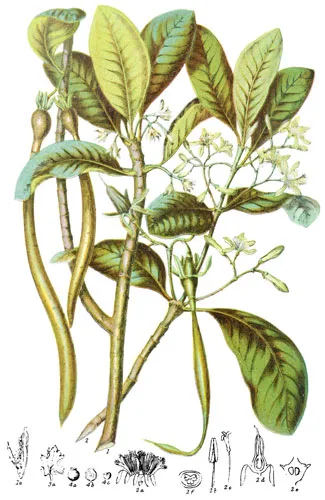
- Among the more strongly poisonous plants is Tanghinia venenifera in Madgascar, where formerly criminals were commanded to eat of the fruit, and if they survived, were considered innocent; a rare occurence, for one kernel would suffice to poison twenty persons.
- Gonolobus macrophyllus is used by the Indians of North America to poison their arrows.
- Echites affords brilliant flowers in our conservatories, and poison for the arrows of the Mandingoes in Africa.
- Hasseltia and others are also excessively acrid.
- Plumiera is a genus of fine flowers, but corrosive juices.
- Allamanda (5) was discovered in Guiana by Aublet, who saw and figured its large rough seed-vessel, which is now produced in this climate.
- Ascelpias is the type of the division with stamens fixed round the style in a column; it belongs almost exclusively to North America, A. curassavica alone growing in South America.
- A. syriaca (7)* is one of the sweet-scented and useful plants of Virginia; the French Canadians eat the young shoots, prepare sugar from the flowers, and collect the silky down of the seeds to stuff beds.
- The fleshy roots of A. nivea are used medicinally.
- Stapelia, named from Stapel, a Dutch commentator on Theophrastus 200 years ago, is a curious genus; the succulent stalks assume divers strange forms, and the flowers have a peculiar aspect, sometimes from their star-shape, tough substance, and hairy clothing appearing to be a link, outwardly at least, with some of the lower tribes of animals. Many of them have an extremely disagreeable odour: like other succulent plants, they exist in a dry soil; a few are said to afford food to the Hottentots.
- Hoya carnosa is a climbing plant from Asia, now seen in almost all conservatories with its honey-bearing waxen flowers and fleshy leaves.
- H. campanulata has elegant clusters of pale buff flowers.
- Sarcostemma is a singular leafless climber.
- Caoutchouc exists in the milky juice of several species: in Collophora and Cameraria† of South America; in Vahea‡ of Madagascar; a vast supply for trade is obtained from Cynanchum in Penang, and Urceola in Sumatra.
- Alyxia has an aromatic bark; many others afford medicine.
- Besides all these, there are several species yielding pleastant eatable fruit; that of Carissa is made into an excellent jelly.
- Carpodium§ is esteemed by the natives of Sierra Leone.
- Willughbeia bears a yellow berry in the axiles of the old leaves; the fruit of Cerbera is agreeable.
- According to ancient tradition in Ceylon, Tabernæmontana dichotoma is the “forbidden fruit” of Paradise, and is now of nauseous flavour.
- T. utilis supplies a copious sweet milk.
- Gymnema lactifera is the cow-plant of the Cingalese.
- Aspidosperma excelsum has a remarkable fluted stem, serviceable for various purposes to the Indians of Guiana.
- A. macrocarpa has a seed-vessel six inches long.
- Vallesia grows in the Galapagos Isles.
Locations
The Tropics is the chief station of these plants; most abundant in Asia. Asclepias belongs to North America. Vast numbers of Stapelia grow in barren tracts of South Africa; one species alone is a native of Sicily. Cynanchum has a wide range between 59° of N. latitude and 32° of S. latitude. Apocynum extends northwards into Europe, Vinca into England.
Legend
- Apocynum hpericifolium, Hypericum-leaved Dog’s-bane. North America.
- Stamens, Pistil, and Glands.
- Stamen.
- Pistil.
- Vinca major, Greater Periwinkle. England.
- Pistil.
- Section of Ovary.
- Section of Seed.
- Cynanchum nigrum, Black Cynanchum. South Europe.
- Seed-vessel.
- Seed.
- Nerium Oleander, Common Oleander. South Europe and India.
- Stamen.
- Pistil.
- Allamanda cathartica. Guiana.
- Tube of Corolla, opened.
- Pistil.
- Stamen.
- Stapelia marginata. Cape of Good Hope.
-
- Asclepias Syriaca. Flower.
- Stamen.
- Seed-vessel.
-
- Glossonema Boroyanum. Stamens and Pistil.
十二观
- 实测花色 黄绿、红
- 纵幅 1.35∶1
- 含 8 个物种
- 23 处解剖图
- 1868 年刊
- Order 92
这不是词条,是一条看画的次序:先站定看整体,再看名字与形色、构图与刀工,然后问它几时开、从哪里来、经了谁的手;最后是中国诗文——同一朵花,中国古人是怎么看的。十二观读完,这幅图就打开了。
-
第一眼
论画以形似,见与儿童邻。
—— 宋·苏轼《书鄢陵王主簿所画折枝》
只求画得像,是小孩的眼光。苏轼不是不要形似,是说形似之后还有一层:神。这一幅是竖的:眼睛从下往上走,落点在上半部。先让整株立起来,再看细节。第二步凑近一寸:主线之外另有 23 处解剖小图——那是画家怕你看不清,替你把花剖开了。第三步,找黄色最重的一小块:整幅的明暗秩序,是从那里排开的。
-
名与实
没有学名可依,就看题名:题名里往往藏着产地、赠者或一句形容。此幅既无通行中文名,学名也不可靠,只能以原书题名相称——图谱里总有几幅这样的图,只能靠画面本身说话。
-
形与色
就这一幅实测:花色占画面的 23.2%,叶色 9.8%,主相是黄绿、辅以红。这个比例与色相,是这一幅独有的。此图为一幅博物插画:一株植物被从山野或温室中取出,安置在纸的中央,根、茎、叶、花、果依次交代,务求可辨、可据、可传。此幅属黄一路,黄如蜜蜡,浅处几乎透光。上色时先铺一层淡底,再在瓣基与背光处加深——层次是这样一层层叠出来的。这一版上不止一个种:一共画了 8 个,彼此挨着放,差别一眼可见——并看,是图谱最省力的读法。
-
构图与呼吸
画幅高而窄,主株一路向上,上下留白多,是图谱中最常见的立轴式构图。(高宽比约 1.35∶1)另附 23 处局部解剖,主体与细部互为注脚。这一幅排得满:枝叶占到画面的 48%,重心近于正中——标本式的画法,图的是看得全。老图谱爱把主株摆在偏中线的位置,左右留得不一样多:这一点偏心,正是画面活起来的原因。
-
一刀一色
十九世纪后半叶,石版与彩色石印渐成主流:颜色可以直接印出,不再依赖手工,线条反倒退居其次。图像的“准确”提高了,手性却淡了。拿放大镜(或手机微距)看三处:花瓣边缘、叶脉、题名。线若连续不断,是刻的;色若越过轮廓半毫米,是手涂的。
-
时序
图版多标花期,因花期是植物一年中最容易被辨认的十余日;其余月份,它只是一丛叶。图上所记的 1868 年是刊行之年,不是花期;真正的花藏在原书的采集记录里,通常比出版早一两年。同一株植物,春天与秋天看起来像两种东西;图谱选花期,是因为那时它最不容易认错。
-
故土
来源不一,或本地山野,或远洋引种。十九世纪的植物园与温室,是这些植物离开故土后的第一个住所。十九世纪的苗圃主是这场植物迁徙的中转站:谁家先开花,谁家就有生意。
-
书与人
《植物自然目》(Natural Orders of plants)由伊丽莎白·特温宁绘,成于1849。此幅为其中Order 92,见原书第 92 页。图谱是集体工程:绘图、刻版、上色、编纂各有其人,署名的往往只有第一个。
-
诗境
朝饮木兰之坠露兮,夕餐秋菊之落英。
—— 战国·屈原《离骚》
中国文学里最早的一顿“花食”:露与英都可入口,草木与人从此不分彼此。图上那些解剖小图,正可作这句诗的注脚:花不只在枝头,也在剖面里。
-
文心
六法者何?一、气韵生动是也;二、骨法用笔是也;三、应物象形是也;四、随类赋彩是也;五、经营位置是也;六、传移模写是也。
—— 南齐·谢赫《古画品录》
一千五百年前,谢赫给了六条看画的标准:气韵、用笔、形似、设色、构图、临摹。前五条今天仍然管用——在这幅图版上一样样对过去,就是一次完整的读画。中国有《本草纲目》《植物名实图考》,欧洲有从《本草》插图到彩色石印的谱系;两条传统都相信:图能补文字的不足。记住这一句,下次在别处见到同类,它会自己浮上来——鉴赏力就是这样一句一句攒出来的。
-
花语
博物画的象征不在花语,而在“记录”本身:它相信一株植物值得被准确画下,这份信念是科学时代最朴素的道德。此幅偏黄,在花语里总要再加重一分情绪。象征会随世道改口:同一株植物,在一个世纪里可以说完全相反的话。
-
带走一双眼睛
下次去公园,找一株开着的花站三分钟:看叶怎么排、花朝哪个方向开、最深的一块色在哪。三分钟之后,你已经会看这一类的图了。1868 年的那朵花早已化作尘土,它留在纸上的样子,却比任何一株活着的同类都长寿。
本图涉及的植物
- Apocynum hypericifolium
- Vinca major
- Cynanchum nigrum
- Nerium Oleander
- Allamanda cathartica
- Stapelia marginata
- Asclepias syriaca
- Glossonema Boryanum
属索引
- Allamanda
- Alyxia
- Apocynum
- Asclepias
- Aspidosperma
- Cameraria
- Carissa
- Carpodinus
- Cerbera
- Collophora
- Cynanchum
- Echites
- Glossonema
- Gonolobus
- Gymnema
- Hasseltia
- Hoya
- Nerium
- Plumiera
- Sarcostemma
- Stapelia
- Tabernæmontana
- Tanghinia
- Urceola
- Vahea
- Vallesia
- Vinca
- Willughbeia