Commelinaceæ
Commelinaceæ
The Spider-Wort Tribe
- 合集
- 植物自然目
- 绘者
- Elizabeth Twining(伊丽莎白·特温宁)
- 年代
- 1868
- 图版号
- Order 143
- 原书页码
- p.143
- 授权
- CC BY-SA 4.0
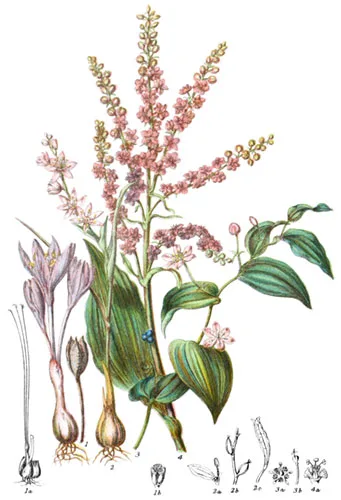
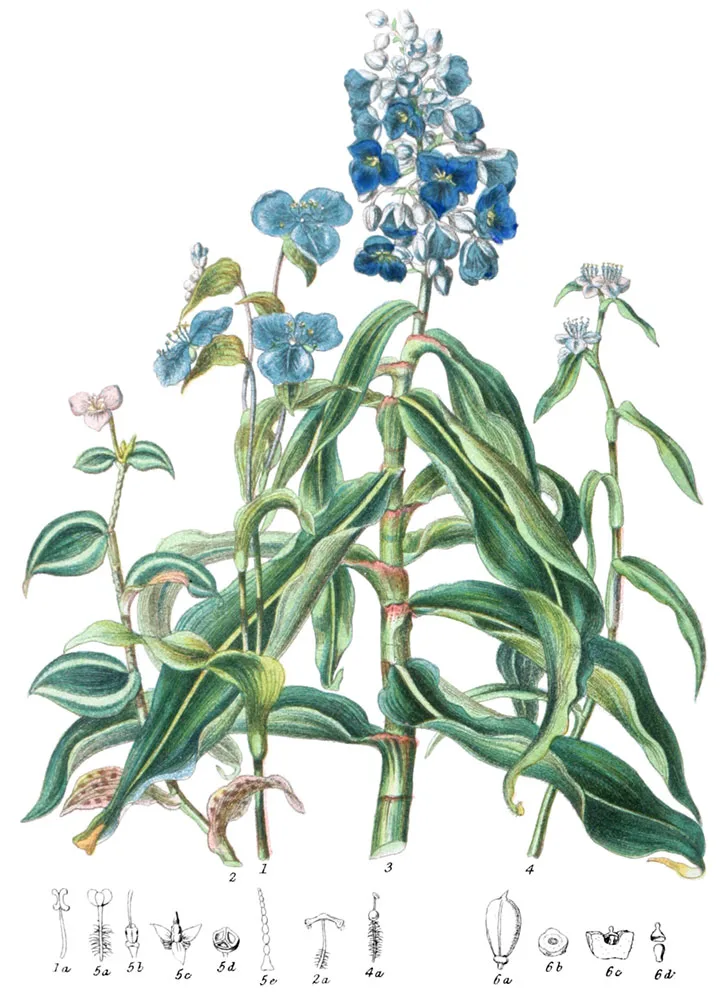
图中植物与部位
-
1.
Commelina cœlestis
, Sky-blue Commelina America
- 1a. Stamen
-
2.
Tradescantia zebrina
, Zebra-leaved Spider-wort Mexico
- 2a. Stamen
- 3. Dichorisandra thyrisflora , Thyrsoid-flowered Dichorisandra Brazil
-
4.
Cyanotis axillaris
, Axil-flowered Cyanotis East Indies
- 4a. Stamen
-
- 5a. Stamen of T. virginica
- 5b. Pistil
- 5c. Calyx and Ovary
- 5d. Section of Capsule
- 5e. Hair, magnified
-
- 6a. Capsule of Aneilema
- 6b. Seed
- 6c. Section
- 6d. Embryo and Cover
关于本图版
此图原刊于《植物自然目》(Natural Orders of plants),绘者为伊丽莎白·特温宁,成书于 1849 年。原书题作“Commelinaceæ”。这是该物种在早期博物学出版物中的图像记录之一。
全编共收录 160 幅图版,本图是其中一幅,原书将其列为 Order 143,见第 143 页,版式为纵幅。此图由原件扫描修复而成,使用时请遵循页面标注的授权条款。
原书文字(英文 / 法文)
Key characteristics
Herbaceous plants, the leaves of which are flat and usually sheathing at the base; the flower is composed of three sepals and three petals, which sometimes cohere at their base. The stamens are six or fewer, attached to the base of the ovary, some with irregular or imperfect anthers, the filaments beset with fine-jointed hairs. The anthers are two-celled, turning inwards. The ovary is three-celled, the style single, the stigma simple. The capsule is two or three-celled, containing two or more seeds in each cell, fixed by their side on the inner angle. The embryo lies in a cavity of the fleshy albumen, covered with a lid.
These plants are a link between the Lily tribe and Sedges and Rushes.
The roots contain a large proportion of starch.
Select plants in this order
Not all plants listed are illustrated and not all plants illustrated are listed.
- Commelina was so named by the French botanist Plumier, in honour of two Dutch merchants and botanists, who promoted the study and culture of plants. The first species was brought from Carolina in 1732, others have been introduced since from different parts of America, as well as from Asia. It has been chosen as the type of this Order, which is interesting from being a marked transition in the scale of development in plants; uniting many characters of the sedges with the more perfect petals and structure of Alismaceæ, and also of the Lily tribe. The petals roll up and become flaccid and moist in withering, like those of the Iris. Three of the stamens are usually irregular, furnished with crossing glands of peculiar form.
- Commelina cœlestis (1)* is one of the most beautiful species, the ephemeral petals are of a pure blue, and the whole plant is remarkable for neatness and elegance of form. The fleshy roots contain a large proportion of starch and mucilage, which renders them fit for food.
- Those of C. tuberosa, C. angustifolia, and C. striata are likewise cooked and eaten in the countries where they are native.
- The Chinese use C. medica medicinally: C. Rumphii is employed as a medicine in the East Indies.
- Tradescantia records the name of two of the earliest travellers and patrons of botany, John Tradescant and his son; the former was gardener to Charles I., and after his travels he made the first museum of natural history in this country, which is still retained and preserve as the Ashmolean Museum in Oxford.
- Tradescantia virginica, which Tradescant brought to England, 1629, is still a favourite plant in the border, and perfectly hardy. The jointed hairs of the stamens (5)† are a beautiful object for the microscope.
- T. zebrina (2) is a lowly plant, creeping over banks, spreading far by means of its rooting jointed stem: the petals, though small, have the peculiar glistening appearance of some Lilies in the sunshine.
- Dichorisandra is derived from the Greek word expressing the separation of two anthers from the rest.
- D. thyrsiflora (3) has a noble aspect when in flower, the large yellow anthers showing well in the deep blue corolla.
- D. discolor is smaller, and of less brilliant appearance.
- Cyanotis axillaris (4) is a very delicate plant, and exhibits the character of hairy stamens in a high degree; they bear on their filament white glands below the anthers, the pollen of which, and of other species of the tribe, is blue. A decoction of the plant is taken medicinally in the East Indies.
- Aneilema is a nearly similar genus, but has no involucre to the cluster of flowers; its capsule‡ contains seeds with a lid over the embryo. The species are scattered in China, Sierra Leone, and Australia.
- Cartonema spicatum belongs to the East Indies; Murdannia scapiflora is amongst the medicinal plants of the Hindoos; the leaves of Flagellaria indica are also said to have astringent properties.
Locations
This Tribe is found chiefly in the East and West Indies, Africa, and Australia. A few species exist in North America, but none have yet been discovered in Northern Asia or in Europe.
Legend
- Commelina cœlestis, Sky-blue Commelina. America.
- Stamen.
- Tradescantia zebrina, Zebra-leaved Spider-wort. Mexico.
- Stamen.
- Dichorisandra thyrsiflora, Thyrsoid-flowered Dichorisandra. Brazil.
- Cyanotis axillaris, Axil-flowered Cyanotis. East Indies.
- Stamen.
-
- Stamen of T. virginica.
- Pistil.
- Calyx and Ovary.
- Section of Capsule.
- Hair, magnified.
-
- Capsule of Aneilema.
- Seed.
- Section.
- Embryo and Cover.
本图涉及的植物
- Commelina cælestis
- Tradescantia zebrina
- Dichorisandra thyrsiflora
- Cyanotis axillaris
- Tradescantia virginica
- Aneilema
属索引
- Aneilema
- Cartonema
- Commelina
- Cyanotis
- Dichorisandra
- Flagellaria
- Murdannia
- Tradescantia