Juncaceæ
Juncaceæ
The Rush Tribe
- 合集
- 植物自然目
- 绘者
- Elizabeth Twining(伊丽莎白·特温宁)
- 年代
- 1868
- 图版号
- Order 144
- 原书页码
- p.144
- 授权
- CC BY-SA 4.0
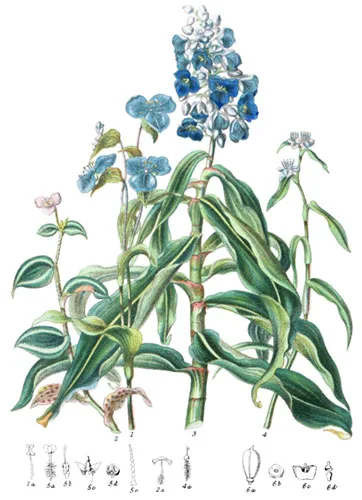
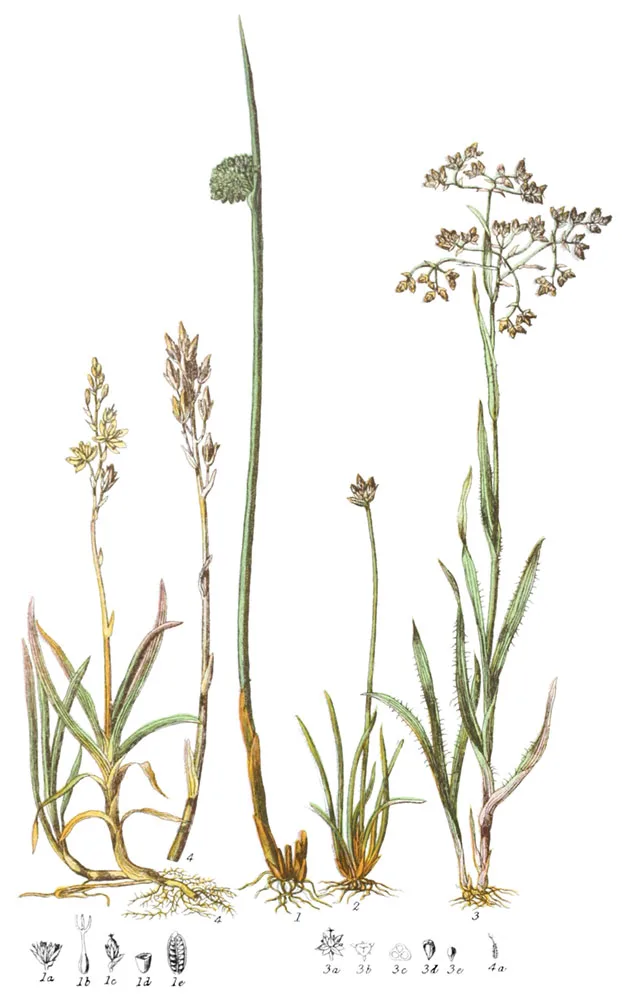
图中植物与部位
-
1.
Juncus conglomeratus
, Common Rush Wet places, Britain
- 1a. Flower
- 1b. Pistil
- 1c. Capsule
- 1d. Section
- 1e. Long Section, magnified
- 2. Juncus triglumis , Three-flowered Rush Streams, Scotland
-
3.
Luciola sylvatica
, Great Wood-rush England
- 3a. Flower
- 3b. Capsule
- 3c. Section of Capsule
- 3d. Capsule
- 3e. Seed
-
4.
Narthecium ossifragum
, Bog Asphodel Moors, Britain
- 4a. Stamen
关于本图版
本图选自伊丽莎白·特温宁的《植物自然目》(Natural Orders of plants),原书 1849 年出版。原书题作“Juncaceæ”。此类图版是当时记录物种形态的主要方式。
该合集全编共 160 幅图版,此图为其中之一,图版编号 Order 144,对应原书第 144 页,版式为纵幅。图像自原件扫描修复,构图与设色未经改动,授权方式见页面下方。
原书文字(英文 / 法文)
Key characteristics
Herbaceous plants with fibrous or clustered roots. The leaves are hollow or flat, and channelled with parallel veins. The flowers are more or less collected in heads; they are seldom brightly coloured, usually dull brown or green. The calyx and corolla are nearly similar, glumaceous or cartilaginous, six-parted, below the ovary. The stamens are six, inserted into the base of the segments; if only three, they are placed opposite the calyx. The anthers are two-celled, turned inwards, opening lengthwise or by pores at the point. The ovary is one or three-celled, the style is single, the stigmas three, sometimes only one. The fruit is a capsule, with three valves or non, one or many-seeded. The seeds have a thin skin, a very small embryo, and contain firm, fleshy, or cartilaginous albumen.
This Tribe is closely connected with Cyperaceæ, it has also affinity with the Lily Tribe through Narthecium.
Very slight properties exist in these plants.
Select plants in this order
Not all plants listed are illustrated and not all plants illustrated are listed.
- Juncus is a genus of very ancient utility to man, in the primæval times affording the simplest materials for covering floors, making ropes, and other homely articles. The pith of the slender stems burns readily, and in many remote parts rushes still furnish the only candles of the peasant’s dwelling. Until the time of Edward IV. they were strewn on the floors of churches and all large buildings; in Westmoreland an old custom is retained of adorning the church with various emblems formed of rushes on an annual festival.
- J. conglomeratus (1) is the common species growing everywhere in watery places.
- J. acutus and J. maritimus assist in preventing the encroachments of the sea on the coasts of Britain and of North America, and the embankments of Holland; these and all the large kinds which have simple channelled stems without leaves, are made into mats and various things in country places.
- J. triglumis (2) is amongst the species which have leaves; it is found chiefly on the summits of Scotch and Welsh mountains, and similar situations on the Continent.
- J. balticus is one of the rare plants of the Hebrides; J. bufonius, of our marshes, grows likewise on the banks of the Ganges.
- The genus has a wide range, J. arcticus belonging to the most northern regions, J. antarcticus existing in Lord Auckland’s isle in the extreme southern latitude.
- On the high mountains of hot regions some species find a locality as favourable as the low marshes of temperate or cold climates; the European J. glaucus is also a native of the Himalayas.
- Luciola was derived from the Italians, to whose vivid imagination the dewy heads of flowers seen sparkling in the moonlight gave an idea of their lucciole or glow-worms. It is distinguished from Juncus by its flat hairy leaves, and the capsule containing only three seeds.
- L. sylvatica (3) is very frequent in woods and on open ground, in May and June; though of so simple a character, it is extremely graceful in growth.
- L. campestris is a much smaller species, coming forth in grassy pastures in early spring. Several kinds abound in Switzerland.
- Narthecium has a more highly-developed flower than other genera of this tribe, and forms a link with some of the lowliest examples of the lily tribe.
- N. ossifragum (4) is the bright ornament of the wild moors in the Scotch Highlands, growing on the dark peat earth amidst small species of carex, grasses, and mosses. The stiff sword-shaped leaves, and the spike of delicate flowers, are sure to attract the notice of a traveller of botanical inclination. The corolla remains, and becomes thickened as the capsule enlarges. The seeds are numerous, enveloped in a long membranous skin.
- Calectasia is one of those plants of which the anthers open by pores at the end; the flowers are dry, of a star shape, and brilliant violet colour.
- In Australia grows also on Xerotes, in the structure of the flowers showing affinity to Palms.
- On the sand-hills near the coast of Tasmania, Astelia alpina affords a link with sedges, the inner part of the base of the wide leaves yields some wholesome food.
- At the Cape of Good Hope Prionum palmita rises with a thick black spongy stem, surmounted with a crown of leaves.
- One species of Juncus is cultivated in Japan, entirely for making mats for floors.
Locations
This Tribe inhabits chiefly the colder countries of the world, extends as far as North as Melville Isle, where it forms about 1/25 of the flowering plants; in the Temperate regions about 1/90; in the Tropics 1/400.
Legend
- Juncus conglomeratus, Common Rush. Wet places, Britain.
- Flower.
- Pistil.
- Capsule.
- Section.
- Long Section, magnified.
- Juncus triglumis, Three-flowered Rush. Streams, Scotland.
- Luciola sylvatica, Great Wood-rush. England.
- Flower.
- Capsule.
- Section of Capsule.
- Capsule.
- Seed.
- Narthecium ossifragum, Bog Asphodel. Moors, Britain.
- Stamen.
本图涉及的植物
- Juncus conglomeratus
- Juncus triglumis
- Luciola sylvatica
- Narthecium ossifragum
属索引
- Astelia
- Calectasia
- Juncus
- Luciola
- Narthecium
- Prionum
- Xerotes