Dipsaceæ
Dipsaceæ
The Teasel Tribe
- 合集
- 植物自然目
- 绘者
- Elizabeth Twining(伊丽莎白·特温宁)
- 年代
- 1868
- 图版号
- Order 77
- 原书页码
- p.77
- 主色
- 绿
- 授权
- CC BY-SA 4.0
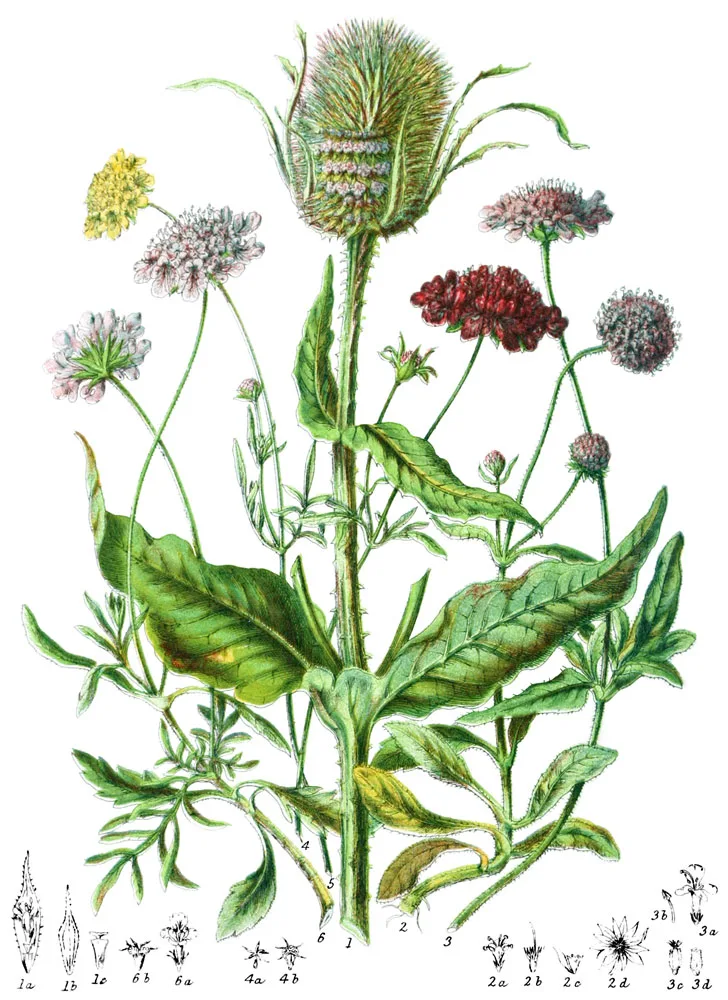
图中植物与部位
-
1.
Dipsacus sylvestris
, Wild Teasel England
- 1a. Flower, magnified
- 1b. Bract
- 1c. Seed
-
2.
Scabiosa succisa
, Devil’s-bit Scabious England
- 2a. Flower
- 2b. Pistil and inner Calyx
- 2c. Outer Calyx and Scale
- 2d. Involucre
-
3.
Knautia arvensis
, Field Scabious England
- 3a. Flower
- 3b. Stamen
- 3c. Seed and Calyx
- 3d. Calyx
-
4.
Scabiosa atro-purpurea
, Sweet Scabious South Europe
- 4a. Seed and inner Calyx
- 4b. The same with outer Calyx
- 5. Scabiosa ochrolenca , Yellow Scabious Germany
-
6.
Scabiosa columbaria
- 6a. Unnamed*
- 6b. Unnamed*
关于本图版
这幅图版出自《植物自然目》(Natural Orders of plants),由伊丽莎白·特温宁绘制,1849 年出版。原书题作“Dipsaceæ”。这是该物种在早期博物学出版物中的图像记录之一。
全编共收录 160 幅图版,本图是其中一幅,原书将其列为 Order 77,见第 77 页,版式为纵幅,整幅以绿为主调。此图由原件扫描修复而成,使用时请遵循页面标注的授权条款。
原书文字(英文 / 法文)
Key characteristics
Herbaceous plants and under-shrubs. The leaves are opposite, or whorled: the flowers are collected into a head at the top of the stalk, surrounded by many-headed involucre; the calyx is adherent, membranous, slender, surrounded by a scarious involucel: the flower is of one petal, tubular, inserted in the calyx, parted at the summit into four or five lobes: the stamens are four, alternate with the lobes of the corolla: sometimes half of them are imperfect: the anthers are distinct: the ovary is one-celled, with one ovule: the style is single: the stigma simple: the fruit is dry, one-celled, closed, crowned by the star-like calyx: the seed contains a small prtion of fleshy albument.
The distinct stamens of these flowers distinguish them from those of the Composite tribe, with which they have much affinity.
The properties are unimportant.
Select plants in this order
Not all plants listed are illustrated and not all plants illustrated are listed.
- Dipsacus is said to have been so named from the Greek word for thirsty, on account of the water sometimes collected in the hollow space formed by the united base of the leaves around the stalk, and hence the common name of Venus’s kettle in some parts of England.
- D. sylvestris (1) grows frequently on waysides and banks of the streams, with a stiff, prickly branching stem, about four feet high.
- D. Fullonum, the Fuller’s Teasel, is cultivated in the west of England for the sake of the bristly heads of flowers, the scales of which are stronger and beset with sharper hooked prickles than those of D. sylvestris: they are thus serviceable in raising the nap of woollen cloth; for this purpose they are fixed in rows on a wheel, against which the cloth is held whilst it revolves. The flowers are pale, and crowded closely together.
- The different species of Scabiosa are chiefly European; a small portion only are of a shrubby nature. The outermost row of flowers are generally the largest, whih gives the appearance of the radiant flowers of the composite plants; in some species the petal is four-cleft, in others, five.
- S. succisa (2) is one of the few examples of a bitten-off root; the point of the root withering and stopping in its growth, small rootlets protrude from the sides. The flowers are all of equal shape, and not radiated at the edge.
- S. columbaria (6) grows on a limestone, chalk, or gravel soil, and together with the other species, are frequently found on chalk-downs, where they assume the usual dwarf habit of the plants which grow in such situations, the flower-stalk being diminished to an inch in height—thus exhibiting in miniature what may be seen on the Alps and other lofty mountains.
- S. ochrolenca (5) is very common by the road-side and in waste places in most parts of Austria and Bohemia.
- S. atro-purpurea (4) is a well-known favourite in gardens.
- Knautia (3), a name bestowed by Linnæus, in honour of a Saxon botanist, was at first applied to some plants of the Levant; it is now given also to the British species formerly called Scabiosa arvensis (3).
- S. speciosa grows in Cashmere and on the Himalayas.
- Some species of Dipsacus are found in Nepal and on the Neelgherries.
- Morinia Wallichiana is one of the most beautiful examples of this tribe in India, bearing clusters of pink and white flowers around the stem, enclosed by four prickly leaves.
- Cephalaria is a genus belonging to Siberia, Germany, Switzerland, and the Cape of Good Hope.
Locations
The plants of this small Tribe are chiefly natives of the South of Europe, the Levant, Barbary, and the Cape of Good Hope, not advancing into hot or cold regions; most abundant in the Temperate climates of the Old World; unknown in America. None belong to the plaints of India, but sevearl are natives of the Himalaya at moderat elevations.
Legend
- Dipsacus sylvestris, Wild Teasel. England.
- Flower, magnified.
- Bract.
- Seed.
- Scabiosa succisa, Devil’s-bit Scabious. England.
- Flower.
- Pistil and inner Calyx.
- Outer Calyx and Scale.
- Involucre.
- Knautia arvensis, Field Scabious. England.
- Flower.
- Stamen.
- Seed and Calyx.
- Calyx.
- Scabiosa atro-purpurea, Sweet Scabious. South Europe.
- Seed and inner Calyx.
- The same with outer Calyx.
- Scabiosa ochrolenca, Yellow Scabious. Germany.
- Scabiosa columbaria, Fine-leaved Scabious. England.
本图涉及的植物
- Dipsacus sylvestris
- Scabiosa succisa
- Knautia arvensis
- Scabiosa atro-purpurea
- Scabiosa ochroleuca
- Scabiosa columbaria
属索引
- Cephalaria
- Dipsacus
- Knautia
- Morina
- Scabiosa