Stylidiaceæ
Stylidiaceæ
The Style-Wort Tribe
- 合集
- 植物自然目
- 绘者
- Elizabeth Twining(伊丽莎白·特温宁)
- 年代
- 1868
- 图版号
- Order 78
- 原书页码
- p.78
- 授权
- CC BY-SA 4.0
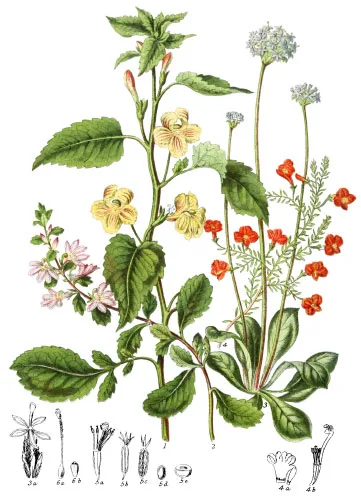
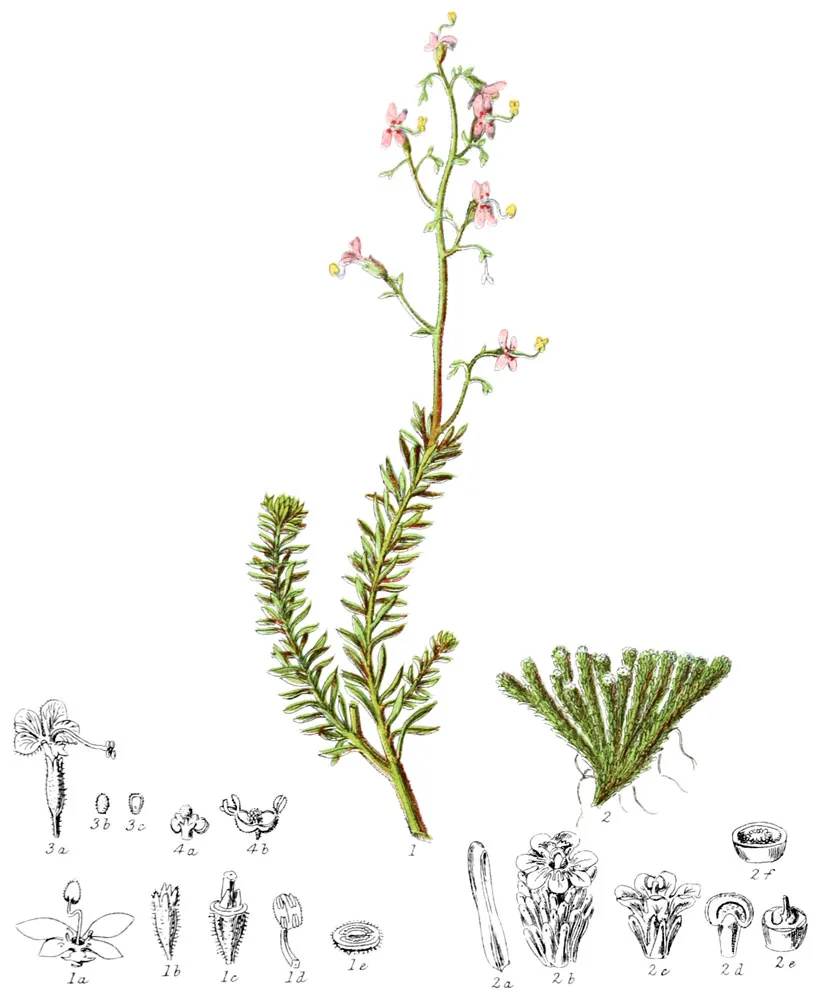
图中植物与部位
-
1.
Stylidium glandulosum
Australia
- 1a. Flower
- 1b. Calyx
- 1c. Ovary and Glands
- 1d. Pistil and Stamens
- 1e. Section of Ovary
-
2.
Forstera clavigera
Lord Auckland’s and Campbell’s Isles
- 2a. Leaf, magnified
- 2b. Flower with plumose Stigma
- 2c. Flower with imperfect Stigma
- 2d. Anther
- 2e. Ovary and Gland
- 2f. Section of Ovary
-
- 3a. Flower of Stylidium lauricifolium
- 3b. Seed, magnified
- 3c. Seed
-
- 4a. Stylidium calcaratum , Stamens on Pistil
- 4b. Capsule, open
关于本图版
《植物自然目》(Natural Orders of plants)由伊丽莎白·特温宁绘制,1849 年印行,本图即其中一幅。原书题作“Stylidiaceæ”。此类图版是当时记录物种形态的主要方式。
该合集全编共 160 幅图版,此图为其中之一,图版编号 Order 78,对应原书第 78 页,版式为纵幅。图像自原件扫描修复,构图与设色未经改动,授权方式见页面下方。
原书文字(英文 / 法文)
Key characteristics
Under-shrubs and herbaceous plants; with watry, not milky juice. The hairs, if present, either simple, acute, or bearing a gland at the top. The leaves are scattered, sometimes in circles on the stalk, entire at the edges, smooth or hairy, the root-leaves cluster at the base of the stalk in those species which have no stem. There are no stipules. The flowers are in spikes, on branching stalks, or solitary, usually terminal, rarely from the base of the leaf-stalks. The calyx is adherent to the ovary, with from two to six divisions at the top, either regular or two-lipped, persistent with the capsule. The corolla is composed of one petal, the lobes irregular, rarely regular, with from five to seven divisions, imbricated in the bud, late in falling off. The stamens are two, the filaments united with the style, forming a long column; the anthers are double or simple, lying over the stigma, gaping by chinks. The ovary is two-celled, many-seeded, sometimes one-celled, often crowned with one or two glands; the style is single, the stigma simple or bifid, enclosed by the anthers. The capsule has two valves and two cells, or one only from the contraction of the partition. The seeds are indefinite in number, small, erect, sometimes stalked, attached to the axis of the partition; they contain fleshy oily albumen.
These few plants have close affinity with Campanulaceæ and Goodeniaceæ, but the anthers affixed to the style clearly distinguish them.
No useful or remarkable properties are known to exist in these plants.
This small Tribe is interesting as forming a singular link with the Orchis tribe, otherwise of so very different a character; the combination of the anthers and the stigma is the one point of resemblance.
Select plants in this order
Not all plants listed are illustrated and not all plants illustrated are listed.
- Stylidium derives its name from the amnner in which the stamens and style are united into one column; in this there exists a strong irritability and elasticity, which causes it to start suddenly aside on being touched. The stigma lies in a hollow cavity at the top of the column, nearly concealed by the anthers on either side.
- S. glandulosum (1) is of a half-shrubby nature; the hairs of the calyx bear small glands on their summits.
- All the known species of Stylidium are natives of Australia, either in New Holland or in New South Wales.
- Forstera clavigera (2) grows in compact tufts in boggy and turfy places on mountains, very commonly both in Lord Auckland’s and Campbell’s Isles; the branches are leafy throughout their whole length, and send forth small roots from the base of the leaves. The flower is minute, bell-shaped, with a wide, short tube, the upper portion being variously parted into five to seven lobes, sometimes of unequal size. In some instances the corolla is undulated on the surface, and furnished at the throat of the tube with linear appendages like nectaries, but containing no honey. The column of style and anthers is often encircled at the base by two crescent-shaped glands. The anthers are usually kidney-shaped; when these are imperfectly formed, the stigma is nearly hidden in the cavity between them. In the perfect flowers, the stigma becomes forked and feathery. The capsule before being fully ripe is fleshy and leathery, containing in its single cell from six to eight seeds.
- F. sedifolia inhabits the turfy parts of the mountain of Tongariro, in the northern island of New Zealand.
- Some species have been found in the morasses bordering the straits of Magellan.
- Levenhookia and others are scarcely known beyond their native situations, where they were discovered by exploring travellers.
Locations
Australia is the principal region of this small Tribe; the greatest number of species being natives of swamps in New Holland; one belongs to Ceylon, another to the coast of Malabar, and another to the district of Silhet, in Northern India. Forstera inhabits the most southern isles of the Southern Hemisphere.
Legend
- Stylidium glandulosum. Autstralia.
- Flower.
- Calyx.
- Ovary and Glands.
- Pistil and Stamens.
- Section of Ovary.
- Forstera clavigera. Lord Auckland’s and Campbell’s Isles.
- Leaf, magnified.
- Flower with plumose Stigma.
- Flower with imperfect Stigma.
- Anther.
- Ovary and Gland.
- Section of Ovary.
-
- Flower of Stylidium lauricifolium.
- Seed, magnified.
- Seed.
-
- Stylidium calcaratum. Stemans on Pistil.
- Capsule, open.
本图涉及的植物
- Stylidium glandulosum
- Forstera clavigera
- Stylidium laricifolium
- Stylidium calcaratum
属索引
- Forstera
- Levenhookia
- Stylidium