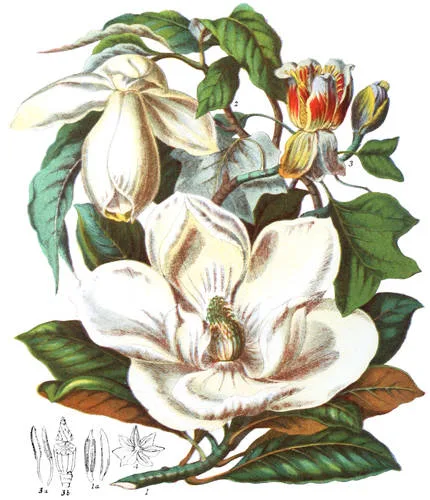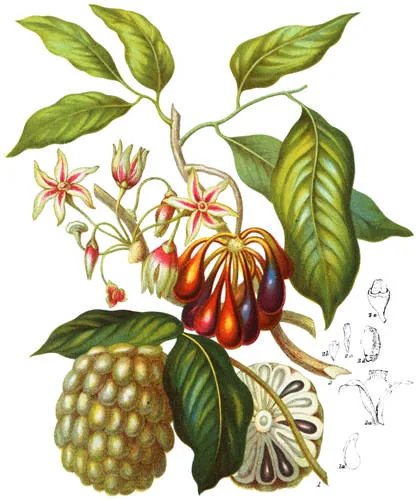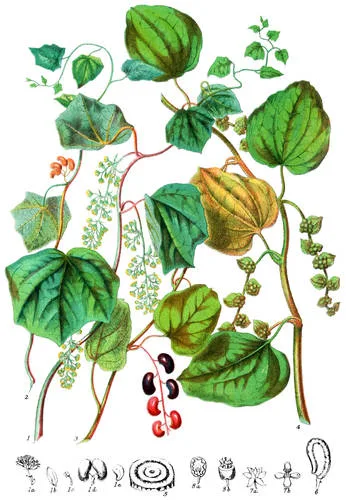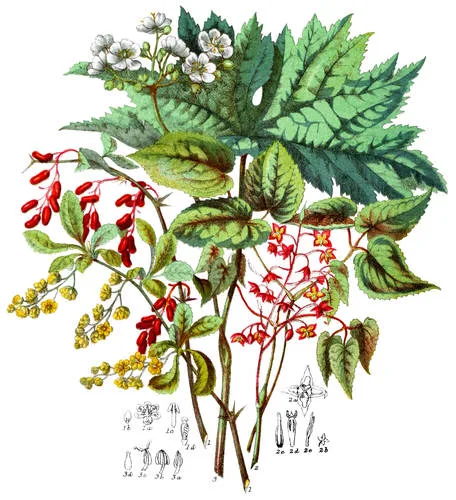
Hæmodoraceæ
Hæmodoraceæ
The Blood-Root Tribe
- 合集
- 植物自然目
- 绘者
- Elizabeth Twining(伊丽莎白·特温宁)
- 年代
- 1868
- 图版号
- Order 135
- 原书页码
- p.135
- 主色
- 黄
- 授权
- CC BY-SA 4.0
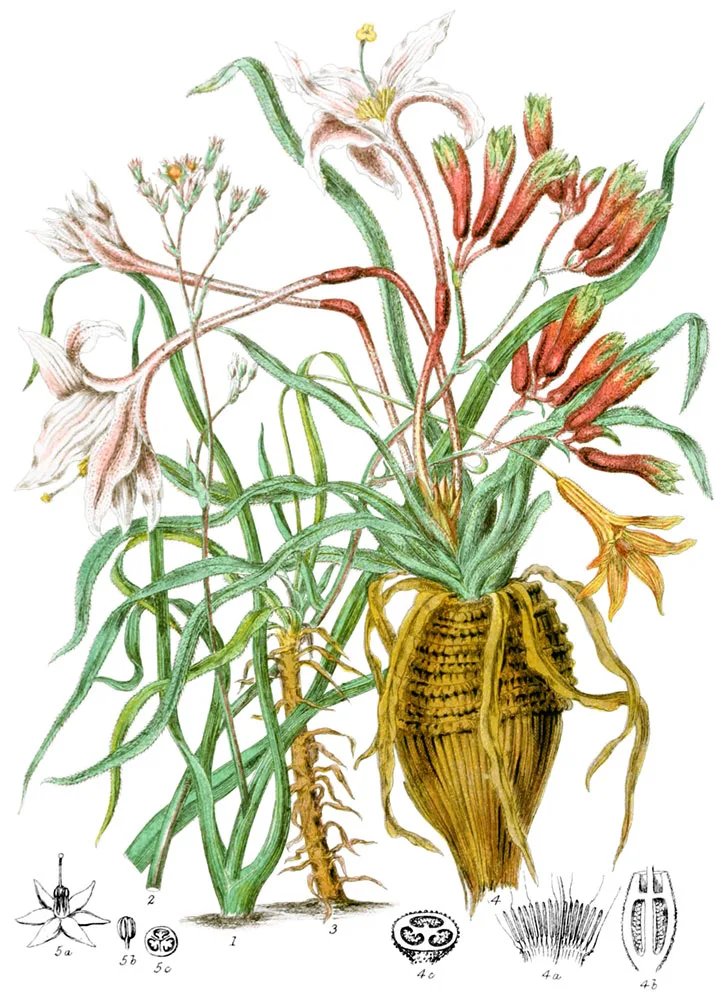
图中植物与部位
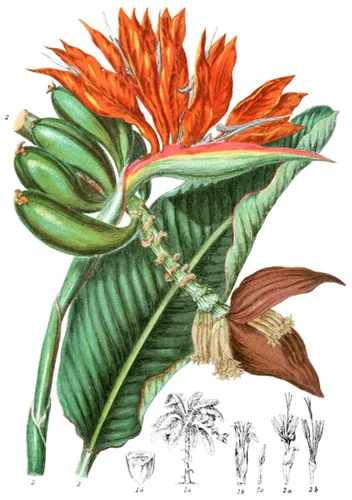
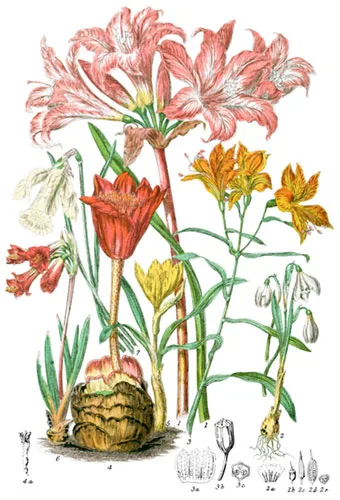
- 1. Hæmodorum planifolium , Flat-leaved Hæmodorum New Holland
- 2. Anigozanthus coccinea , Red Anigozanthus Swan River
- 3. Barbacenia Veitchii South America
-
4.
Barbacenia Alexandrinæ
British Guiana
- 4a. Stamens
- 4b. Section of Ovary
- 4c. Cross Section
-
- 5a. Flower of H. spicatum
- 5b. Stamen
- 5c. Section of Ovary
关于本图版
《植物自然目》(Natural Orders of plants)由伊丽莎白·特温宁绘制,1849 年印行,本图即其中一幅。原书题作“Hæmodoraceæ”。原书为这一物种留下了成幅的彩色图像记录。
该合集全编共 160 幅图版,此图为其中之一,图版编号 Order 135,对应原书第 135 页,版式为纵幅,设色以橙为基调。图像自原件扫描修复,构图与设色未经改动,授权方式见页面下方。
原书文字(英文 / 法文)
Key characteristics
Herbaceous plants with fibrous perennial roots and long narrow leaves. The corolla is composed of sepals and petals scarcely distinguishable, usually united into a tube, and woolly on the exterior. The stamens arise form the sepals and petals, either three or six; the anthers burst inwardly. The ovary is usually three-celled, the style is simple, the stigma undivided; the fruit is covered by the withered corolla, and is either a capsule or valvular, usually gaping when ripe. The seeds are either few or many, winged or wrinkled and angular; they contain cartilaginous albumen.
This Tribe has affinity with Amaryllidaceæ and Iridaceæ.
A red dye and bitter property exist in the roots, some of which are eatable.
Select plants in this order
Not all plants listed are illustrated and not all plants illustrated are listed.
- Hæmodorum was named from the Greek, describing the red hue produced by the root. Although in many points of structure it bears resemblance to the Amaryllis tribe, yet it has no beauty of form or colour to compare with those magnificent flowers.
- H. planifolium (1) was brought to English gardens from New South Wales in 1810; as being the only species of this genus, and affording the type of a natural Order, it is of interest to botanists, but it can scarcely be esteemed valuable by the horticulturalist.
- H. paniculatum is also a native of Australia, and is found in the district of Swan River, where its roots are said to afford a supply of food to the inhabitants.
- H. spicatum has likewise eatable roots, when their acrid properties have been dispelled by roasting.
- Anigozanthus is a genus first discovered in New Holland in 1803; the flowers grow on long stalks, and are woolly on the outside.
- A. coccinea (2) is the brightest species; it was brought from the Swan River in 1837, and is now frequently to be seen in conservatories.
- Barbacenia is a genus belonging to South America, named after a governor of the province of Minas Geras, from whence several plants have been transplanted into European gardens.
- B. Veitchii (3) is a small but brilliant example of the genus.
- B. Alexandrinæ (4) is one of those remarkable specimens of the vegetable world discovered by Sir Robert Schomburgk on the sandstone mountain of Roraimé, and on Itapu, which rises like a gigantic obelisk 4000 feet above the savannahs of Guiana, in 5° north latitude, where the temperature ranges between 60° and 86°. The stem is from ten to twelve feet high, the forks of the branches clothed with the membranous withered bases of leaves. The scent of the flowers is extremely fragrant, similar to that of Hippeastrum, allied to Amaryllis.
- But the most extraordinary plant of this tribe is undoubtedly Vellozia, discovered and described by the celebrated Bavarian traveller, Von Martius, in Brazil. The trunk consists of a central cylindrical column, not increasing in diameter, only growing upwards like other monocotyledonous plants. The exterior of the stem is composed of quantities of slender fibrous roots, cohering and forming a kind of wood of the same nature as that of the ferns, and partly resembling that of some Palms. At the top the branches grow in forks, from the ends of which proceed tufts of leaves and flowers, after the manner of Yucca. As they grow always in numerous groups, the effect is very singular.
- A few other genera are worthy of notice: Dilatris is always extremely downy over the whole flowering stem: D. corymbosa and D. viscosa belong to the Cape.
- D. Heritiera yields a red dye to the natives of North America.
- Lachnanthes tinctoria affords also a red dyeing matter.
- An infusion of Aletris farinosa is one of the most intense bitters known, and is used occasionally as a tonic medicine.
Locations
This Tribe exists chiefly in Brazil and in the Mascaren Isles, in Guiana, and in the Temperate parts of Australia; a few species are found in North America, and at the Cape.
Legend
- Hæmodorum planifolium, Flat-leaved Hæmodorum. New Holland.
- Anigozanthus coccinea, Red Anizoganthus. Swan River.
- Barbacenia Veitchii. South America.
- Barbacenia Alexandrinæ. British Guiana.
- Stamens.
- Section of Ovary.
- Cross Section.
-
- Flower of H. spicatum.
- Stamen.
- Section of Ovary.
本图涉及的植物
- Hæmodorum planifolium
- Anigozanthus coccinea
- Barbacenia Veitchii
- Barbacenia Alexandrinæ
- Hæmodorum spicatum
属索引
- Aletris
- Anigozanthus
- Barbacenia
- Dilatris
- Hæmodorum
- Lacnanthes
- Vellozia