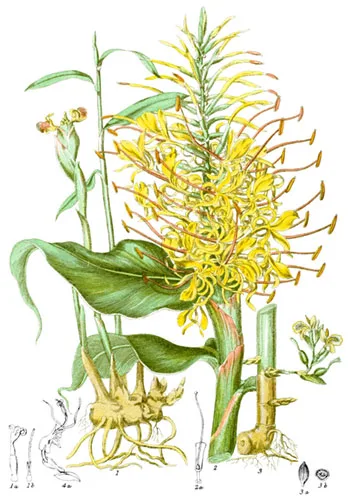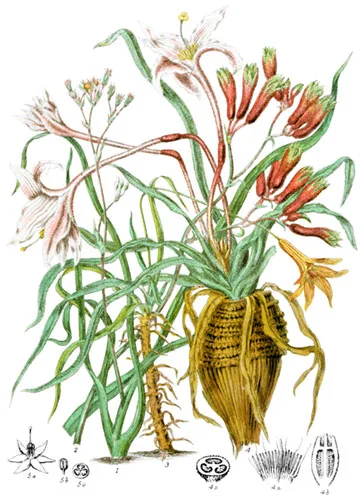
Musaceæ
Musaceæ
The Banana Tribe
- 合集
- 植物自然目
- 绘者
- Elizabeth Twining(伊丽莎白·特温宁)
- 年代
- 1868
- 图版号
- Order 134
- 原书页码
- p.134
- 主色
- 橙
- 授权
- CC BY-SA 4.0
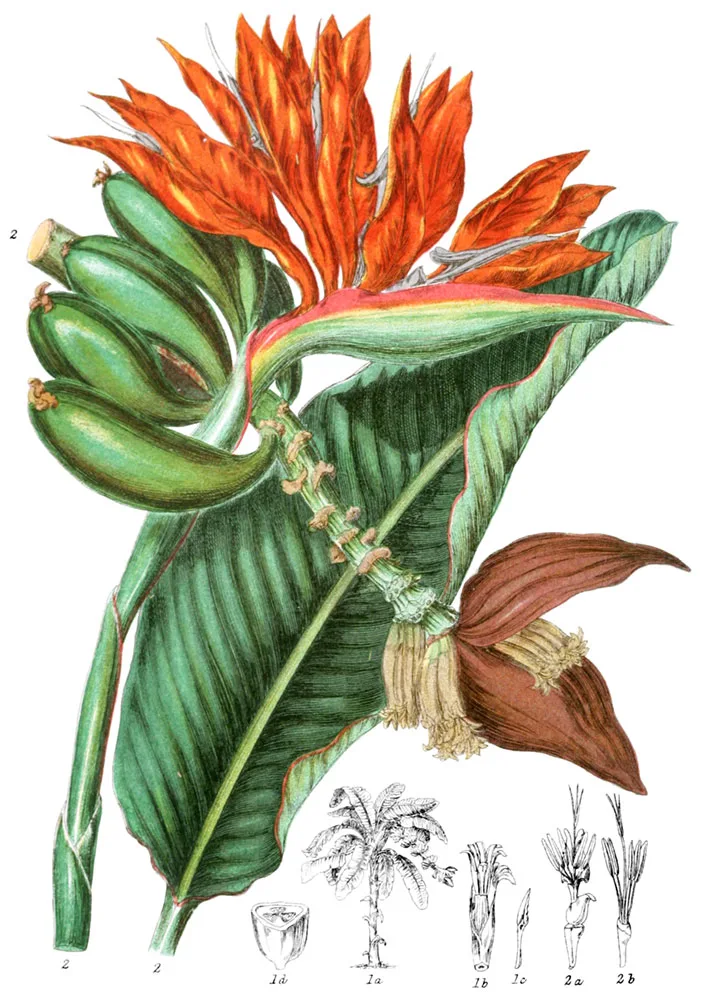
图中植物与部位
-
1.
Musa paradisiaca*
, Banana or Plantain
- 1a. Tree
- 1b. Flower
- 1c. Stamen
- 1d. Section of Ovary
-
2.
Strelitzia reginæ
, Queen Charlotte’s Strelitzia Cape of Good Hope
- 2a. Stamens and Pistil in inner petals
- 2b. Stamens and Pistil
关于本图版
此图原刊于《植物自然目》(Natural Orders of plants),绘者为伊丽莎白·特温宁,成书于 1849 年。原书题作“Musaceæ”。原书为这一物种留下了成幅的彩色图像记录。
全编共收录 160 幅图版,本图是其中一幅,原书将其列为 Order 134,见第 134 页,版式为纵幅,整幅以朱红为主调。此图由原件扫描修复而成,使用时请遵循页面标注的授权条款。
原书文字(英文 / 法文)
Key characteristics
Plants without a stem, or having one formed by the sheathing bases of the leaf-stalks. The leaves are simple, with fine parallel veins diverging regularly from the midrib towards the margin. The flowers grow in a spathe; the six petals are in two distinct rows, more or less regular in their arrangement. In Strelitzia the three inner petals form a covering to the stamens and pistil. The stamens are six, one or more usually imperfect, inserted on the petals. The anthers are linear, turned inwards, two-celled, often having a petal-like crest. The ovary is below the petals, three-celled, with a simple style and three-lobed stigma. The fruit is either a capsule with three cells and gaping, or succulent and closed; containing three or many seeds. The seeds are sometimes surrounded with hairs, and have a crustaceous covering; the embryo is often mushroom-shaped, placed on the mealy albumen.
This Tribe has close affinity with the Ginger tribe.
Highly nutritive properties are contained in the fruit of Musa.
Select plants in this order
Not all plants listed are illustrated and not all plants illustrated are listed.
- Musa, a name probably derived from the Arabic, is a genus of noble growth and appearance, the straight columnar stem composed of the expanded bases of of the leaf-stalks, rises to the height of twenty feet; the leaves are often as much as ten feet in length.
- In general aspect as well as in some points of structure, Musa paradisiaca (1) has a resemblance to Palms, and forms a link in the transition to that Tribe. Every portion of Musa is of value, and it is an indispensable tree to the native of tropical regions: the leaves serve to cover the roof of his hut, the fibres of the stalks and leaves are woven into baskets, cords, and many other useful articles. It is capable of being much more extensively applied to the varied uses of civilized life, if the natives were encouraged and assisted in the manufacture of the fibres. Excellent paper of different qualities has been made from it in Madras, and also in France. But hitherto the chief value is in the fruit, which is produced in enormous abundance: from the base of each stem spring ten or twelve young plants, yielding in succession a continual supply; it contains an unusual portion of farinaceous nutritive substance, fourfold that of the Potato, and 133 times as much as Wheat. Throughout the Tropics the Banana or Plantain is the principal source of food, wholesome and pleasant in flavour; it ripens in conservatories in England, but does not acquire its full development and nourishing properties; when grown in hot regions it has so much saccharine matter that it dries like figs, and may be kept for many years. Boiled or roasted, it is eaten like bread, when ripe it may be preserved as a sweetmeat; a kind of wine is sometimes prepared from it, and the young shoots are eaten as a vegetable.
- M. textilis is the Manilla hemp, from which an excellent fibre is obtained not only for ropes, but of a quality fine enough for the most delicate of Indian muslins.
- Strelitzia (2) was named by Sir Joseph Banks in honour of Queen Charlotte of Mecklenburgh Strelitz. It is a genus of singular form and remarkable beauty; the leaves grow direct from the root, forming a kind of stem by their sheathing bases, in the midst of which springs the flower-stalk, terminating in a spathe, from whence rises the brilliant crest of flame-coloured flowers. The three inner petals are deep blue, enclosing the stamens and pistil.
- S. angusta is eighteen feet high, with white flowers.
- Heliconia is a nearly similar genus, belonging to the West Indies; H. psittacorum is a beautiful object in the clearings amongst the mountains of Jamaica, the graceful flexile stem bearing clusters of flowers at the joints towards the summit, the orange petals marked by a black spot have a singular effect.
- H. Bihai is a larger species flourishing in moist shaded valleys; the small succulent berries, containing three rugged seeds, are eatable.
- Urania speciosa, a noble, Palm-like tree of Madagascar, has wholesome seeds, enveloped in a blue pulpy aril, full of an essential oil. The fruit is used in dyeing.
Locations
This Tribe inhabits chiefly the Cape of Good Hope, and the islands on its south-eastern coast, and is dispersed over the Tropics, principally on plains. It is scarcely found elsewhere, except in Japan.
Legend
- Musa paradisiaca, Banana or Plantain.*
- Tree.
- Flower.
- Stamen.
- Section of Ovary.
- Strelitzia reginæ, Queen Charlotte’s Stralitzia. Cape of Good Hope.
- Stamens and Pistil in inner petals.
- Stamens and Pistil.
本图涉及的植物
- Musa paradisiaca
- Strelitzia reginæ
属索引
- Heliconia
- Musa
- Strelitzia
- Urania