Hippocrateaceæ
Hippocrateaceæ
The Hippocratea Tribe
- 合集
- 植物自然目
- 绘者
- Elizabeth Twining(伊丽莎白·特温宁)
- 年代
- 1868
- 图版号
- Order 32
- 原书页码
- p.32
- 主色
- 绿
- 授权
- CC BY-SA 4.0
图中植物与部位
-
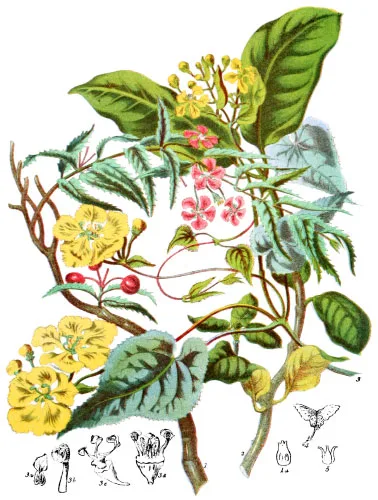
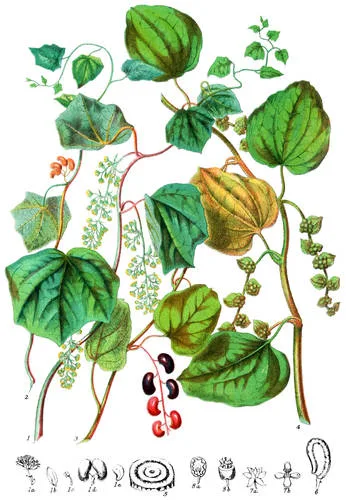
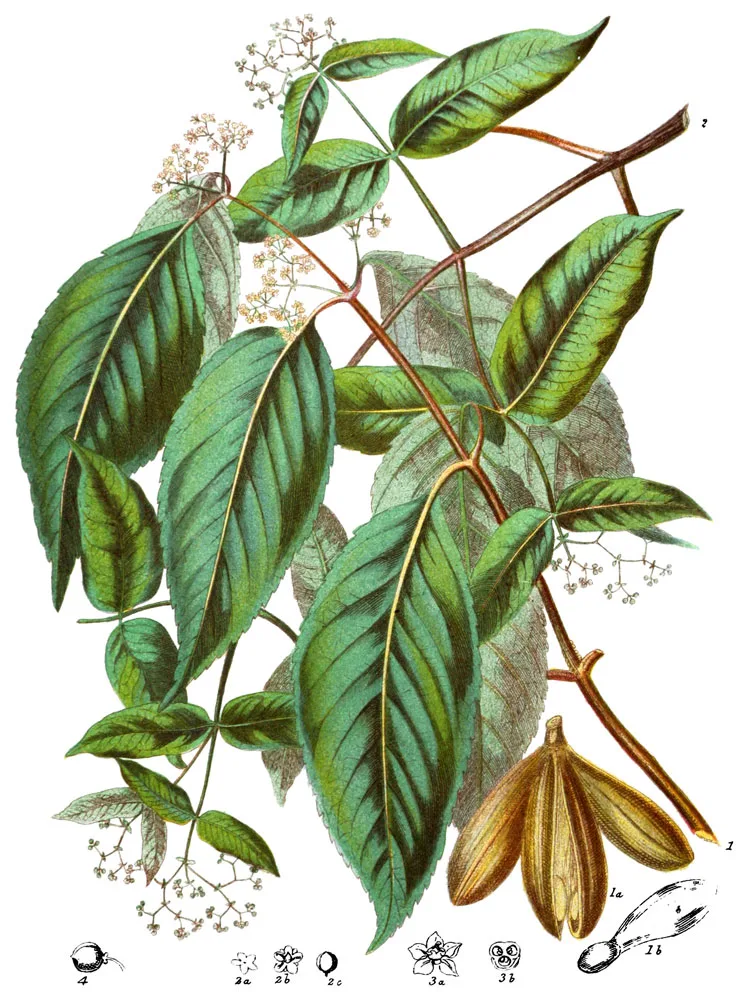
1.
Hippocratea arborea
, Tree Hippocratea Hindostan
- 1a. Seed-vessels
- 1b. Winged seed
-
2.
Tontelea scandens
, Climbing Tontelea South America
- 2a. Calyx
- 2b. Flower
- 2c. Fruit
-
- 3a. Flower of Hippocratea Aronttiana
- 3b. Section of Ovary East Indies
- 4. Fruit of Salacia prinoides East Indies
关于本图版
这幅图版出自《植物自然目》(Natural Orders of plants),由伊丽莎白·特温宁绘制,1849 年出版。原书题作“Hippocrateaceæ”。原书为这一物种留下了成幅的彩色图像记录。
全编共收录 160 幅图版,本图是其中一幅,原书将其列为 Order 32,见第 32 页,版式为纵幅,设色以绿为基调。此图由原件扫描修复而成,使用时请遵循页面标注的授权条款。
原书文字(英文 / 法文)
Key characteristics
Arborescent or climbing shrubs, whichare almost always smooth. The leaves are opposite, simple, entire at the edges, or toothed, somewhat leathery, with small stipules at the base soon falling off. The flowers grow in clusters from the base of the leaf-stalks. The flowers are small and inconspicuous: the sepals of the calyx are five, minute, combined at the base, persistent: the petals are five, partly folded over each other in the bud. The stamens are three; the filaments are wide at the base, and cohere to form a thick disk around the ovary; the anthers open transversely at the point. The ovary is free, partly concealed within the disk of the filaments, three-celled, surmounted by one stle, and either one or three stigmas. The fruit consists either of three dry carpels, as in Hippocratea, or of a berry with one to three cells as in Salacia; the seeds are attached to the axis of each cell, in pairs; in some instances they are winged.
The winged fruit of some species connects this Order with Malpighiaceæ; there are also some affinities with the Spindle-tree tribe.*
The fruit of some of these plants contains oil.
Select plants in this order
Not all plants listed are illustrated and not all plants illustrated are listed.
- Hippocratea was so named by Linnæus in memory of Hippocrates, a descendant of Esculapius, and the renowned founder of a scientific school of medicine if Greece, 2300 years ago. He was deeply studios of natural history, and having travelled through a great part of Asia, the genus of plants selected to bear his name is not inappropriate.
- Hippocratea arborea (1) has a slender stem with smooth brown bark; the young week branches are usually disposed to climb over trees; the flowers appear in July; the fruit does not ripen until March; two seeds lie in the top of each carpel, and have a long thin wing extending to the base.
- H. indica extends in Bengal as far as the mountains at Monghyr.
- H. comosa, the wood almond of the Antilles, bears thick clusters of small flowers on fine feathery branches; the seeds are oily, of sweet, pleasant flavour, and are much esteemed; the flowers have a bitter taste, and are said to be used as a remedy in fever.
- The seed vessels of H. velutina are clothed with a velvet-like down. The flowers of one species are extremely fragrant. The manner of growth of these plants varies much.
- H. volubilis twines and twists its branches in knotted curles over other trees.
- H. Schimperiana of Sierra Leone grows stiff and straight, the opposite branches forming right angles with the stem.
- Tontelea scandens (2) was discovered by Aublet, near the River Pinemari about a hundered miles from the coast of the Pacific: it spreads its long branches and tough leaves over lofty trees, sending out roots from its branches; the small green flowers are of very insignificant appearance. Several kinds of Tontelea in Brazil are said by Martius to have a sweet, muscilaginous fruit.
- Salacia prinoides (4) has a small, eatable, pulpy fruit; that of S. pyriformis, of Sierra Leone, is much larger, and is also eaten by the natives.
- Several species of Salacia belong to the same regions of India as Hippocratea, and some extend to the Burmese country and the Malay Isles.
- Johnia coromandelliana produces an eatable berry of agreeable flavour.
Locations
The chief portion of this Tribe belongs to South America; a few species are natives of Africa and the Mauritius: some grow also in the Peninsula of India, but none have been discovered in the northern provinces.
Legend
- Hippocratea arborea, Tree Hippocratea. Hindostan.
- Seed-vessels.
- Winged Seed.
- Tontelea scandens, Climbing Tontelea. South America.
- Calyx.
- Flower.
- Fruit.
-
- Flower of Hippocratea Arnottiana.
- Section of Ovary. East Indies.
- Fruit of Salacia prinoides. East Indies.
本图涉及的植物
- Hippocratea arborea
- Tontelea scandens
- Hippocratea Arnottiana
- Salacia prinoides
属索引
- Hippocratea
- Johnia
- Salacia
- Tontelea