Hypericaceæ
Hypericaceæ
The St. John’s Wort Tribe
- 合集
- 植物自然目
- 绘者
- Elizabeth Twining(伊丽莎白·特温宁)
- 年代
- 1868
- 图版号
- Order 33
- 原书页码
- p.33
- 主色
- 黄
- 授权
- CC BY-SA 4.0
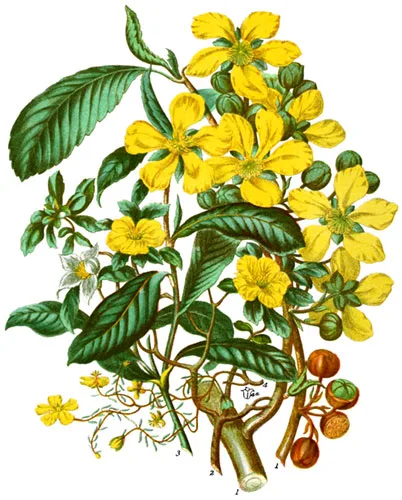
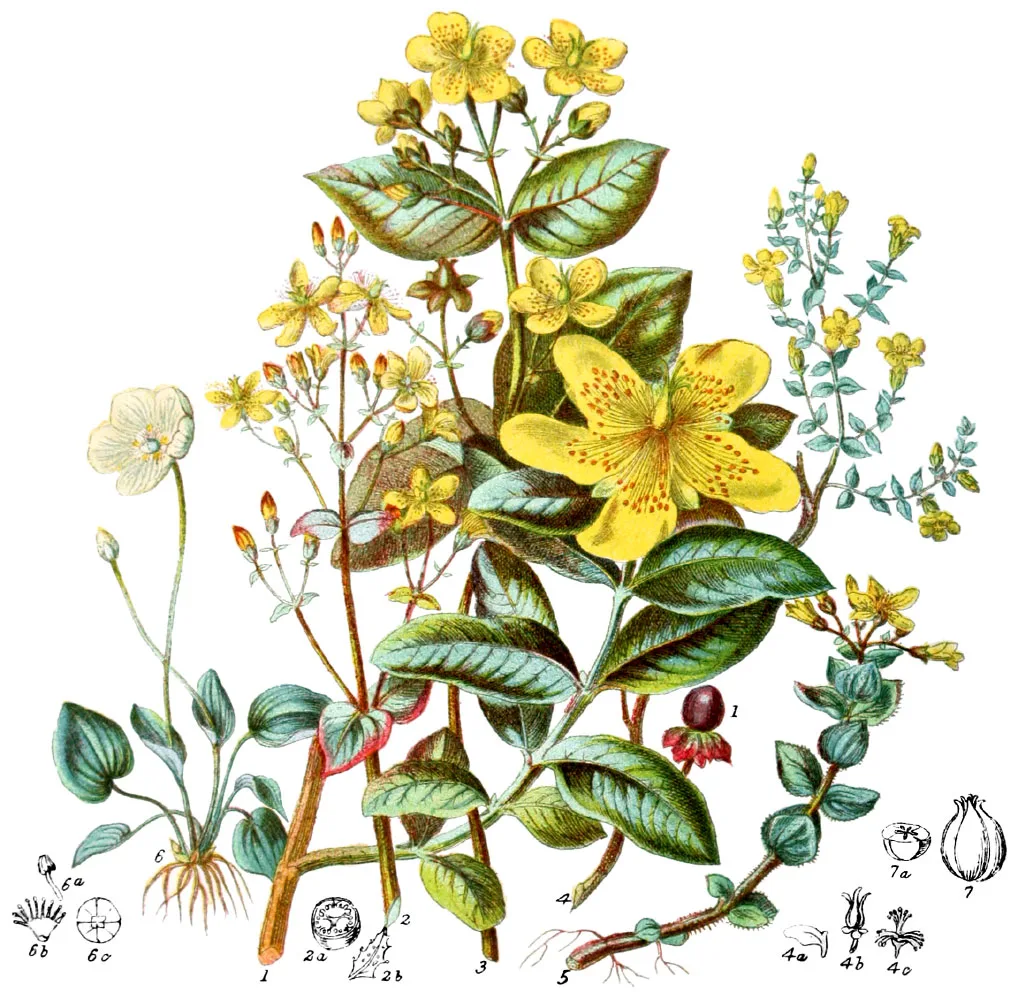
图中植物与部位
- 1. Hypericum calycinum , Large-flowered St. John’s Wort Ireland
-
2.
Hypericum pulchrum
, Upright St. John’s Wort England
- 2a. Cross section of Seed-vessel
- 2b. Sepal of Calyx, magnified
- 3. Androsæmum officinale , Tutsan England
-
4.
Hypericum ægyptiacum
, Egyptian St. John’s Wort Egypt
- 4a. Petal
- 4b. Pistils
- 4c. Stamens
- 5. Hpericum elodes , Marsh St. John&rsquo's Wort England
-
6.
Parnassia palustris
, Grass of Parnassus England
- 6a. Stamen
- 6b. Nectary
- 6c. Ovary
-
7.
Capsule of Vismia guianensis
- 7a. Cross-section of Capsule
关于本图版
本图选自伊丽莎白·特温宁的《植物自然目》(Natural Orders of plants),原书 1849 年出版。原书题作“Hypericaceæ”。此类图版是当时记录物种形态的主要方式。
该合集全编共 160 幅图版,此图为其中之一,图版编号 Order 33,对应原书第 33 页,画面接近方形,设色以橙黄为基调。图像自原件扫描修复,构图与设色未经改动,授权方式见页面下方。
原书文字(英文 / 法文)
Key characteristics
Trees, shrubs, herbaceous and annual plants, having a resinous juice, and often with angular branches. The leaves are opposite, entire, without stipules, occasionally alternate, sometimes notched at the edges, usually impressed with transparent dots, and bordered with dark glands. In almost every instance, the flowers are yellow, the rest red or white; the form of inflorescence is various, though the flowers are regular. The calyx has four or five sepals free from the ovary, two exterior, three within, either separate or partially united. The petals are of the same number as the sepals, unequal sided, twisted spirally in the bud, sometimes bordered with black dots, and often having a fleshy scale or hollow at their base. The stamens are numerous, growing from the base of the pistil, either distinct or united into one, or generally many sets; the filaments are slender, the anthers two-celled, opening lengthwise, frequently surrounded by a gland. Small fleshy glands are in some species placed between the sets of stamens as in Parnassia and others. The carpels are three or five, partly united around an axis, the styles are of the same number, usually distinct, but occasionally cohering to the base. The stigmas are capitate or truncate, rarely two-lobed. The fruit is sometimes one-celled, but seeds are minute, usually tapering at the point.
The unequal sided petals, and dark glands upon their edges, and the stamens united in sets, are the chief distinguishing points of recognition in this Order.
An essential oil is contained in the glands of Hypericum resembling those of the Orange tribe; a yellow juice in other parts of the plant, as well as some points of structure, connect this tribe with Clusiaceæ.
Select plants in this order
Not all plants listed are illustrated and not all plants illustrated are listed.
- The different species of Hypericum are chiefly small undershrubs; a few which grow in the woods and hedges of England and other countries of Europe to are herbaceous. Some are of much beauty and delicacy, the border of round glands giving a peculiar ornament to the delicate flowers.
- Hypericum calycinum (1) is a well-known evergreen plant in shrubberies, where it spreads over the ground, flourishing well under the shade of trees, and producing abundantly its bright golden flowers during the summer.
- H. pulchrum (2) is an elegant species, frequent in the woods or healthy places, on a clay soil.
- H. performatum, a British species, is also a native of France and Germany; it was formerly valued by the peasants as a charm against storms and other dangers. In Scotland it was considered a preservative against witchcraft; and if gathered on the even of St. John, was supposed by the imaginative to be endued with peculiar power. its more real properties consist in dyeing wood of a yellow colour, and in the flowers imparting a fine purple hue to spirits and oil; it was also used as a healing balsam in the olden time. This is one of our British plants which is also found on the Himalaya.
- The bruised seed-vessels and the leaves of Androsæmum officinale (3) have long been reputed beneficial for slight wounds in France, where the plant is still called Toute-saine, whence the common English name Tutsan was derived. The fruit of this species is pulpy, and has the appearance of a berry. This is almost entirely an European species, but has been seen in Greece.
- Parnassia palustris (6), said to have been discovered on Mount Parnassus, is one of the most delicately beautiful of our marsh plants, and does not appear to be surpassed by any other species; that of Carolina has a larger flower, but is of a greener colour, and the nectaries are crowned by only three glands each.
- Elodea has also bundles of glands between the stamens.
- Elodea virginica is a medicinal plant of the United States.
- Vismia guianensis (7) yields a copious yellow gum, known as gummy gutta, Vismia micrantha and V. laccifera of Brazil contain a gum resin similar to gamboge.
- The leaves of Hypericum laxiusculum are supposed to afford a remedy against the bite of serpents in Brazil.
- Cratoxylon is also used medicinally.
- Ascyrum is a North American genus of evergreen shrubs.
Locations
The plants of this Tribe are very widely spread over the earth, on mountains and in valleys, in meadows and on heaths, marshes and dry plains. North America possesses the largest number of species; in South America about half the number have been found; to Asia belong several species of arborescent shrubs, growing in the south of India, and others are scattered over the Himalaya.
Legend
- Hypericum calycinum, Large-flowered St. John’s Wort. Ireland.
- Hypericum pulchrum, Upright St. John’s Wort. England.
- Cross section of Seed-vessel.
- Sepal of Calyx, magnified.
- Androsæmum officianale, Tutsan. England.
- Pulpy Capsule.*
- Hypericum ægyptiacum, Egyptian St. John’s Wort. Egypt.
- Petal.
- Pistils.
- Stamen.
- Hypericum elodes, Marsh St. John’s Wort. England.
- Parnassia palustris, Grass of Parnassus. England.
- Stamen.
- Nectary.
- Ovary.
- Capsule of Vismia Guianensis.
- Cross-section of Capsule.
本图涉及的植物
- Hypericum calcycinum
- Hypericum pulchrum
- Androsæmum officinale
- Hypericum ægyptiacum
- Hypericum elodes
- Parnassia palustris
- Vismia guianensis
属索引
- Androsæmum
- Ascyrum
- Cratoxylon
- Elodea
- Hypericum
- Parnassia
- Vismia