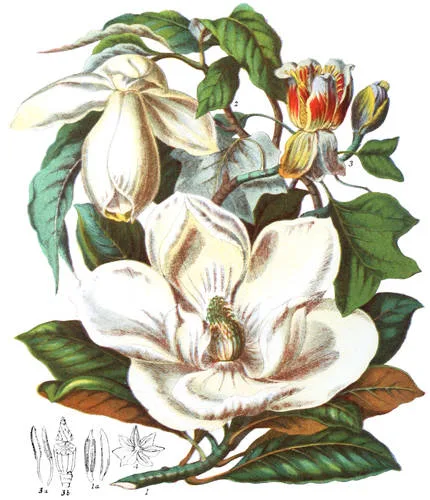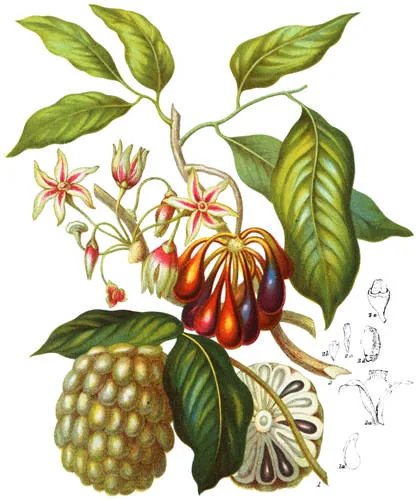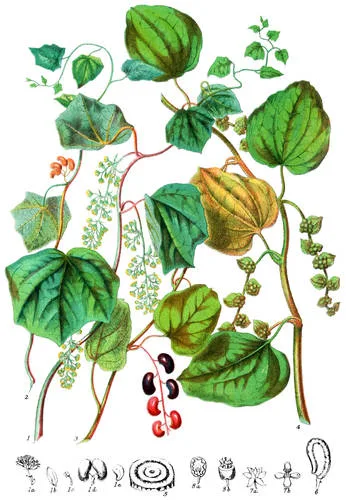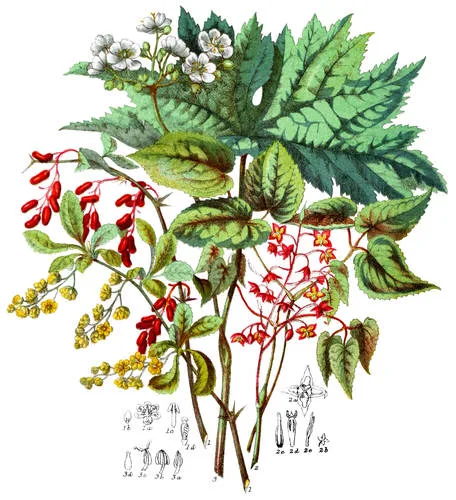
Lauraceæ
Lauraceæ
The Laurel Tribe
- 合集
- 植物自然目
- 绘者
- Elizabeth Twining(伊丽莎白·特温宁)
- 年代
- 1868
- 图版号
- Order 116
- 原书页码
- p.116
- 主色
- 绿
- 授权
- CC BY-SA 4.0
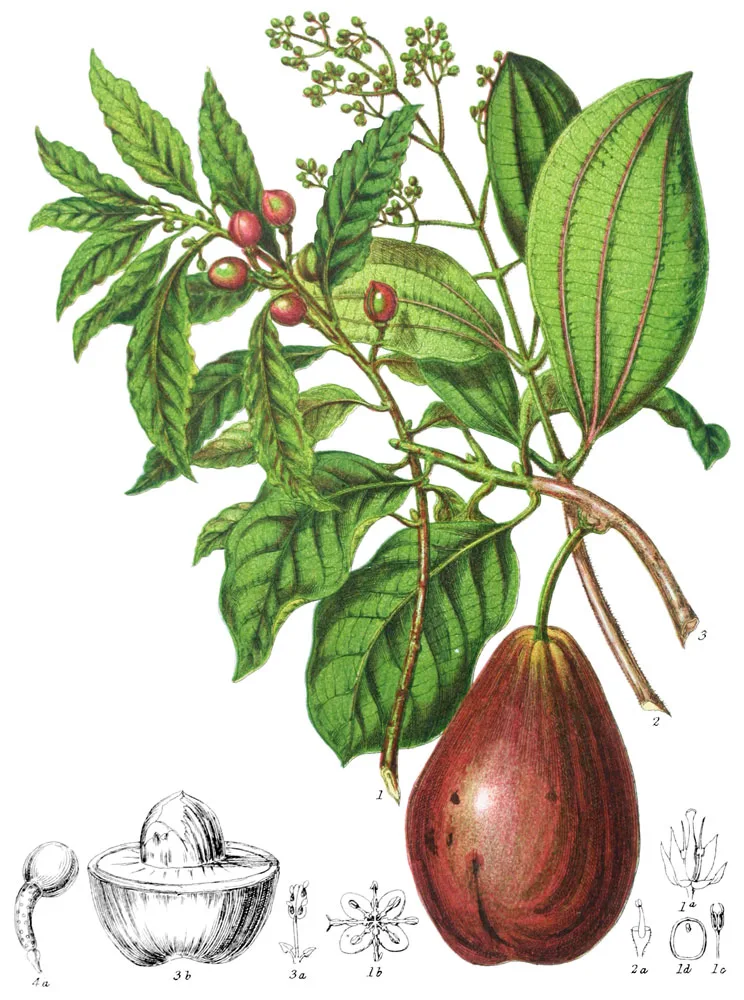
图中植物与部位
-
1.
Laurus nobilis
, Sweet Bay Italy
- 1a. Pistil Flower
- 1b. Stamen Flower
- 1c. Stamen
- 1d. Section of Seed
-
2.
Cinnamonum javanicum
, Japanese Cinnamon Java
- 2a. Pistil
-
3.
Persea gratissima
, Avocado Pear West Indies
- 3a. Stamen
- 3b. Section of Fruit
-
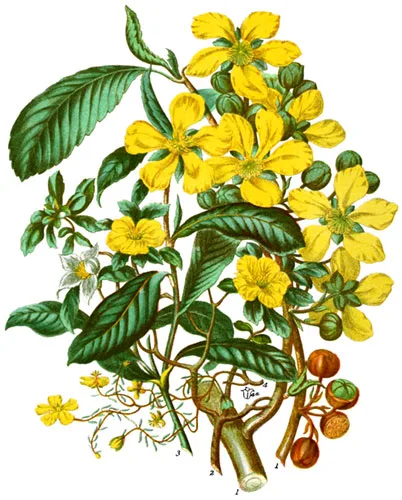
- 4a. Dehaasia media , Fruit on enlarged Stalk Java
关于本图版
本图选自伊丽莎白·特温宁的《植物自然目》(Natural Orders of plants),原书 1849 年出版。原书题作“Lauraceæ”。原书为这一物种留下了成幅的彩色图像记录。
该合集全编共 160 幅图版,此图为其中之一,图版编号 Order 116,对应原书第 116 页,版式为纵幅,整幅以绿为主调。图像自原件扫描修复,构图与设色未经改动,授权方式见页面下方。
原书文字(英文 / 法文)
Key characteristics
Trees, some of which are of large size. The leaves are alternate, seldom opposite, entire at the edges, or rarely lobed, without stipules. The flowers are small, and grow in panicles or umbels, or small cluster. The clayx is four to six-cleft, petals are wanting; sometimes the stamens and pistil are not perfect in the same flowers. The stamens are of definite number, placed on the calyx, usually twice as many as its segments, and opposite to them. The three innermost stamens are imperfect; the six outer have perfect anthers, which are two to four-celled, the cells bursting by a long persistent valve, opening upwards. The inner filaments usually have glands at their base. The ovary is above the calyx, one-celled, with a simple style, and stigma, either obtuse or two or three-lobed. The fruit is either a berry or a drupe, naked or covered, its stalk often becoming enlarged (4). The seed has no albumen.
This Tribe is chiefly distinguished from Thymelaceæ and others by the reflexed valves of the anthers.
Aromatic properties, oil and camphor, exist abundantly in these trees.
Select plants in this order
Not all plants listed are illustrated and not all plants illustrated are listed.
- Laurus, derived from the Celtic laur, green, is a genus with evergreen leaves, existing in the East and West Indies, and more abundantly in North America. It yields valuable timber in its largest trees, aromatic oil, spice, camphor, and a delicious fruit.
- L. nobilis (1), the only European species, was selected in ancient times as an appropriate plant for garlands to adorn heroes and sages: it was consecrated to the service of priests, and used by them in their sacrifices. The leaves contain aromatic oil, and a small portion of prussic acid, which gives them medicinal power; the fruit when boiled yields also oil. In the southern parts of Hampshire, the Bay grows luxuriantly, and bears a plentiful crop of fruit; but in Italy it attains greater height, becoming a tree.
- L. indica, the Royal Bay, is a native of Madeira and the Canaries, and affords a useful wood for furniture.
- L. chloroxylon, the Cog-wood tree of Jamaica, is sixty feet high; the wood is hard and tough, well adapted for the construction of sugar-mills.
- One of the most valuable spices is Cinnamon, the inner bark of several trees of this tribe: Cinnamomum javanicum (2) abounds in Java and the neighbouring isles. In Ceylon, the trees of that produce it are so common, that the wood is used for fuel and various purposes. Twice in the year the young branches are cut, the outer bark is scraped off, the thin inner layer carefully loosened. On being exposed to the sun, it curls up into the form we receive it in. The trees have a stunted appearance, not being allowed to grow above nine feet: the delicious scent is not perceptible until the branches are cut, as it is contained in the internal portion of the bark.
- Cassia bark has nearly similar properties, but is not so fragrant. The Chinese Cassia comes from Cinnamomum Cassia.
- The Clove-cassia of Brazil is the bark of Dicypellium caryophyllatum, one of the noblest trees of this tribe as described by Martius.
- Persea gratissima (3) is the only eatable fruit; in the West Indies, it is called Avocado, or Alligator Pear; the pulp is of a sweet, agreeable flavour, but Europeans think it so rich as to require the addition of some kind of spice or wine. By the negroes it is considered their chief delicacy, and it is eaten by every animal or bird; the large seed is enveloped in a thin membranous coat.
- Camphor, a concrete state of oil, is a frequent secretion of this tribe; a large supply is obtained from all parts of Camphora officinarum, which grows plentifully in the Island of Formsa, and being taken in junks to Canton is dispersed thence to various countries.
- Sassafras officinarum, a large tree of North America, yields an aromatic oil from its berries, and the tonic bark is used medicinally.
- Benzoin odoriferum has similar properties.
- Some of the fruits bear a resemblance to the true Nutmeg, but are of inferior quality.
- The Clove-nutmegs of Madagascar are produced by Agathophyllum aromaticum; the Brazilian Nutmegs by Cryptocarya moschata.
- The fruit of Acrodiclidium, or Camara-nutmeg, is highly esteemed in Guiana for its medicinal properties.
- Among the fever and ague remedies of Guiana, Nectandra Rodiæi, the Bibiri, is considered the best; the wood, celebrated for its hardness, is known as the Greenheart of Demerara.
- Oreodaphne is remarkable for a hard yellow wood, with a very disagreeable odour.
- There occurs frequently one exception in a tribe, which seems to make a link with other plants of a very different manner of growth and appearance: Cassytha is an example of such a variation from the chief type. It is a slender cord-like leafless plant, resembling most nearly Dodder, and, like that parasitic, bearing small flowers with round white fruit. The structure of the flower, more especially of the stamens with recurved anther-valves, is precisely that of Laurels; but the fruit differs in being enclosed in the calyx, and becoming a berry. Although not fully conformable to any known Order, it appears to be most rightly placed here.
Locations
This extensive Tribe inhabits cool situations in the Tropics; a few species are found in Madeira, Teneriffe, and Madagascar; a very few advance northwards into North America; scarcely any exist in Africa; one only in Southern Europe. Cassytha belongs to the Tropics.
Legend
- Laurus nobilis, Sweet Bay. Italy.
- Pistil Flower.
- Stamen Flower.
- Stamen.
- Section of Seed.
- Cinnamomum javnicum, Japanese Cinnamon. Java
- Pistil.
- Persea gratissima, Avocado Pear. West Indies.
- Stamen.
- Section of Fruit.
-
- Dehaasia media. Fruit on enlarged Stalk. Java.
十二观
- 实测花色 红、橙黄
- 纵幅 1.34∶1
- 含 4 个物种
- 11 处解剖图
- 1868 年刊
- Order 116
这不是词条,是一条看画的次序:先站定看整体,再看名字与形色、构图与刀工,然后问它几时开、从哪里来、经了谁的手;最后是中国诗文——同一朵花,中国古人是怎么看的。十二观读完,这幅图就打开了。
-
第一眼
搜尽奇峰打草稿。
—— 清·石涛《苦瓜和尚画语录》
走遍山川,才有资格落笔。博物画的画家也一样:先在温室与山野里看够了活的花,纸上那一朵才不虚。这一幅是竖的:眼睛从下往上走,落点在上半部。先让整株立起来,再看细节。第二步凑近一寸:主线之外另有 11 处解剖小图——那是画家怕你看不清,替你把花剖开了。第三步,找绿色最重的一小块:整幅的明暗秩序,是从那里排开的。
-
名与实
此幅未见可靠的学名,只能以原书题名相称——早期图谱里这种情形并不少见。此幅既无通行中文名,学名也不可靠,只能以原书题名相称——图谱里总有几幅这样的图,只能靠画面本身说话。
-
形与色
就这一幅实测:花色占画面的 12.9%,叶色 29.4%,主相是红、辅以橙黄。这个比例与色相,是这一幅独有的。此图为一幅博物插画:一株植物被从山野或温室中取出,安置在纸的中央,根、茎、叶、花、果依次交代,务求可辨、可据、可传。此幅以绿为主,绿近嫩苔,是花萼与叶的主色。这一路颜色多来自叶、萼与枝,花只占很小一块——图谱的次序向来如此:先立植株,再点花色。别只看花:叶脉的走向、萼片的长短、甚至茎上的毛,都是画家用来区分物种的证据。
-
构图与呼吸
画幅高而窄,主株一路向上,上下留白多,是图谱中最常见的立轴式构图。(高宽比约 1.34∶1)另附 11 处局部解剖,主体与细部互为注脚。这一幅排得满:枝叶占到画面的 47%,重心略偏右——标本式的画法,图的是看得全。空白不是没画完,是给眼睛留的落脚处:一张图若四边都塞满,花反而会闷。
-
一刀一色
十九世纪后半叶,石版与彩色石印渐成主流:颜色可以直接印出,不再依赖手工,线条反倒退居其次。图像的“准确”提高了,手性却淡了。拿放大镜(或手机微距)看三处:花瓣边缘、叶脉、题名。线若连续不断,是刻的;色若越过轮廓半毫米,是手涂的。
-
时序
图版多标花期,因花期是植物一年中最容易被辨认的十余日;其余月份,它只是一丛叶。图上所记的 1868 年是刊行之年,不是花期;真正的花藏在原书的采集记录里,通常比出版早一两年。同一株植物,春天与秋天看起来像两种东西;图谱选花期,是因为那时它最不容易认错。
-
故土
来源不一,或本地山野,或远洋引种。十九世纪的植物园与温室,是这些植物离开故土后的第一个住所。产地写在图上的,往往是“据说来自”;真正的野外记录,要等采集人回来才敢落笔。
-
书与人
《植物自然目》(Natural Orders of plants)由伊丽莎白·特温宁绘,成于1849。此幅为其中Order 116,见原书第 116 页。一本书的“作者”常常是主编;真正决定这幅图好不好看的,是没留下名字的刻工与上色人。
-
诗境
朝饮木兰之坠露兮,夕餐秋菊之落英。
—— 战国·屈原《离骚》
中国文学里最早的一顿“花食”:露与英都可入口,草木与人从此不分彼此。图上那些解剖小图,正可作这句诗的注脚:花不只在枝头,也在剖面里。
-
文心
六法者何?一、气韵生动是也;二、骨法用笔是也;三、应物象形是也;四、随类赋彩是也;五、经营位置是也;六、传移模写是也。
—— 南齐·谢赫《古画品录》
一千五百年前,谢赫给了六条看画的标准:气韵、用笔、形似、设色、构图、临摹。前五条今天仍然管用——在这幅图版上一样样对过去,就是一次完整的读画。中国有《本草纲目》《植物名实图考》,欧洲有从《本草》插图到彩色石印的谱系;两条传统都相信:图能补文字的不足。中外的分别不在谁高明,而在问的问题不同:欧洲问它是什么,中国问它像谁。两个问题都答了,一幅图才算读完。
-
花语
博物画的象征不在花语,而在“记录”本身:它相信一株植物值得被准确画下,这份信念是科学时代最朴素的道德。象征会随世道改口:同一株植物,在一个世纪里可以说完全相反的话。
-
带走一双眼睛
下次去公园,找一株开着的花站三分钟:看叶怎么排、花朝哪个方向开、最深的一块色在哪。三分钟之后,你已经会看这一类的图了。二百年后,这株植物的后代或许仍在某处活着;而纸上这一株,永远停在 1868 年的那个季节。
本图涉及的植物
- Laurus nobilis
- Cinnamomum javanicum
- Persea gratissima
- Dehaasia media
属索引
- Acrodiclidium
- Agathophyllum
- Benzoin
- Camphora
- Cassytha
- Cinnamomum
- Cryptocarya
- Dicypellium
- Laurus
- Nectandra
- Oreodaphne
- Persea
- Sassafras