Myristicaceæ
Myristicaceæ
The Nutmeg Tribe
- 合集
- 植物自然目
- 绘者
- Elizabeth Twining(伊丽莎白·特温宁)
- 年代
- 1868
- 图版号
- Order 117
- 原书页码
- p.117
- 主色
- 绿
- 授权
- CC BY-SA 4.0
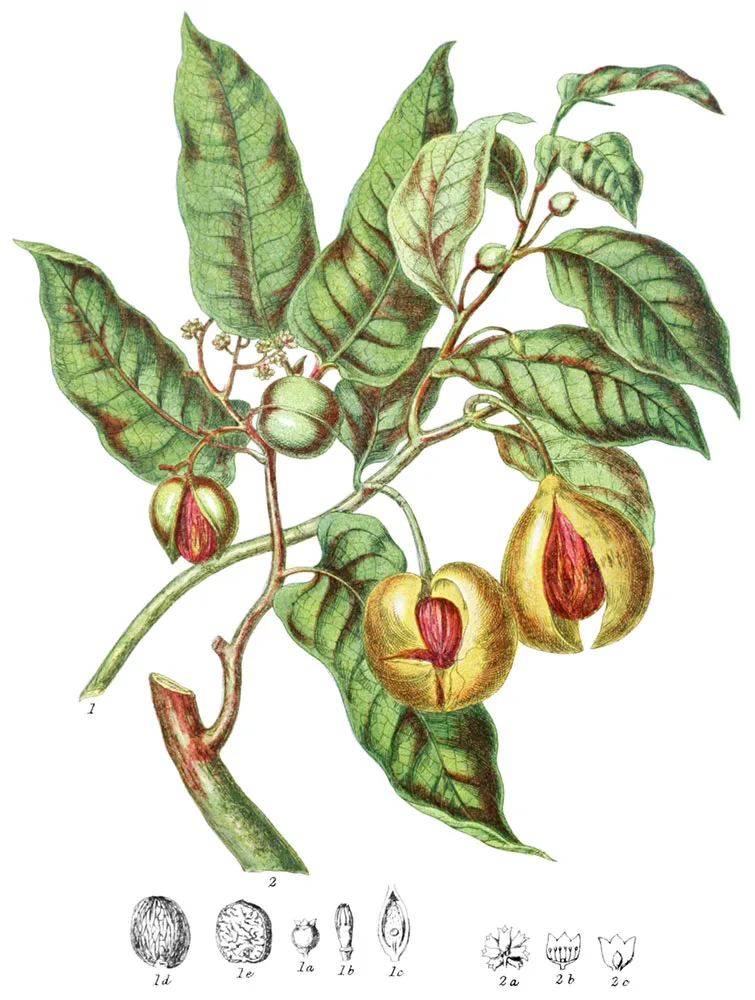
图中植物与部位
-
1.
Myristica moschata
, Common Nutmeg Tropics of Asia
- 1a. Flower
- 1b. Stamens
- 1c. Section of Ovary
- 1d. Nutmeg
- 1e. Section
-
2.
Virola sebifera
, Oily Virola Guiana
- 2a. Cluster of Flowers
- 2b. Stamen Flower
- 2c. Pistil Flower
关于本图版
这幅图版出自《植物自然目》(Natural Orders of plants),由伊丽莎白·特温宁绘制,1849 年出版。原书题作“Myristicaceæ”。这是该物种在早期博物学出版物中的图像记录之一。
全编共收录 160 幅图版,本图是其中一幅,原书将其列为 Order 117,见第 117 页,版式为纵幅,画面以绿为主色。此图由原件扫描修复而成,使用时请遵循页面标注的授权条款。
原书文字(英文 / 法文)
Key characteristics
Tropical trees, often containing a red juice, the leaves are alternate, without stipules, not dotted, entire at the edges, stalked and leathery. The flowers are small, and grow from the base of the leaf-stalk, or on terminal branches, panicles. A short folded bract is at the base of the flower; the calyx is leathery, usually downy, three or four notched. The stamens and pistil are in separate flowers, the filaments of the stamens are either distinct or united in a cylinder; the anthers are from three to twelve, two-celled, turned outwards, bursting lengthwise, either united or distinct. The carpels are solitary or many, with a single ovule. The style is very short, the stigma lobed. The fruit is a berry, containing a nut enveloped in an arillus. The seed contains slightly fleshy albumen.
This Tribe has affinity with Lauraceæ and Proteaceæ, but is distinguished by the structure of the anthers and fruit.
Select plants in this order
Not all plants listed are illustrated and not all plants illustrated are listed.
- Myristica is said to be derived from the Greek for myrrh, in allusion to the aromatic flavour of the fruit.
- Nutmeg trees, Myristica moschata (1), were first cultivated by the Dutch in the island of Banda, but they soon became dispersed throughout the Eastern and Western Tropics, wherever colonies were established by French or English settlers. In the Moluccas and in Sumatra extensive plantations were formed; in the West Indies Trinidad was found to be very favourable for their growth, and in the last tropical territory acquired by English intrepidity and influence, now being subdued by skilful cultivation, in the Sarawak district of the vast island of Borneo, the Nutmeg is considered one of the most valuable objects of attention, and will probably be one of the chief branches of that opening commerce destined to contribute largely to the civilization of the country. The peculiarity of the fruit, which would otherwise be a simple drupe, is the aril or tough leathery covering of the nut, within the fleshy coat of the exterior. Thi aril, when taken out and dried, is known as a mace, a spice of considerable importance for culinary purposes, especially in all hot countries where food requires to be highly seasoned. The nut, or Nutmeg, containing an essential oil of fragrant aromatic odour, and medicinal properties, has a thin black coat, wrinkled by the impression of the aril, also an inner skin which adheres closely to the kernel: it is usually employed in a powdered state, both as a condiment and as a medicine. When the fruit is ripe it splits open, showing the red aril within.
- M. fatua is a native of Surinam, with long drooping branches, bearing an oblong fruit, from the kernel of which is extracted a yello fatty substance used for candles and other purposes of domestic economy; the fragrance of this species is very slight. The bark of this and other species yields an acrid red juice.
- M. sphærocarpa of Martaban has a small round fruit of bright red colour, with a pale nut within, which, as well as its aril, are aromatic; the fleshy portion of the fruit is acid and astringent.
- M. amygdalina of the same country is nearly similar.
- Virola sebifera (2), a tree fo South America, abounds on the borders of forests and hills in Cayenne and Guiana, it attains to 60 feet in height with a top composed of thick twisting branches; the leaves when young are clothed on the under surface with a rusty down. The kernel yields a yellow oily material for making soap and candles, and various uses; the red juice which exudes from the bark wherever incisions are made, is said to be a preservative for the teeth.
- Pyrrhosa tingens of Amboyna has a mace full of red mucilaginous juice, which, when mixed with lime, is used as a pigment.
- The red juice collected from the trunc of Myristica spuria is called Dooghan in the Philippines, and used as a substitute for Dragon’s Blood.
- Hyalostemma differs from the true type of this Order in having no aril to the fruit; its numerous carpels make it a kind of link with the Custard-apple Tribe.
Locations
This Tribe inhabits exclusively the Tropics of Asia and America, and is most abundant in India.
Legend
- Myristica moschata, Common Nutmeg. Tropics of Asia.
- Flower.
- Stamens.
- Section of Ovary.
- Nutmeg.
- Section.
- Virola sebifera, Oily Virola. Guiana.
- Cluster of Flowers.
- Stamen Flower.
- Pistil Flower.
本图涉及的植物
- Myristica moschata
- Virola sebifera
属索引
- Hyalostemma
- Myristica
- Pyrrhosa
- Virola