Linaceæ
Linaceæ
The Flax Tribe
- 合集
- 植物自然目
- 绘者
- Elizabeth Twining(伊丽莎白·特温宁)
- 年代
- 1868
- 图版号
- Order 21
- 原书页码
- p.21
- 授权
- CC BY-SA 4.0
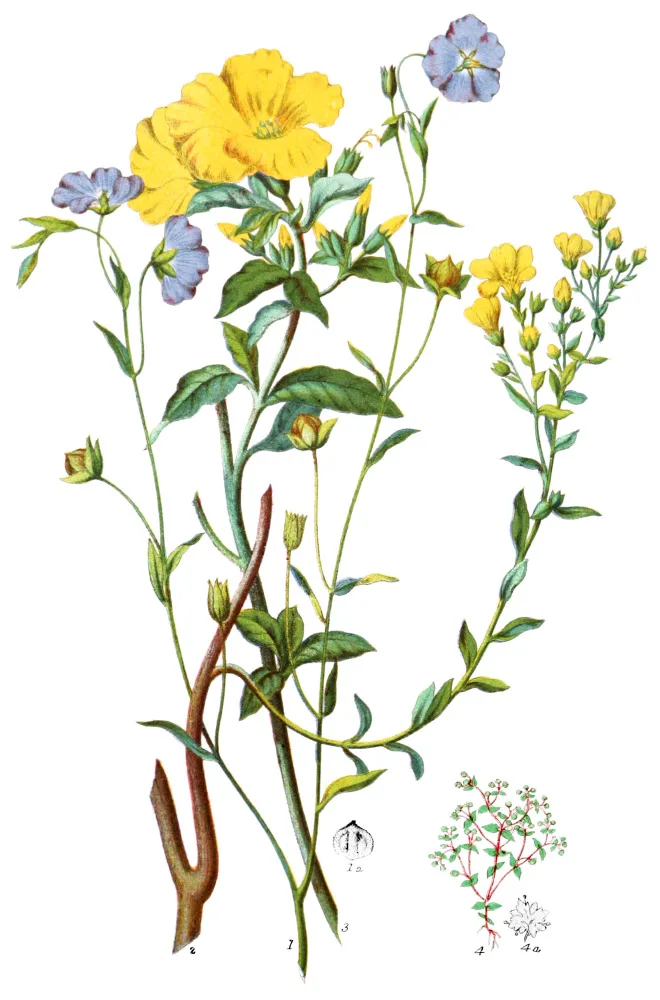
图中植物与部位
-
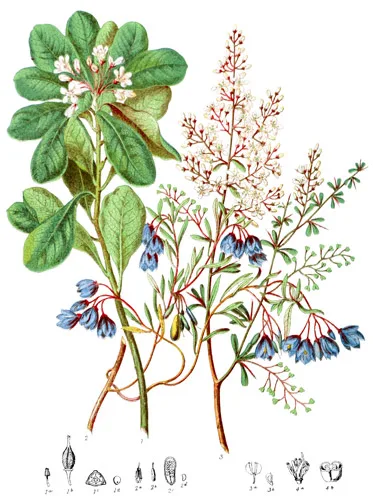
1.
Linum usitatissimum
, Common Flax England
- 1a. Capsule
- 2. Linum Africanum , African Flax Cape of Good Hope
- 3. Linum trigynum , Three-styled Flax East India
-
4.
Radiola millegrana
, Allseed England
- 4a. Flower magnified
关于本图版
本图选自伊丽莎白·特温宁的《植物自然目》(Natural Orders of plants),原书 1849 年出版。原书题作“Linaceæ”。原书为这一物种留下了成幅的彩色图像记录。
该合集全编共 160 幅图版,此图为其中之一,图版编号 Order 21,对应原书第 21 页,版式为纵幅。图像自原件扫描修复,构图与设色未经改动,授权方式见页面下方。
原书文字(英文 / 法文)
Key characteristics
Annual and perennial herbaceous plants, and a few small shrubs. The leaves are either alternate or opposite, rarely growing in whorls, simple, entire, and without stipules, sometimes with a pair of glands. The calyx is composed of three, four, or five sepals, continuous with flower-stalk, and remaining after the petals are fallen off; the petals are of the same number as the sepals, have a claw at their base, and are twisted in the bud state. The stamens are placed alternately with the petals, and are united at their base in a ring, from which proceed small teeth opposite to the petals, indicating imperfect stamens; the anthers are ovate; the ovary has about as many cells as sepals, seldom fewer; the styles equal the number of the cells, an have round-headed stigmas; the capsule is generally pointed with the hardened base of the styles, and opens by two valves from the top; it contains many cells, completely or partially divided by an imperfect partition, each cell has a single compressed polished seed within.
The chief characteristic of the Flax tribe are the tenacity of the fibre, the oil of the seed, and the mucilage of its covering.
Select plants in this order
Not all plants listed are illustrated and not all plants illustrated are listed.
- Linum derives its name from the old Celtic word Llin, signifying thread; the tenacious and delicate fibre of Linum usitatissimum (1) is well known as Flax, and has been cultivated and made into linen from the most remote antiquity. In Egypt flax-seed was sown on land annually inundated by the waters of the Nile, which was very favourable for its growth; line was made and used plentifully by the ancient Egyptians; the wrappings of mummies have been ascertained to be invariably of linen cloth. The Hebrews were early acquainted with the art of making fine linen. Flax is cultivated throughout India, but the natives prefer Hibiscus cannabinus and other plants, for the sake of the fibrous thread, employing only the mucilage and oil of the seeds of Linum. The period of the introduction of Flax into Britain is unknown, but it is now become indigenous, and is grown to some extent in Ireland. After it is pulled, and has been steeped in water during several days, the fibrous part separates from the stalk, it is then dried in the sun before being further prepared for use: the water in which Flax has been soaked is rendered injurious to cattle, on which account the practice of steeping it in any running stream or common pond was forbidden by Act of Parliament in the reign of Henry VIII. The fibres of Flax are spun and wrought into the strongest kind of linen, and are also capable of extreme attenuation for the most delicate cambric: at Cambrai in France, where the art of manufacturing fine cambric was first practised, it is still the custom to weave it in damp cellars, in order to prevent the breaking of the slender thread, which would occur in a dry atmosphere. The seeds yield by pressure a valuable oil, which is much used in painting and varnishing, and also in medicine; the mucilaginous portion that remains affords a very nutritious food for cattle.
- Linum selaginoides is considered medicinal in Peru, and Linum catharticum, a native of Britain, with small white flowers, is also used in medicine.
- Linum perenne and other species are ornamental in gardens; the flowers of all are fugitive, but generally of bright colour and delicate texture.
- Radiola millegrana, allseed (4), is a small plant occasionally found on commons where the turf has been pared off, as on Esher Common, Surrey; its slender stem is repeatedly forked, having small ovate leaves in pairs; the minute white flowers grow from the divisions and the tops of the branches.
Locations
The principle portion of this Tribe is found in Europe and the North of Africa, but a few species are scattered more or less over most parts of the World. Several are natives of North and South America, a few belong to the mountains of India, one is known in New Zealand, none have yet been discovered in New Holland; the most northern limit of the tribe is at 54° N. lat. in North America.
Legend
- Linum usitatissimum, Common Flax. England.
- Capsule.
- Linum Africanum, African Flax. Cape of Good Hope.
- Linum trigynum, Three-style Flax. East India.
- Radiola millegrana, Allseed. England.
- Flower magnified.
本图涉及的植物
- Linum usitatissimum
- Linum trigynum
- Linum africanum
- Radiola millegrana
属索引
- Linum
- Radiola