Passifloraceæ
Passifloraceæ
The Passion-Flower Tribe
- 合集
- 植物自然目
- 绘者
- Elizabeth Twining(伊丽莎白·特温宁)
- 年代
- 1868
- 图版号
- Order 14
- 原书页码
- p.14
- 主色
- 红
- 授权
- CC BY-SA 4.0
图中植物与部位
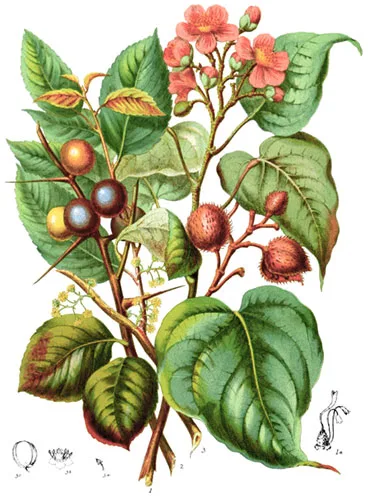
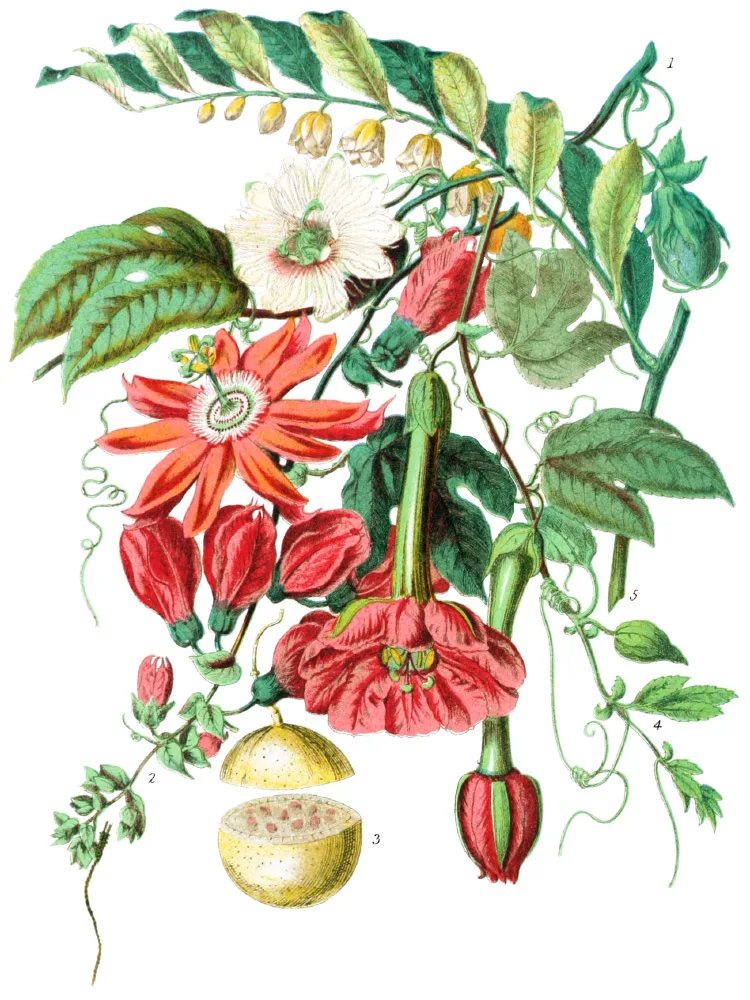
- 1. Passiflora edulis , Eatable-fruited Passion-flower West Indies
- 2. Passiflora racemosa , Racemose Passion-flower Brazil
- 3. Passiflora maliformis , Sweet Calabash, Fruit West Indies
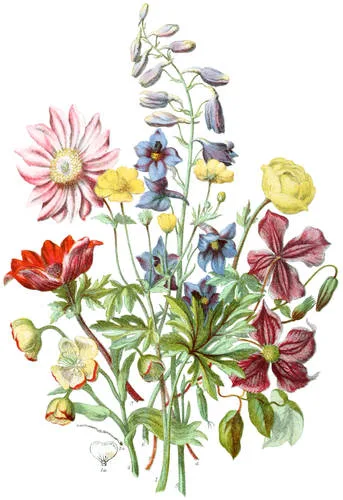
- 4. Tacsonia mollissima , Downy Tacsonia Santa Fé de Bogota
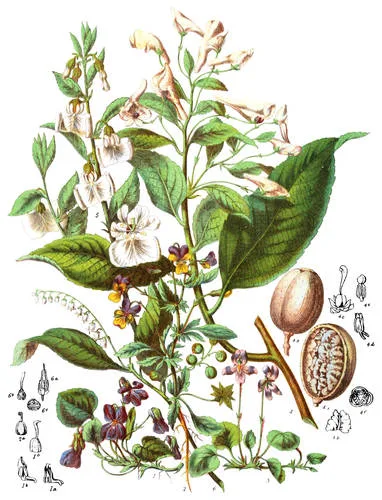
- 5. Smeathmannia lævigata , Smooth-leaved Smeathmannia Sierra Leone
关于本图版
《植物自然目》(Natural Orders of plants)由伊丽莎白·特温宁绘制,1849 年印行,本图即其中一幅。原书题作“Passifloraceæ”。原书为这一物种留下了成幅的彩色图像记录。
该合集全编共 160 幅图版,此图为其中之一,图版编号 Order 14,对应原书第 14 页,版式为纵幅,整幅以红为主调。图像自原件扫描修复,构图与设色未经改动,授权方式见页面下方。
原书文字(英文 / 法文)
Key characteristics
Herbaceous plants or shrubs, usually of a climbing habit, very seldom erect. The leaves are alternate, with foliaceous stipules, the leaf-stalks usually having glands. The flowers grow either from the base of the leaf-stalk, or at the ends of the branches; they often have a three-leaved involucre immediately beneath them, which falls off before the flower expands. The calyx has generally five sepals, sometimes of irregular form, the inner surface usually coloured, and formed in appearance a part of the flower itself; the lower part is combined into a tube of variable length, the sides of which are lined by slender filaments. The petals are five, arising from the summit of the tube of the calyx outside the filaments; they are sometimes irregular, and sometimes wanting; in the bud state they are folded one over the other. The stamens are five, united in one set, rarely more, surrounding the stalk of the ovary; the anthers are linear, turned outwards, and bursting horizontally in two cells. The ovary is at the top fo a long stalk, and contains one cell; three styles with spreading stigmas arise from the point. The fruit is stalked, oval, containing many seeds attached to the interior by small stalks, and surrounded by a pulpy covering.
The most singular feature of this remarkable order is the filamentous coronet of rays encircling the orifice of the tubular calyx; these annular appendages appear to be of an intermediate nature, between petals and stamens.
Smeathmannia forms a connecting link with Samydaceæ, and some resemblances exist with the gourd, the caper, and the violet tribes.
Although many of these plants have wholesome fruit, yet some possess rather dangerous qualities.
Select plants in this order
Not all plants listed are illustrated and not all plants illustrated are listed.
- Passiflora was so named by its first discoverers in the forests of South America, who, being zealous Catholics, imagined they perceived, in the singular arrangement of the interior of the flower, a resemblance to those emblematical images of the Passion of Christ which they were accustomed to form. Various species abound in the woods of Brazil and other countries of South America, climbing from tree to tree in extreme profusion, adorning them with their beautiful flowers, and yeilding a refreshing fruit, sometimes of a bright purple colour.
- Passiflora edulis (1), P. maliformis (3), and several other species, produce fruit in this country, but it does not fully ripen.
- P. racemosa (2) is one of those which flower at the ends of the branches, and is of extreme beauty and elegance; upwards of fifty flowers come forth in succession on one branch: the wide keel of the calyx of this species causes the buds to appear deeply five-winged.
- P. quadrangularis, the Granadilla, has eatable fruit, but the root is powerfully narcotic, and is cultivated in the French colonies for its medicinal property, called Passiflorine.
- P. contrayerva has also a medicinal root.
- The flowers of P. rubra, in Jamaica, yield a tincture used as laudanum. The leaves of some species are employed medicinally by the Brazilians.
- Tacsonia (4) is so called from its Peruvian name, Tacso; it is one of the most graceful of climbers, growing to a vast height with great rapidity, where light and warmth are favourable; bearing numerous flowers. The fruit of this and other species of Tacsonia are eatable in South America.
- Smeathmannia lævigata (5) is an example of an erect shrub in this Tribe; it was discovered by a traveller of the name of Smeathmann, in Africa.
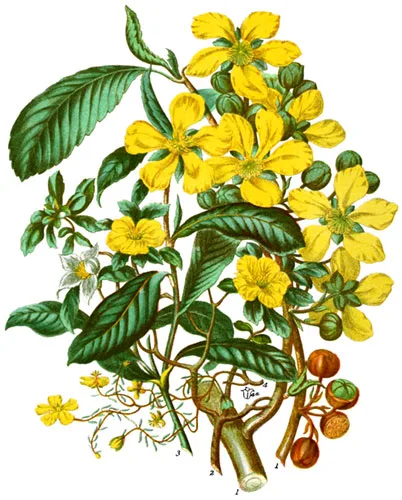
- Paropsia edulis, a Madagascar shrub, yields a wholesome fruit to the natives.
Locations
The chief station of this Tribe is South America, where the woods abound with various species; many are also found in the West Indies. One or two extend northwards in North America; several grow in Africa, and the neighbouring islands; a few have been found natives of the East Indies; Passiflora Lechanaultii on the Neelgherries, and P. Nepalensis in Nepal. One species of Passiflora extends to New Zealand. Disemma prevails in New Holland. Tacsonia seems to be confined to South America. Modecca belongs to the East Indies, Java, and the northern coast of New Holland.
Legend
- Passiflora edulis, Eatable-fruited Passion-flower. West Indies.
- Passiflora racemosa, Racemose Passion-flower. Brazil.
- Passiflora maliformis, Sweet Calabash, Fruit. West Indies.
- Tacsonia mollissima, Downy Tacosnia. Santa Fé de Bogota.
- Smeathmannia lævigata, Smooth-leaved Smeathmannia. Sierra Leone.
本图涉及的植物
- Passiflora edulis
- Passiflora racemosa
- Passiflora maliformis
- Tacsonia mollissima
- Smeathmannia lævigata
属索引
- Disemma
- Modecca
- Paropsia
- Passiflora
- Smeathmannia
- Tacsonia