Violaceæ
Violaceæ
The Violet Tribe
- 合集
- 植物自然目
- 绘者
- Elizabeth Twining(伊丽莎白·特温宁)
- 年代
- 1868
- 图版号
- Order 15
- 原书页码
- p.15
- 主色
- 绿
- 授权
- CC BY-SA 4.0
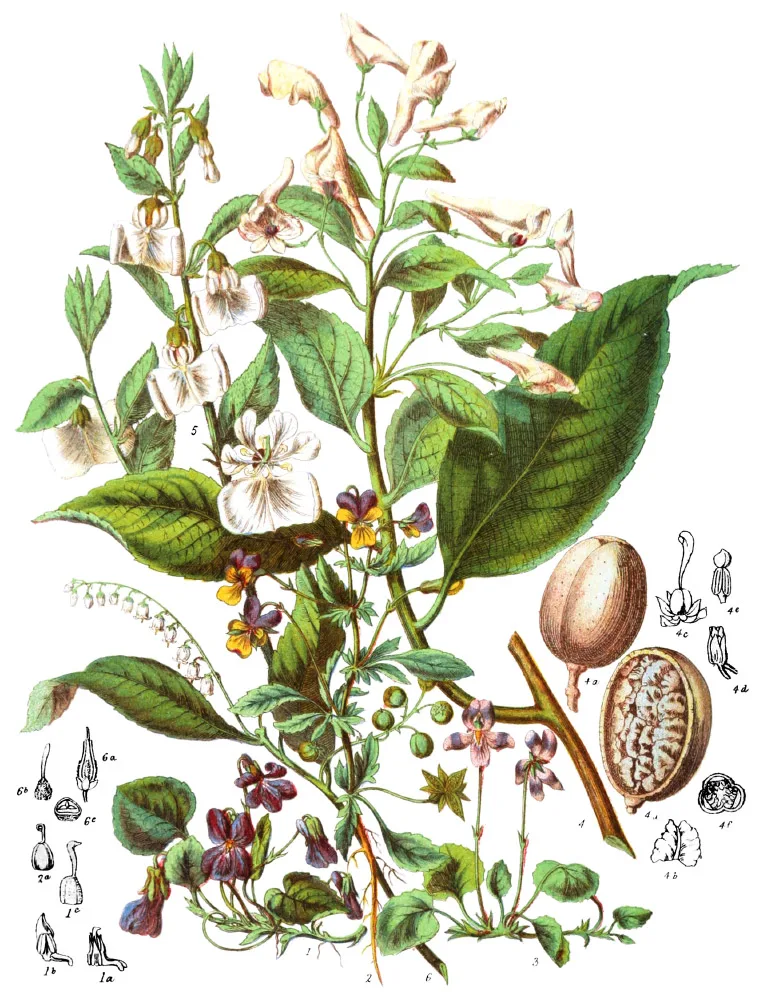
图中植物与部位
-
1.
Viola odorata
, Sweet Violet England
- 1a. Pistil and Stamens
- 1b. Stamen with appendage
- 1c. Pistil
-
2.
Viola tricolor
, Heart’s-ease England
- 2a. Pistil
- 3. Erpetion reniformis , Spurless Violet New Holland
-
4.
Corynostylis Hybanthus
- 4a. Seed-vessels
- 4b. Seed
- 4c. Pistil and Calyx
- 4d. Stamens
- 4e. Stamen
- 4f. Cross-section of Ovary
- 5. Ionidium Itoubou Guiana
-
6.
Alsodea Physiphora
Brazil
- 6a. Pistil and Stamens
- 6b. Pistil
- 6c. Cross-section of Ovary
关于本图版
此图原刊于《植物自然目》(Natural Orders of plants),绘者为伊丽莎白·特温宁,成书于 1849 年。原书题作“Violaceæ”。原书为这一物种留下了成幅的彩色图像记录。
全编共收录 160 幅图版,本图是其中一幅,原书将其列为 Order 15,见第 15 页,版式为纵幅,画面以黄绿为主色。此图由原件扫描修复而成,使用时请遵循页面标注的授权条款。
原书文字(英文 / 法文)
Key characteristics
Herbaceous plants and shrubs, the leaves of which are simple, usually alternate, sometimes opposite, having stipules at their base. The flowers are of various forms; the sepals of the calyx are five, permanent, imbricated in the bud, usually elongated at the base. The petals are five, attached to the base of the pistil, regular or irregular; one being elongated into a horn, as in the Viola odorata; of unequal size, as an Ionidium; or of equal size as in Alsodea. The stamens are five, alternate with the petals, or in a few instances opposite to them, inserted on the disk of the base of the pistil, often unequal; the anthers are two-celled, bursting inwardly, either separate or cohering, and lying close upon the ovary; the filaments are dilated, and lengthened beyond the anthers; in the irregular flowers, two of them are generally furnished with an appendage, or gland, at the base. The ovary is one-celled, many seeded, rarely with only one seed. The style is single, with an oblique, hooded stigma; the capsule has three valves, bearing the seeds on a thin plate along the centre of each: the seeds are numerous, as in Viola, or of a definite number, as in Alsodea, round or winged, often with a swelling at the base.
This Order has some affinity with Droseraceæ, and the fruit of Croynostylis connects it with the Passion-flowers; but the position of the anthers, on the middle instead of at the top of the filament, is one distinguishing mark.
The chief character of the violet tribe is the emetic property of the roots, which is very powerful in the South American species, and exists in a less degree in those of Europe.
Select plants in this order
Not all plants listed are illustrated and not all plants illustrated are listed.
- Viola odorata (1) ranks amongst the select favourites of the floral kingdom, and has been duly celebrated in all countries where it flourishes; it may be found in woods, and on sheltered banks in many parts of England, as well as on the continent of Europe; it grows also in Palestine, China, and Japan. The roots, leaves and flowers, all possess medical qualities in a slight degree; a tincture made from the flowers is a useful chemical test. Some travellers have observed the flowers to be used in making sherbet in Turkey, and it is related by ancient historians that the Romans prepared a kind of wine from them.
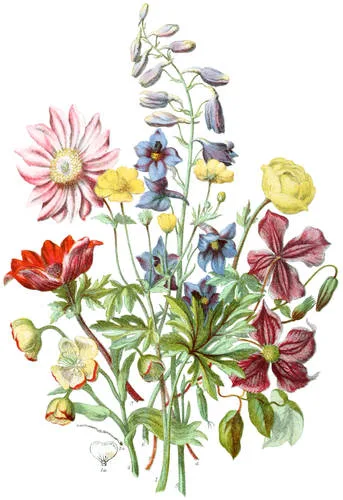
- Viola tricolor (2) in its natural state is frequently found in corn-fields; in the highly cultivated condition to which it has been brought by the skill of modern florists it is a much admired flower, but cannot be admitted in groups of natural orders.
- Viola canina is widely dispersed, and is said to be strongly medicinal.
- V. ovata is considered a remedy for the bit of rattlesnakes. The species are generally of a hearty nature; three inhabit Iceland;
- V. cheiranthifolia, a downy-leaved Pyrennean species, is he last flowering plant on the Peak of Teneriffe, at an elevation of 11,200 feet above the sea, on the verge of the barren pumice and lava.
- Erpetion reniformis (3) is a hardy little plant from New Holland, of elegant aspect, but not fragrant.
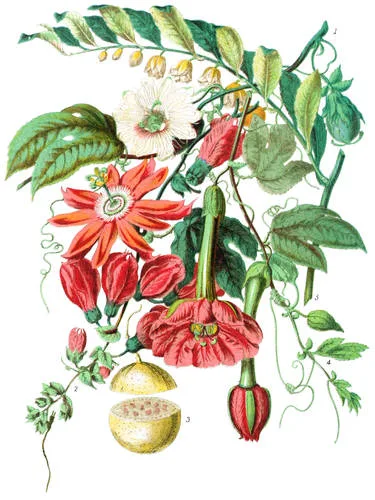
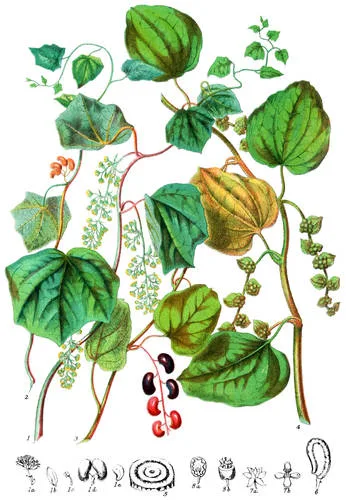
- Corynostylis Hybanthus (4) inhabits the primæval forests on the shores of the Amazon, and particularly near the confluence of the Yapura in the province of growing to the height of three or four feed, partly climbing over other trees. The flowers are very irregular, two petals very small, the two side petals wider, the lower petal hooded, and prolonged into a tube or horn. The stamens are hairy at the back, the two placed under the horned petal have two downy prolongations at their base into the tube.
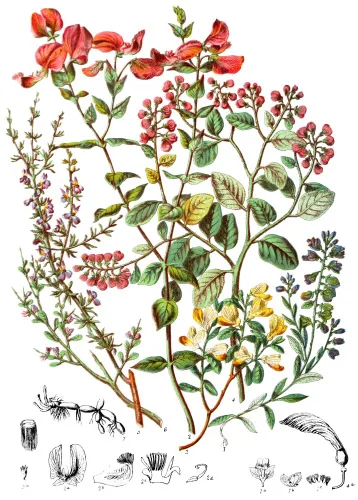
- Ionidium Itoubou (5), a species so called from the native name, grows on sandy ground in various parts of Guiana, bearing flowers nearly all year; it is usually about two feet high, covered with grey down; the flowers have a singular appearance, the four smaller petals being usually rolled up, the lower large one only expanded. A pretty variety, with blue flowers, is very common in Guiana.
- I. parviflorum and other species are used as true Ipecacuanha in Peru and the West Indies.
- I. suffruticosum, of South America, grows also abundantly in the valley of the Ganges.
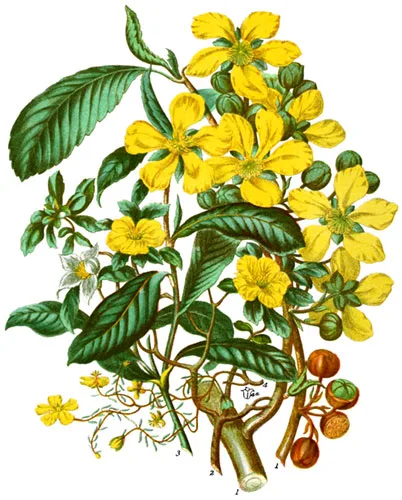
- Alsoea Physiphora (6) is an example of the regular flowers of this Tribe; it is a shrub thirty or forty feet high, with stem and spreading branches of a greyish hue: the graceful flowers on a slender stalk resemble in appearance the Lily of the Valley, though of much smaller size. Other species of Alsodea are natives of Madagascar.
- Conohoria Lobolobo of Brazil has mucilaginous leaves, which are boiled and eaten by the natives.
- Hymenanthera is an evergreen shrub of New Holland.
Locations
The different species of Viola belong chiefly to Europe, Siberia, America, and the mountain ranges of India, a few only belong to the Tropics of Asia. In South America this tribe abounds, but the plants differ considerably from those of Europe, being nearly all shrubs, whilst the northern species are almost entirely herbaceous. Alsodea and its immediate allies are exclusively natives of South America, and Africa, except Pentaloba, which inhabits the Malay Isles.
Legend
- Viola odorata, Sweet Violet. England.
- Pistil and Stamens.
- Stamen with appendage.
- Pistil.
- Viola tricolor, Heart’s-ease.
- Pistil.
- Erpetion reniformis, Spurless Violet. New Holland.
- Corynostylis Hybanthus.
- Seed-vessels.
- Seed.
- Pistil and Calyx.
- Stamens.
- Stamen.
- Cross-section of Ovary.
- Ionidium Itoubou. Guiana.
- Alsodea Physiphora. Brazil.
- Pistil and Stamens.
- Pistil.
- Cross-section of Ovary.
本图涉及的植物
- Viola tricolor
- Viola odorata
- Erpetion reniformis
- Corynostylis Hybanthus
- Alsodea Physiphora
- Ionidium Itoubou
属索引
- Alsodea
- Corynostylus
- Erpetion
- Hymenanthera
- Ionidium
- Pentaloba
- Sumatrana
- Viola