Primulaceæ
Primulaceæ
The Primrose Tribe
- 合集
- 植物自然目
- 绘者
- Elizabeth Twining(伊丽莎白·特温宁)
- 年代
- 1868
- 图版号
- Order 107
- 原书页码
- p.107
- 授权
- CC BY-SA 4.0
图中植物与部位
-
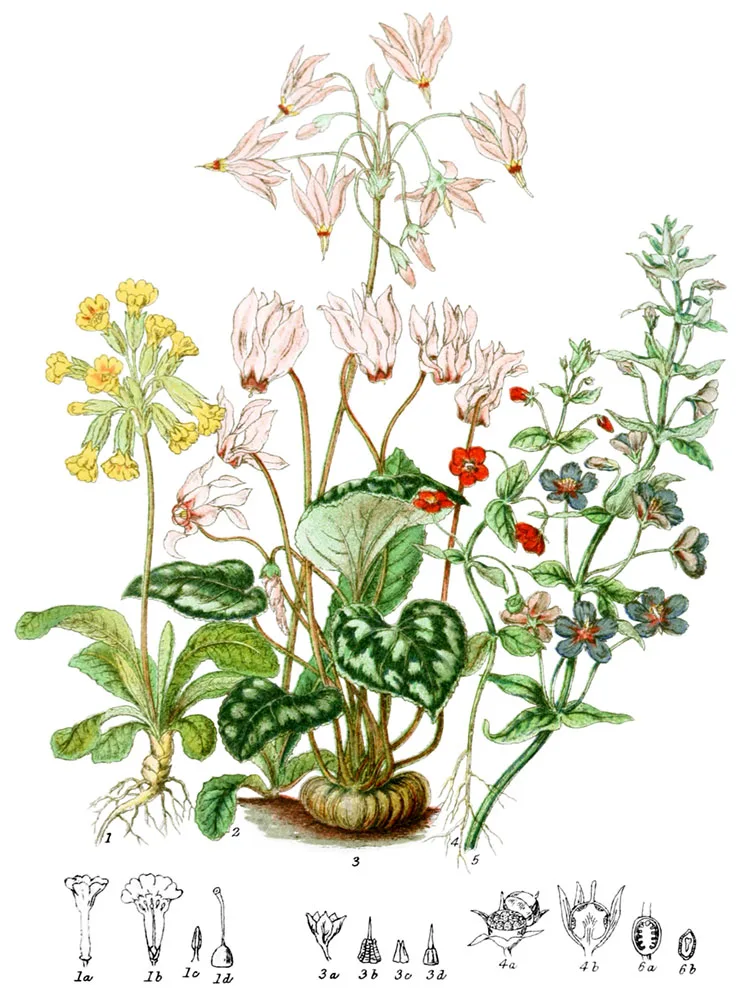
1.
Primula veris
, Common Cowslip England
- 1a. Flower
- 1b. Flower, opened
- 1c. Stamen
- 1d. Pistil
- 2. Dodecatheon Maedia , American Cowslip Virginia
-
3.
Cyclamen europæum
, Common Cyclamen Europe
- 3a. Calyx
- 3b. Stamens and Pistil
- 3c. Stamen
- 3d. Pistil
-
4.
Anagallis arvensis
, Scarlet Pimpernel England
- 4a. Seed-vessel
- 4b. Section
- 5. Anagallis Monelli Italy
-
- 6a. Ovary of Aretia
- 6b. Seed
-
- bg.
关于本图版
此图原刊于《植物自然目》(Natural Orders of plants),绘者为伊丽莎白·特温宁,成书于 1849 年。原书题作“Primulaceæ”。此类图版是当时记录物种形态的主要方式。
全编共收录 160 幅图版,本图是其中一幅,原书将其列为 Order 107,见第 107 页,版式为纵幅。此图由原件扫描修复而成,使用时请遵循页面标注的授权条款。
原书文字(英文 / 法文)
Key characteristics
Annual or perennial plants, generally of herbaceous nature, and sometimes nearly shrubby. The leaves usually proceed from the top of the root, or else are opposite, or alternate, or in whorls on the stem; they have no stipules. The flowers are either on a simple stem arising from the root, or in an umbel at the top of the stem, or variously arranged in the axils of the leaves on the stem. The calyx is five-cleft at the top, half or entirely below the ovary, regular and persistent. The corolla is of one petal, attached to the base of the ovary, regular in form, the top divided into five segments, seldom four; Glaux is without petals. The stamens are inserted upon the corolla, and are equal in number to its segments, and placed opposite to them. In Samolus and Lysimachia imperfect stamens are alternate with them. The ovary is one-celled, the style is single, the stigma capitate; the seed-vessel is a capsule opening by valves, with a central distinct plate; that of Anagallis is a pyxis, opening with a lid at the top. The seeds are numerous, with fleshy albumen.
This Tribe of herbaceous plants has much affinity with Myrsinaceæ, which is chiefly distinguished by the shrubby nature of the species and the fleshy fruit.
Some of these flowers have soporific properties; the roots are sometimes bitter and acrid.
Select plants in this order
Not all plants listed are illustrated and not all plants illustrated are listed.
- The name Primula denotes its being amongst the first plants to flower in the spring.
- P. vulgaris is one of the earliest tokens of departing winter, adorning our woods and hedge-banks some weeks before other plants have opened their buds. By garden cultivation it has produced double varieties of all colours.
- P. veris (1) is the sweet-scented favourite cowslip, plentiful in the meadows and copses of some districts of England, as well as of most European countries. The flowers make an excellent wine, much esteemed by farmers’ wives.
- P. auricula, a native of the alpine regions of Europe, has been developed into countless beautiful varieties; the flowers exhibit various shades of purple and brown, the peculiar powdery covering renders it a singular plant, and it was formerly an object of much attention, now in some degree superseded by the immense number of new plants imported from all lands. In some of our large manufacturing towns in the north it still affords interesting occupation to the workmen to raise new varieties of Auriculas.
- P. farinosa, of Yorkshire, is one of our most delicate native flowers; in Switzerland it is also frequent. Five species only belong to Britain, but the German and Swiss Floras contain twenty-one; P. longiflora, P. villosa, P. integrifolia, and others, inhabiting the pastures and rocks of the higher Alps.
- Dodecatheon (2) is one of the first importations from Virginia; its specific name of Meadia records a celebrated physician and naturalist, whose monument may be seen in the nave of Westminster Abbey.
- Cyclamen is another of this tribe, which sends forth its welcome flowers in the early months of the year.
- C. europæum (3) is become rare in this country, though it is common in the woods of Austria and Lombardy; the flattened bulbs lie on the surface of the ground, and are eaten by pigs. After the flowers are withered, the stalks curl round, and remain amongst the leaves till the seeds ripen.
- Anagallis appears to have been known to Pliny and Dioscorides.
- A. arvensis (4) is a frequent in corn-fields and open places, one of the few red flowers indigenous in this country, and, like the Poppy and al bright red flowers, is found in situations exposed to the sun. By peasants it is called Shepherd&rdsquo;s-clock, as it closes its flowers after noon-day; this power, however, seems to be lost if the plant be gathered and placed in water.
- A. tentella is a very delicate little trailing plant on bogs, in Wales and elsewhere.
- A. Monelli (5) flourishes well in our conservatories.
- Hottonia is the elegant Feather-foil of our streams and ditches, the slender stalks rising above the water, bearing whorls of pink flowers.
- Lysimachia grows in watery places or moist woods; all the British species have yellow flowers.
- L. thyrsiflora is chiefly found in Scotland.
- One of the most widely dispersed genera of this tribe is Samolus, belonging to every quarter of the world.
- S. Valerandi in the ditches of our south coast, may be examined with interest, the form of both flower and capsule being remarkably neat; a small bract is on the middle of each flower-stalk.
- S. ebracteatus grows on the shores of Cuba.
- S. floribundus on the coast of Peru; S. littoralis on the coast of New Holland.
- Trientalis europæa is rarely to be seen in the north of England, but it abounds in the woods of Norway; the stem is about four inches high, crowned by a few leaves and brilliant white flowers; the black seeds are covered with a white netted skin.
- Soldanella and Aretia are among the beautiful little Alpine plants which ascend to the limits of perpetual snow.
- In Lapland and Siberia we trace this tribe in the forms of Diaspensia and Androsace.
- Douglasia blossoms amidst snow on the Rocky Mountains of North America.
Locations
This Tribe is most common in the northern and colder regions of the globe; rare within the Tropics, where it only exists on the sea-shore or on lofty mountains.
Legend
- Primula veris, Common Cowslip. England.
- Flower.
- Flower, opened.
- Stamen.
- Pistil.
- Dodecatheon Maedia, American Cowslip. Virginia.
- Cyclamen europæum, Common Cyclamen. Europe.
- Calyx.
- Stamens and Pistil.
- Stamen.
- Pistil.
- Anagallis arvensis, Scarlet Pimpernel. England.
- Seed-vessel.
- Section.
- Anagallis Monelli. Italy.
-
- Ovary of Aretia.
- Seed.
本图涉及的植物
- Primula veris
- Dodecatheon Meadia
- Cyclamen euopæum
- Anagallis arvensis
- Anagallis Monelli
- Aretia
属索引
- Anagallis
- Androsace
- Aretia
- Cyclamen
- Diapensia
- Dodecatheon
- Douglasia
- Glaux
- Hottonia
- Lysimachia
- Primula
- Samolus
- Trientalis