Utriculariaceæ
Utriculariaceæ
The Bladder-Wort Tribe
- 合集
- 植物自然目
- 绘者
- Elizabeth Twining(伊丽莎白·特温宁)
- 年代
- 1868
- 图版号
- Order 106
- 原书页码
- p.106
- 授权
- CC BY-SA 4.0
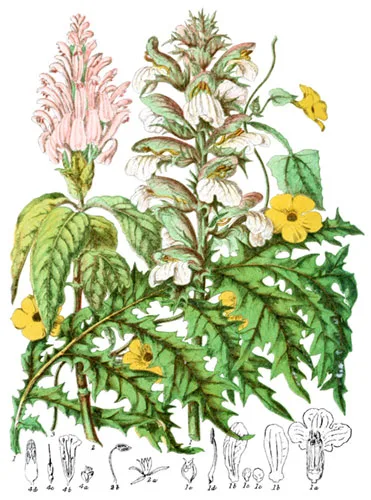
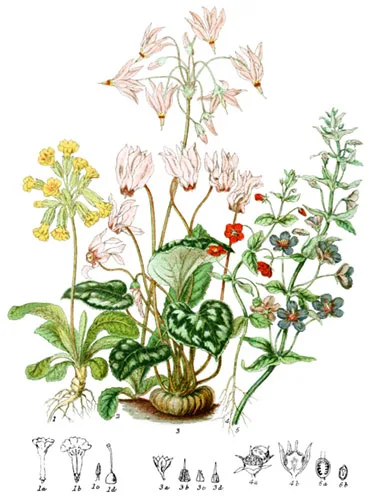
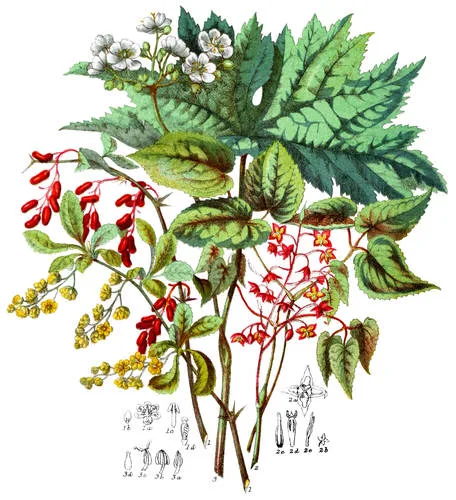
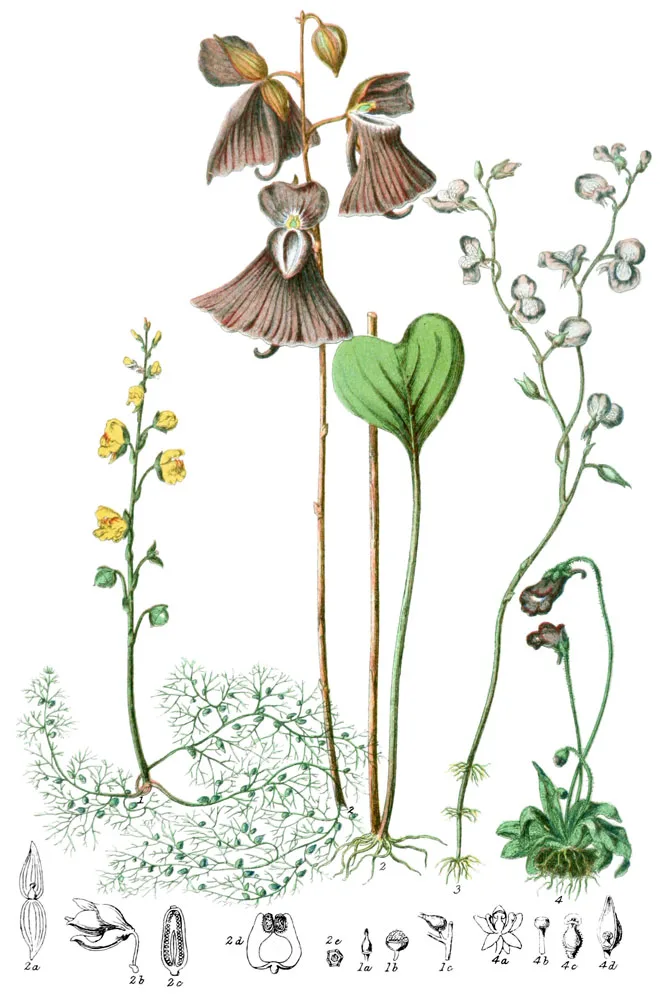
图中植物与部位
-
1.
Utricularia vulgaris
, Greater Bladder-wort England
- 1a. Pistil
- 1b. Capsule
- 1c. Vesicle, magnified
-
2.
Utricularia Humoldtiana
Savannahs, Guiana
- 2a. Calyx and Ovary
- 2b. Calyx and Capsule
- 2c. Section of Capsule, magnified
- 2d. Stamens
- 2e. Pollen, magnified
- 3. Utricularia reticulata Rice-grounds, East Indies
-
4.
Pinguicula vulgaris
, Common Butter-wort England
- 4a. Calyx, Pistil, and Stamens
- 4b. Stamen
- 4c. Pistil
- 4d. Section of Capsule
关于本图版
《植物自然目》(Natural Orders of plants)由伊丽莎白·特温宁绘制,1849 年印行,本图即其中一幅。原书题作“Utriculariaceæ”。此类图版是当时记录物种形态的主要方式。
该合集全编共 160 幅图版,此图为其中之一,图版编号 Order 106,对应原书第 106 页,版式为纵幅。图像自原件扫描修复,构图与设色未经改动,授权方式见页面下方。
原书文字(英文 / 法文)
Key characteristics
Herbaceous plants in habiting marshes or water. The leaves grow from the top of the root, are either whole or compound, resembling little roots, and bearing small blatters of air or water. The flower-stalk is generally single, seldom branching, and is either naked or clothed with minute scales like stipules, sometimes bearing little vesicles in whorls. The flowers are single or in spikes, or in many-flowered branches, with a single bract, seldom without. The calyx is below the ovary, divided, persistent, partly two-lipped, the upper lip generally three-notched, the lower two-notched. The corolla is of one petal, placed below the ovary, irregular and two-lipped; the lower lip produced into a spur, which is sometimes double. The stamens are two, included within the corolla, and inserted into its base; the anthers are one-celled, sometimes contracted in the middle. The ovary is composed of two carpels, united at the edges, one-celled. The style is single, very short, the stigma bilabiate. The capsule is one-celled, many-seeded, with a large central plate to which the seeds are attached. The sees are minute, without albumen.
These herbaceous plants have most affinity with Scrophulariaceæ, chiefly distinguished by having a one-celled capsule: they are connected with Primulaceæ through Hottonia.
A peculiar property of thickening milk exists in the leaves of Pinguicula.
Select plants in this order
Not all plants listed are illustrated and not all plants illustrated are listed.
- Utricularia is named from utricula, a little bottle, alluding to the vesicles of several species. The plants grow abundantly in the ribulets, lakes, and marshy pools of hot countries; three species are natives of Britain, in different localities; few are known beyond their respective stations, being difficult of cultivation. The flowers are extremely fugacious and delicate, and can scarecely be preserved in a herbal; the brilliant colour of the petals changing to black when pressed and dried; those of the British species are yellow; those of the Tropics and other hot regions are generally blue. The structure of the small bladders is very curious; during the early growth of the plan they are wholly submerged, and contain only water, but when the flowers begin to be developed a change takes place, they rise to the surface, and are found to be filled with air only, small valves closing the orifice. When the seeds are ripening they again sink low. The aquatic species are amply provided with vesicles, and are kept floating by their aid; some which belong to the Tropics are fixed by fibrous roots in the marshes, requiring no other support, and have no vesicles.
- U. vulgaris (1) is our finest species, and may be seen in ditches and deep pools on the south coast; from the finely-divided leaves, as well as form of the flower, it is sometimes called Hooded Milfoil.
- U. Humboldtiana (2) grows in the elevated marshy savannahs of the Roraimé mountains in Guiana, the stem rising to the height of three or four feet, bearing several singularly formed and very elegant purple flowers. This is a remarkable instance of the manner in which an European genus is developed into a more noble type in Tropical regions. It was discovered adorning its native savannahs by Sir Robert Schomburgk, who dedicated it to his learned friend Alexander von Humboldt, but it is one of those fragile ornaments of creation not destined for transportation or dispersion.
- U. reticulata (3) is the native of inundated rice-grounds in the East Indies, twining amongst the rice-stalks, with its round smooth stems and destitute of leaves. The pale netted flower is a curious variety from other species.
- U. montana adorns with its delicate white flowers the sunny meadows around the mountains of the island of Martinique.
- During the late voyage of Mr. Spruce in the Amazon, he found a remarkable species, U. quinqueradiata; the flower-stalks, about two inches long, have an involucre of five rays, spreading horizontally, which floats and supports the plant with its large yellow flower, like a floating lamp. The rays are composed of transparent cells, convex on the surface, forming a kind of chain of vesicles.
- U. uniflora growing on the white sand of the shore is the simplest species yet known; the stem, the size of a sewing-needle, is fixed in the sand by a small cone of roots; it bears no leaves, only a small tubular bract below the simple white flower.
- U. nelumbœfolia is a curious species described by travellers in South America; it makes its habitation in the pools of water accumulated from rain or dew in the hollows of the leaves of a plant of the Pine-apple tribe, probably a Tillandsia, or some allied genus. The roots derive nourishment from the watr entirely, for it is no paraside, and has no connexion with the plant which thus in so singular a way affords it shelder. The roots creep from one leaf to another, and the Utricularia spreads and flourishes.
- Pinguicula inhabits the marshes and bogs of Britain and many othr countries.
- P. vulgaris (4) abounds also in Sweden and Norway, where the leaves are used by the peasants to thicken the milk of reindeer, which is effected without the separation of curd or whey, and is esteemed as a delicacy, the luxuries of food being in those northern countries of a simple nature. The leaves appear to have a certain degree of irritability, bending backwards when the plant is taken out of the ground.
- P. lusitanica is an example of a Portuguese plant migrated to Britain; it grows in Dorsetshire and in the south of Ireland, and has also been found in Scotland.
- This genus is represented in Fuegia by P. antarctica, the chief distinguishing character being a spur much shorter than that of P. lusitanica.
- Genlisea belongs exclusively to Brazil.
Locations
This Tribe inhabits marshes, streams, and still water in all parts of the world; most abundant in the Tropics.
Legend
- Utricularia vulgaris, Greater Bladder-wort. England.
- Pistil.
- Capsule.
- Vesicle, magnified.
- Utricularia Humboldtiana. Savannahs, Guiana.
- Calyx and Ovary.
- Calyx and Capsule.
- Section of Capsule, magnified.
- Stamens.
- Pollen, magnified.
- Utricularia reticulata. Rice-grounds, East Indies.
- Pinguicula vulgaris, Common Butter-wort. England.
- Calyx, Pistil, and Stamens.
- Stamen.
- Pistil.
- Section of Capsule.
十二观
- 实测花色 橙黄、黄绿
- 纵幅 1.50∶1
- 含 4 个物种
- 16 处解剖图
- 1868 年刊
- Order 106
这不是词条,是一条看画的次序:先站定看整体,再看名字与形色、构图与刀工,然后问它几时开、从哪里来、经了谁的手;最后是中国诗文——同一朵花,中国古人是怎么看的。十二观读完,这幅图就打开了。
-
第一眼
六法者何?一、气韵生动是也;二、骨法用笔是也;三、应物象形是也;四、随类赋彩是也;五、经营位置是也;六、传移模写是也。
—— 南齐·谢赫《古画品录》
一千五百年前的六条标准:气韵、用笔、形似、设色、构图、临摹。你在这幅图上一样样对过去,就是一次完整的读画。这一幅是竖的:眼睛从下往上走,落点在上半部。先让整株立起来,再看细节。第二步凑近一寸:主线之外另有 16 处解剖小图——那是画家怕你看不清,替你把花剖开了。第三步,把视线放到最深的那一小块:整幅的用色秩序,都是从那里排开的。
-
名与实
学名缺席时,画面本身就是唯一的证据。此幅既无通行中文名,学名也不可靠,只能以原书题名相称——图谱里总有几幅这样的图,只能靠画面本身说话。
-
形与色
就这一幅实测:花色占画面的 5.2%,叶色 5.2%,主相是橙黄、辅以黄绿。这个比例与色相,是这一幅独有的。此图为一幅博物插画:一株植物被从山野或温室中取出,安置在纸的中央,根、茎、叶、花、果依次交代,务求可辨、可据、可传。此幅未作色相归档,只能就形制论。画幅高而窄,形与色的关系因此看得格外清楚:先读轮廓,再读色层,最后才看笔触。
-
构图与呼吸
画幅高而窄,主株一路向上,上下留白多,是图谱中最常见的立轴式构图。(高宽比约 1.50∶1)另附 16 处局部解剖,主体与细部互为注脚。这一幅留白多:枝叶只占 20%,重心近于正中——空处是给眼睛喘气的,也更显出这株的姿态。试着用拇指遮住空白处——画面立刻变闷;放开,它才重新“喘上气”。留白,是给主体让出的气口。
-
一刀一色
十九世纪后半叶,石版与彩色石印渐成主流:颜色可以直接印出,不再依赖手工,线条反倒退居其次。图像的“准确”提高了,手性却淡了。拿放大镜(或手机微距)看三处:花瓣边缘、叶脉、题名。线若连续不断,是刻的;色若越过轮廓半毫米,是手涂的。
-
时序
图版多标花期,因花期是植物一年中最容易被辨认的十余日;其余月份,它只是一丛叶。图上所记的 1868 年是刊行之年,不是花期;真正的花藏在原书的采集记录里,通常比出版早一两年。要判断一幅图的季节,不必看题跋:看叶的老嫩、花与果是否同在枝上,也就八九不离十了。
-
故土
来源不一,或本地山野,或远洋引种。十九世纪的植物园与温室,是这些植物离开故土后的第一个住所。十九世纪的苗圃主是这场植物迁徙的中转站:谁家先开花,谁家就有生意。
-
书与人
《植物自然目》(Natural Orders of plants)由伊丽莎白·特温宁绘,成于1849。此幅为其中Order 106,见原书第 106 页。图版今属公有领域,可以自由取用;但纸上那层手工上色,仍是两百年前某一个人的手。
-
诗境
天地有大美而不言,四时有明法而不议。
—— 《庄子·知北游》
博物画所做的,正是替不言者立言。图上那些解剖小图,正可作这句诗的注脚:花不只在枝头,也在剖面里。
-
文心
六法者何?一、气韵生动是也;二、骨法用笔是也;三、应物象形是也;四、随类赋彩是也;五、经营位置是也;六、传移模写是也。
—— 南齐·谢赫《古画品录》
一千五百年前,谢赫给了六条看画的标准:气韵、用笔、形似、设色、构图、临摹。前五条今天仍然管用——在这幅图版上一样样对过去,就是一次完整的读画。中国有《本草纲目》《植物名实图考》,欧洲有从《本草》插图到彩色石印的谱系;两条传统都相信:图能补文字的不足。中外的分别不在谁高明,而在问的问题不同:欧洲问它是什么,中国问它像谁。两个问题都答了,一幅图才算读完。
-
花语
博物画的象征不在花语,而在“记录”本身:它相信一株植物值得被准确画下,这份信念是科学时代最朴素的道德。花语是后人添上去的,花本身并不知道;但这层“不知道”,正是它最动人的地方。
-
带走一双眼睛
鉴赏力不是知识,是习惯:每次多看一眼,十年之后你看什么都和别人不一样。二百年后,这株植物的后代或许仍在某处活着;而纸上这一株,永远停在 1868 年的那个季节。
本图涉及的植物
- Utricularia vulgaris
- Utricularia Humboldtiana
- Utricularia reticulata
- Pinguicula vulgaris
属索引
- Genlisea
- Pinguicula
- Utricularia