Proteaceæ
Proteaceæ
The Protea Tribe
- 合集
- 植物自然目
- 绘者
- Elizabeth Twining(伊丽莎白·特温宁)
- 年代
- 1868
- 图版号
- Order 118
- 原书页码
- p.118
- 主色
- 黄
- 授权
- CC BY-SA 4.0
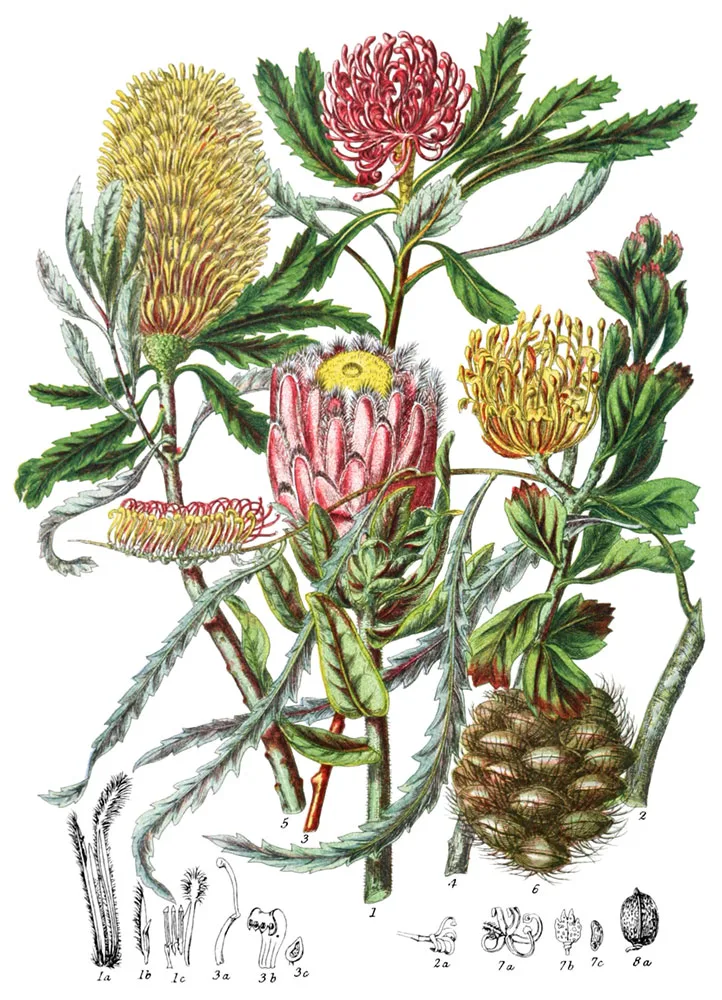
图中植物与部位
-
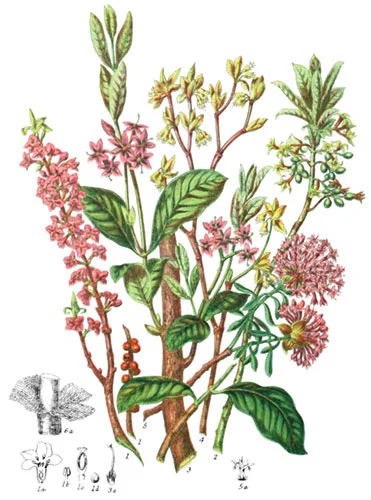
1.
Protea pulchella
, Wave-leaved Protea Cape of Good Hope
- 1a. Flower with Pistil
- 1b. Stamen
- 1c. Three Stamens
-
2.
Grevillea longifolia
, Long-leaved Grevillea Australia
- 2a. Flower of G. linearis
-
3.
Telopea speciosissima
, Waratah New South Wales
- 3a. Pistil
- 3b. Calyx and Stamens
- 3c. Anther
- 4. Leucospermum hypophyllum , Trifid-leaved Leucospermum Cape of Good Hope
- 5. Bansia media New Holland
- 6. B. speciosa , Fruit
-
- 7a. Hakea acicularis
- 7b. Fruit
- 7c. Seed
-
- 8a. Hakea undulata , Seed-vessel
十观
- 实测花色 黄绿、橙黄
- 纵幅 1.39∶1
- 含 8 个物种
- 17 处解剖图
第一眼
论画以形似,见与儿童邻。
—— 宋·苏轼《书鄢陵王主簿所画折枝》
只求画得像,是小孩的眼光。苏轼不是不要形似,是说形似之后还有一层:神。这一幅是竖的:眼睛从下往上走,落点在上半部。先让整株立起来,再看细节。第二步凑近一寸:主线之外另有 17 处解剖小图——那是画家怕你看不清,替你把花剖开了。第三步,找黄色最重的一小块:整幅的明暗秩序,是从那里排开的。
名与实
没有学名可依,就看题名:题名里往往藏着产地、赠者或一句形容。此幅既无通行中文名,学名也不可靠,只能以原书题名相称——图谱里总有几幅这样的图,只能靠画面本身说话。
形与色
就这一幅实测:花色占画面的 19.3%,叶色 15.0%,主相是黄绿、辅以橙黄。这个比例与色相,是这一幅独有的。山茶为常绿灌木或小乔木,叶厚革质、缘有细齿,表面如涂蜡;花单生枝顶,重瓣者花瓣层叠如覆瓦,凋时整朵坠落,不散不乱。此幅属黄一路,黄如蜜蜡,浅处几乎透光。上色时先铺一层淡底,再在瓣基与背光处加深——层次是这样一层层叠出来的。主株之外另有 17 处解剖小图,正可与这段形制对读:整株定其貌,细部定其名。
构图与呼吸
画幅高而窄。另附 17 处局部解剖,主体与细部互为注脚。这一幅排得满:枝叶占到画面的 49%,重心近于正中——标本式的画法,图的是看得全。
一刀一色
十九世纪后半叶,石版与彩色石印渐成主流:颜色可以直接印出,不再依赖手工,线条反倒退居其次。图像的“准确”提高了,手性却淡了。工艺留下的破绽比题跋更诚实:刻工不会撒谎,上色的人赶时间的时候会。想动笔临它的人记住一句:先铺大块的形与色,干后再收细部;石印的柔和层次来自薄涂与网点,水彩分两三遍淡铺即可逼近。
诗境
人卖山茶先谷雨,鸦随墦祭过清明。
—— 宋·陆游《春晴自云门归三山》
“人卖山茶先谷雨”——诗以气行,画以形立;两种“看”叠在一起,才是看画的意思。
花语
中国以山茶为“耐久”之友,陆游所谓“惟有山茶偏耐久”;西方则以茶花为东方之艳与不可得,小仲马《茶花女》之后,它又多了一层薄命的意味。此幅偏黄,在花语里总要再加重一分情绪。象征多半来自形状与气味:像杯的、像泪的、香的、臭的——先有形状,后有意义。
时与地
冬末至春初,正月的寒里开。花期极长,一朵可撑十余日,故有“耐久”之名。中国西南及日本。云南山茶最盛,十九世纪传入欧洲后引起轰动,被称作“东方的玫瑰”。图上所记的 1868 年是刊行之年,不是花期;真正的花藏在原书的采集记录里,通常比出版早一两年。看叶的老嫩、花与果是否同在枝上,季节便八九不离十;看题名里藏着的地名,来路也猜得出七分。
书与人
《植物自然目》只署了伊丽莎白·特温宁一个人的名字。从画稿到成图要过好几双手:转刻的人求准,上色的人求快——快与准之间,就是各幅之间深浅不一的来历。
带走一双眼睛
下次去公园,找一株开着的花站三分钟:看叶怎么排、花朝哪个方向开、最深的一块色在哪。三分钟之后,你已经会看这一类的图了。1868 年的那朵花早已化作尘土,它留在纸上的样子,却比任何一株活着的同类都长寿。
关于本图版
《植物自然目》(Natural Orders of plants)由伊丽莎白·特温宁绘制,1849 年印行,本图即其中一幅。原书题作“Proteaceæ”。原书为这一物种留下了成幅的彩色图像记录。
该合集全编共 160 幅图版,此图为其中之一,图版编号 Order 118,对应原书第 118 页,版式为纵幅,设色以橙为基调。图像自原件扫描修复,构图与设色未经改动,授权方式见页面下方。
原书文字(英文 / 法文)
Key characteristics
Small trees and shrubs, the branches usually in umbels. The leaves are rigid, dry, divided or undivided, opposite or alternate, without stipules, sometimes having pores equally on both sides. The calyx is four-lobed, or four-cleft; petals are wanting. The stamens are four, sometimes part imperfect, opposite the segments of the calyx, placed upon them. The ovary consists of a simple carpel above the calyx; the style is single, usually very long; the stigma simple. The fruit is gaping when ripe, or closed, and contains one or more seeds which have no albumen.
This Tribe has some affinity with Thymelaceæ, but is distinguished by the stamens of the lobes of the calyx, and the gaping fruit.
Very few useful properties exist in these plants; the seeds of some are eatable.
Select plants in this order
Not all plants listed are illustrated and not all plants illustrated are listed.
- Protea displays considerable varieties in species, and other genera being of extremely differing aspect, the name is well applied to the whole Tribe.
- P. pulchella (1) is one of the fairest examples in regard to the flower and general aspect, but the character of the Tribe is dull, stiff foliage, and the heads of small flowers afford very little beauty of bright colouring. Like many Australian trees and shrubs, a pale dusky hue pervades the leaves, sometimes not only on the under, but also on the upper surface.
- P. grandiflora rises to the size of a tree eight feet high, and is called Wagenboom by the Dutch colonists at the Cape, as they use the wood for the wheels of their strong rude carts. The bark is valued for medicinal properties.
- P. mellifera yields a kind of honey in some abundance, which is thought to be a remedy for coughs.
- The bark of P. speciosa is used in tanning leather.
- Nearly all the genera have been named after the learned botanists, Banskia, Lambertia, Persoonia, Dryandra, Hakea, and others, all recording the memory of celebrated men.
- Grevillea, so called from a nobleman who was a great promoter of general science, is very abundant in New South Wales.
- G. longifolia (2), is an elegant species when in flower, the extremely long styles bent backwards, giving a singular effect to the flower-spike.
- Telopea speciosissima (3), is of a brilliant colour and considered ornamental in the conservatory, although seldom seen in its full vigour; it is best known by its native name of Waratah.
- Leucospermum is named from the whiteness of the seeds; the shrubs are usually downy or hairy, and the heads of flowers stand erect at the ends of the branches.
- The leaves of L. hypophyllum (4) have, like those of those other species, a few strong notches at the end of leaves. This is peculiarly a Cape genus, and some of the species were amongst the first importations we obtained from that settlement in 1774.
- Banksia was named by Linnæus in honour of his friend Sir Joseph Banks, who, although younger, had already attained to great eminence as a naturalist. It is an Australian genus of noble aspect, and has the peculiar character of bearing the produce of four years on the tree at the same time: the dry hard seed-vessels of the two previous years, the cone of expanded flowers of the present season, and the buds of the future year.
- B. media (5) is a fine shrub in our conservatories, but all these shrubs can only flourish in a spacious airy building, a moist atmosphere is very uncongenial to their nature.
- B. speciosa (6) bears a large cone-shaped fruit, which seems to form a kind of link with the Fir Tribe, as also does the rigid foliage: the two-valved capsule gapes when ripe.
- B. grandis is said to attain a great size on the barren hills on the banks of the Swan River; some trees have been found fifty feet high, and more than two and a half in diameter.
- Dryandra is a very similar genus, the leaves are all more or less clothed with fine white down on the under surface, and the bracts of the flowers extremely silky.
- D. plumosa has a remarkably delicate pinnated leaf, the small triangular leaflets tipped with a fine point.
- Hakea is a shrub with very stiff foliage, the seed-vessel (7)* is a follicle of a woody nature, containing two winged seeds.
- Hakea undulata bears a large seed-vessel, and has wavy prickly-toothed leaves.
- Amongst these shrubs very few afford food of any kind; the seeds of Brabejum stellatum, the African almond of the Cape, when roasted are eaten like chesnuts, and their outer covering is used as coffee.
- The nut-like fruit of Guevina is sold in the markets of Chile.
- The flowers of Persoonia macrostachya and Petrophila brevifolia yield a bright colour when boiled, which might doubtless be available for dyeing.
- Lomatia, Stenocarpus, Nivenia, and several others, are natives of the Cape of Good Hope.
Locations
This Tribe is most abundant at the Cape, and in Australia. A few species only belong to South America, and the Isles of the Malay Archipelago. In the Northern Hemisphere Protea abyssinica and P. Paulina are almost the only examples.
Legend
- Protea pulchella, Wave-leaved Protea. Cape of Good Hope.
- Flower with Pistil.
- Stamen.
- Three Stamens.
- Grevillea longifolia, Long-leaved Grevillea. Australia.
- Flower of G. linearis.
- Telopea speciosissima, Waratah. New South Wales.
- Pistil.
- Calyx and Stamens.
- Anther.
- Leucospermum hypophyllum, Trifid-leaved Leucospermum. Cape of Good Hope.
- Banksia media. New Holland.
- B. speciosa. Fruit.
-
- Hakea acicularis.
- Fruit.
- Seed.
-
- Hakea undulata. Seed-vessel.
本图涉及的植物
- Protea pulchella
- Grevillea longifolia
- Telopea speciosissima
- Leucospermum hypophyllum
- Hakea acicularis
- Hakea undulata
- Banksia media
- Banksia speciosa
属索引
- Banksia
- Brabejum
- Dryandra
- Grevilliea
- Guevina
- Hakea
- Lambertia
- Leucospermum
- Lomatia
- Nivenia
- Persoonia
- Petrophila
- Protea
- Stenocarpus
- Telopea