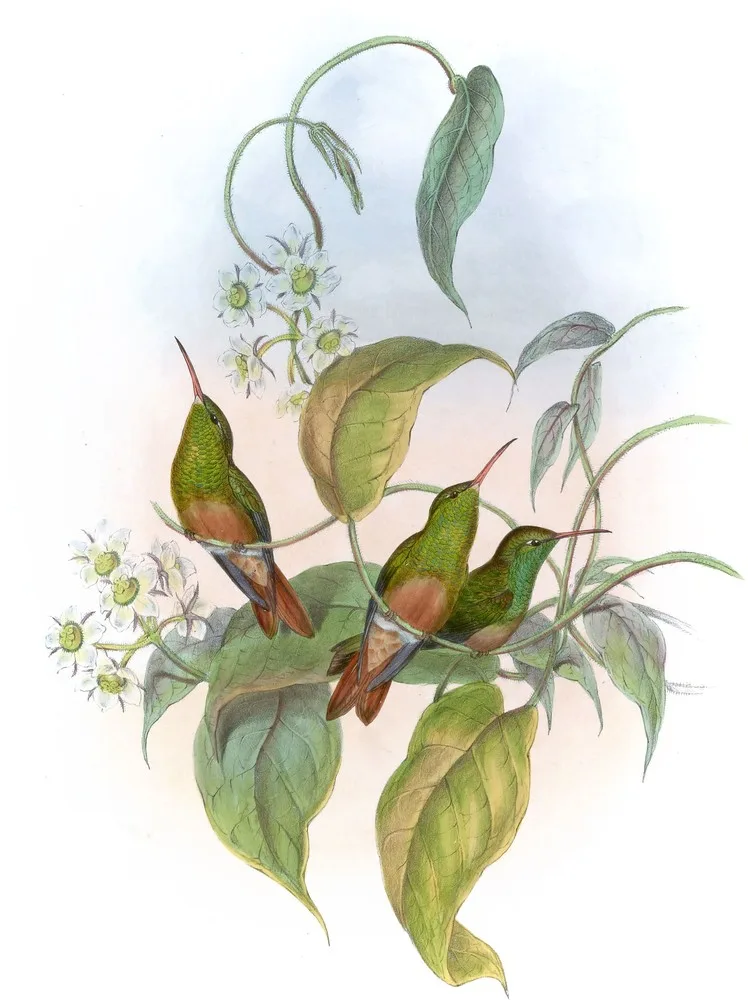
Amazilia cerviniventris
美洲蜂鸟属
Amazilia cerviniventris
Fawn-breasted Amazili
About this plate
Mexico. In the neighbourhood of Cordova, according to M. Sallé.
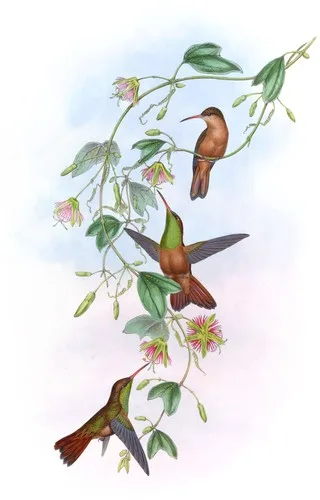
The Humming-bird figured on the accompanying Plate is a species very recently discovered by M. Salle at Cordova in Mexico.
It differs sufficiently from every other to satisfy the most scrupulous as to its distinctness. Less difference occurs in the colouring of the sexes than is observable in most other species, but in this particular it accords with the other members of the genus. Two of the three specimens procured by M. Salle, all of which now form part of my own collection, are said to be males and the third a female; the latter being principally distinguished from the former by the indistinct mark of blackish-brown near the tips of four of the tail-feathers, namely the two on each side next the middle ones.
The tips of all the tail-feathers of both sexes are fringed with a bronzy-orange, which is more intense on the middle than on the outer ones, where indeed it becomes almost obsolete.
This species is about the size of A. Riefferi; but its bill is less robust, and the chestnut colouring of the tail-feathers is of a somewhat lighter hue; as also are the under tail-coverts.
Head, all the upper surface, wing- and upper tail-coverts bronzy-green; wings purplish-brown; tail dark chestnut-red, each feather narrowly bordered and tipped with a bronzy lustre, which is of greatest extent and most conspicuous on the two centre tail-feathers; throat and chest luminous green; under surface of the shoulder and flanks dull green; abdomen and under tail-coverts fawn-colour; thighs white; bill reddish-flesh or yellow, at the base merging into brown, and tipped with black.
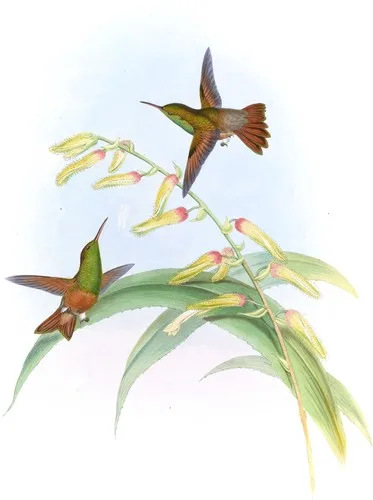
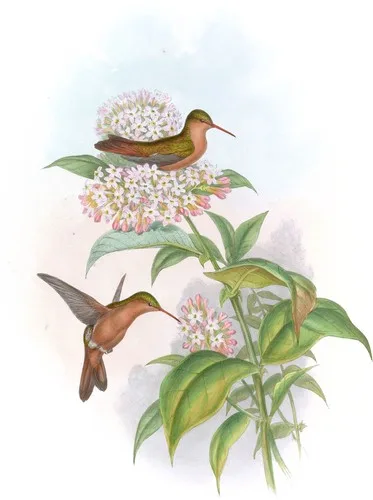
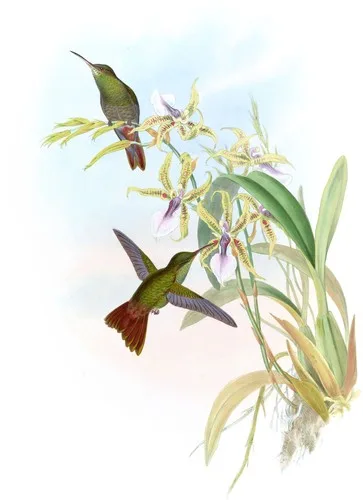
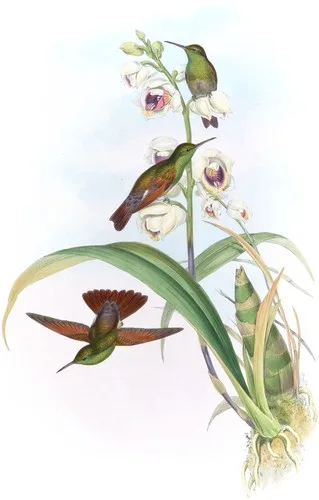
The Plate represents two males and a female. The plant is the Gonolobus Martianus.
References
- Amazilius cerviniventris, Gould in Proc. of Zool. Soc., part xxiv. p. 150.
Twelve ways of seeing
- upright 1.34 : 1
- published 1861
- Pl. 309, Vol. V
Not a catalogue entry but a way of looking: how to stand, what to notice, how the line was cut, when it flowers, where it came from, who made it — and then the poems and the classics that taught China to see the same flower. Read the twelve in order and the plate opens.
-
First Look
搜尽奇峰打草稿。
—— 清·石涛《苦瓜和尚画语录》
Exhaust the strange peaks, and then make the sketch.
The sheet is vertical: the eye climbs and settles on the bird. Take the posture before the plumage. Then step in close: watch where colour meets line, and whether the line ever breaks. Third, find the darkest small patch: the whole tonal order is measured from there.
-
Name and Thing
The binomial is Amazilia cerviniventris: the first word is the genus it belongs among, the second the epithet that sets it apart. Two words carry a whole provenance. The Chinese name 美洲蜂鸟属 is a modern rendering of the Latin, not an old garden name.
-
Form and Colour
The smallest of birds: a needle-fine bill, a forked tubular tongue, wings beating so fast the bird hovers and even flies backwards. Its colour is not pigment but structure — light bent by feather barbules, changing with the angle.No colour group is recorded. A single plant, laid out with nothing hidden.
-
Composition
Tall and narrow, the bird perched mid-branch with generous margins above and below. (about 1.34 : 1) No details are appended: a plate for looking, not for keying out. Old plates set the plant slightly off centre, with unequal margins — that small imbalance is what keeps it alive.
-
Line and Colour
In the later nineteenth century chromolithography took over: colour printed rather than painted, line demoted. There is evidence on the back too: the plate mark pressed into the paper, the slight relief of the pigment, lines worn shallow in a later printing.
-
Season
In tropical America they are present all year, their season set by flowers; temperate hummingbirds follow the bloom north and back, thousands of kilometres a year. The year 1861 on the plate is that of publication, not of flowering — the gathering came a year or two earlier. Note the season. Phenology is the most practical tool of appreciation.
-
Provenance
Americas only, from southern Alaska to Tierra del Fuego, richest in the Andes. China has no hummingbirds and no classical record of them; the name arrives with late-Qing travel writing. The localities on the plate are those of a century ago; plants travel and places change their names.
-
The Book and the Hand
“Gould's Hummingbirds” was drawn by John Gould and published 1849-1887. This plate is Pl. 309, Vol. V, book page 309. The image is public domain; the hand-colouring is still one person's hand.
-
Poetic Resonance
穿花蛱蝶深深见,点水蜻蜓款款飞。
—— 唐·杜甫《曲江二首》
Butterflies thread the flowers, seen deep within; dragonflies touch the water and fly on, slow and deliberate.
The poem gives the mood first and the picture supplies the form; set the line beside the plate and the bird itself becomes its resting point.
-
The Written Tradition
宁古无时,宁朴无巧,宁俭无俗。
—— 明·文震亨《长物志》
Better old than fashionable, better plain than clever, better spare than vulgar.
Gould's Hummingbirds (1849–1887) used hand-coloured lithography over gold leaf so the iridescence survived on paper — a monument to Victorian printing and collecting alike. The difference is not of quality but of question: Europe asks what it is, China asks whom it resembles.
-
Symbolism
For the Aztecs the hummingbird was warrior and sun; for Victorian Europe it was the ultimate ornament, millions killed for breast jewellery. China has no tradition here — and that blank is itself a history of exchange. Flower language was added later; the flower knows nothing of it, and that innocence is part of its power.
-
What to Take Away
Next time you watch a bird: posture first, then where the plumage is deepest, and only then the field guide. A flora exists to be consulted; look long enough and you forget to consult — someone in 1861 gave a whole day to a single flower.