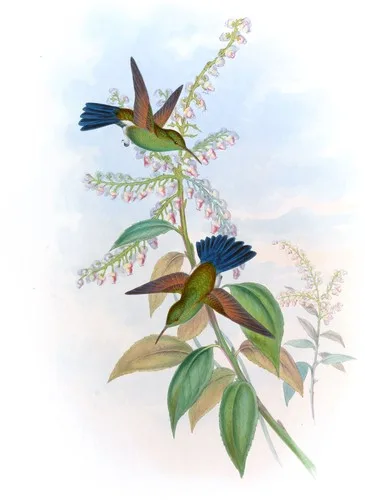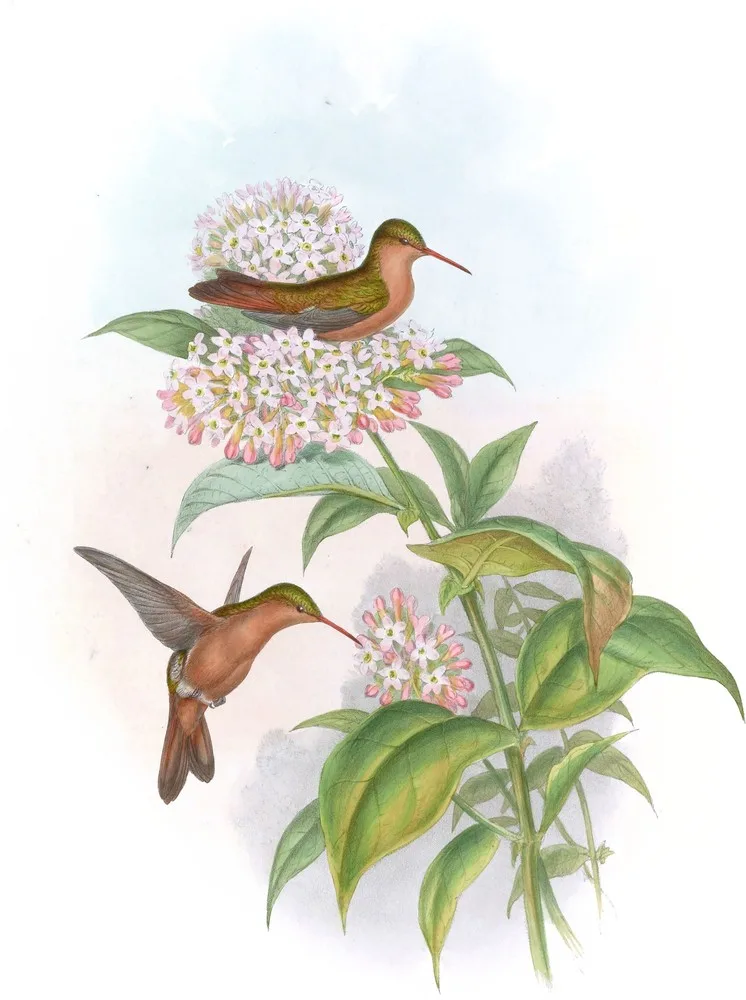
Amazilia corallirostris
美洲蜂鸟属
Amazilia corallirostris
Coral-billed Amazili
About this plate
Central America
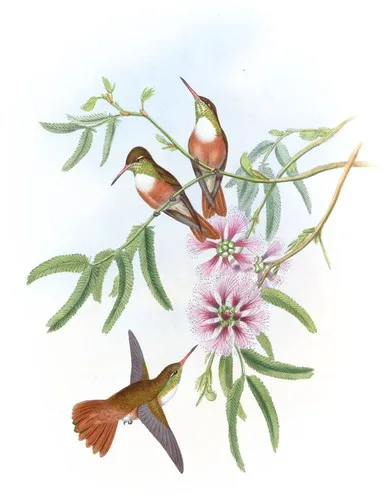
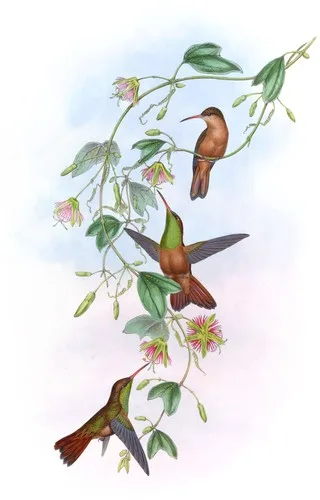
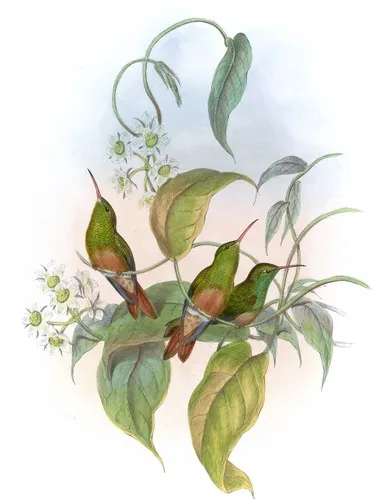
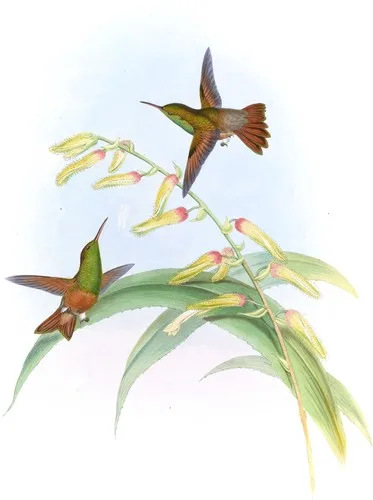
Few of the Humming-birds are more plainly coloured than the Amazilia corallirostris; the tints of the under surface, from the chin to the lower part of the abdomen, being uniform sandy-buff, while on the crown and all the upper surface, a similar uniformity of tint, although of a different hue, prevails; the chestnut-red tail, too, is only relieved by the bronzy tipping of the feathers.
In all the members of this genus, a tendency to a buffy style of plumage occurs, which appears to be carried to a greater extent in the present species than in any other.
The native habitat of this bird is Central America, whence numerous specimens were brought by M. Sallé and others. M. Bourcier gives Escuintla, in the republic of Guatemala, as one of its habitats. None of the examples of this species which have come under my notice present sufficient differences to suggest which are males and which females; the colouring of the sexes in fact appears to be precisely similar.
All the upper surface, wing- and tail-coverts bronzy-brown; wings purplish-brown; tail-feathers deep chestnut, glossed with bronze on their margins and tips; all the under surface sandy-buff; bill said to be red; feet apparently fleshy-brown.
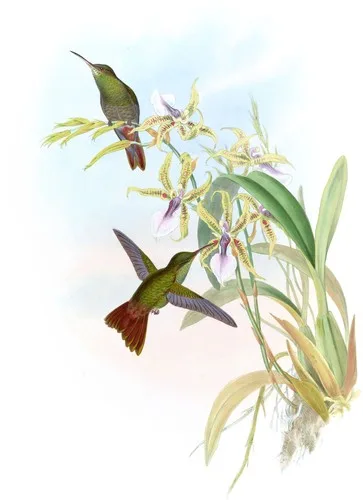
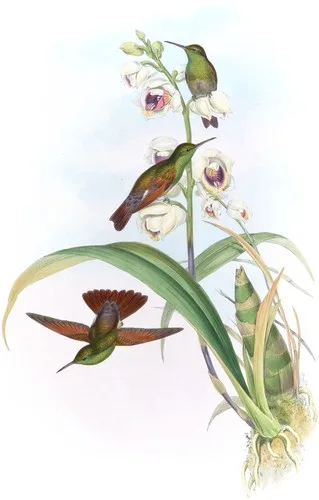
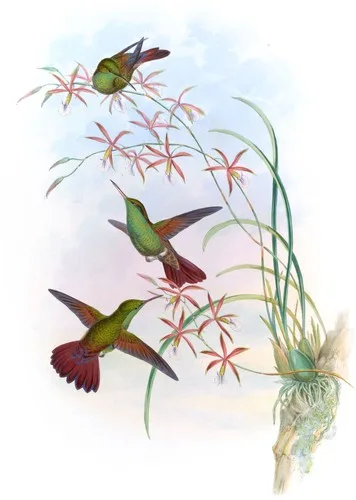
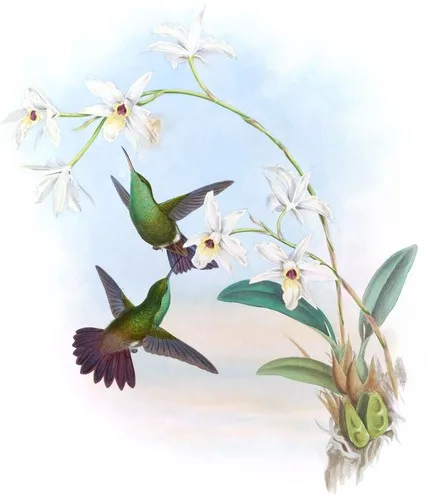
The Plate represents the birds the size of life. The plant is the Rondeletia versicolor.
References
- Trochilus corallirostris, Bourc. et Muls. Ann. de la Soc. Sci. de Lyon, tom. ix. 1846, p. 328.
- Polytmus corallirostris, Gray and Mitch. Gen. of Birds, vol. i. p. 109, Polytmus, sp. 74.
- Amazilius corallirostris, Bonap. Consp. Gen. Av., p. 77, Amazilius, sp. 5.—Ib. Rev. et Mag. de Zool. 1854, p. 254.
- Amazilia corallirostris, Reich. Aufz. der Col., p. 10.
Twelve ways of seeing
One plate, read twelve times over: its name, its colour, the burin and the brush, the shape of the sheet, the season, the soil it came from, the book it belongs to, its language of flowers, the poem it answers to, the lore behind it, how to look, and what remains.
-
The Name
The plate is titled “Amazilia corallirostris”, numbered Pl. 307, Vol. V (book page 307). Its binomial is Amazilia corallirostris: the genus places it among its kin, the epithet records a place, a shape or a person. The Chinese name 美洲蜂鸟属 is a modern rendering of the Latin, not an old garden name — between a plant and its names there is always translation.
-
Form and Colour
The smallest of birds: a needle-fine bill, a forked tubular tongue, wings beating so fast the bird hovers and even flies backwards. Its colour is not pigment but structure — light bent by feather barbules, changing with the angle. No colour group is recorded for this plate, but the palette still belongs to its season. Three things fix the habit: leaf arrangement, tepal count, and how the flower is borne.
-
Line and Colour
In the later nineteenth century chromolithography took over: colour printed rather than painted, line demoted. Images grew more accurate and less personal. Look closely at the line and the colour: an unbroken line means engraving, colour crossing the outline by half a millimetre means hand-colouring. Craft leaves franker evidence than inscriptions.
-
Composition
Tall and narrow, the plant rising in one movement with generous margins above and below — the upright format of most floras. (about 1.34 : 1). No details are appended: this is a plate for looking, not for keying out.
-
Season
In tropical America they are present all year, their season set by flowers; temperate hummingbirds follow the bloom north and back, thousands of kilometres a year. The year 1861 on the plate is the year of publication, not of flowering — the gathering came a year or two earlier.
-
Provenance
Americas only, from southern Alaska to Tierra del Fuego, richest in the Andes. China has no hummingbirds and no classical record of them; the name arrives with late-Qing travel writing. The volume was made in 1849-1887, when most of this knowledge came from living plants under glass rather than from the wild.
-
The Book
“Gould's Hummingbirds” was drawn by John Gould and published 1849-1887. This plate is Pl. 307, Vol. V, book page 307. The image is in the public domain; the hand-colouring on the paper is still one person's hand, two centuries ago.
-
Symbolism
For the Aztecs the hummingbird was warrior and sun; for Victorian Europe it was the ultimate ornament, millions killed for breast jewellery. China has no tradition here — and that blank is itself a history of exchange. Flower language was added later; the flower knows nothing of it, and that innocence is part of its power.
-
Poetic Resonance
夫列子御风而行,泠然善也,旬有五日而后反。
—— 《庄子·逍遥游》
Liezi rode the wind and came back after fifteen days, so light was his going.
The poem gives the mood first and the picture supplies the form; set the line beside the plate and the bird itself becomes its resting point.
-
Classical Lore
Gould's Hummingbirds (1849–1887) used hand-coloured lithography over gold leaf so the iridescence survived on paper — a monument to Victorian printing and collecting alike. Chinese flower books ranked plants by character; European floras described them by form and name. This plate belongs to the second tradition, yet bears reading by the first. Printed in 1861, at the moment the two traditions began to see each other.
-
How to Look
Look at the metallic throat and back: structural colour that needed gold leaf or layered washes to match. Then bill length against corolla depth — bird and flower evolved together. Read the hatching: three or four directions inside one leaf means the engraver was describing light, not decoration.
-
Afterword
Two centuries on, the plant may still flower in some garden; the one on this sheet stopped in the season of 1861.