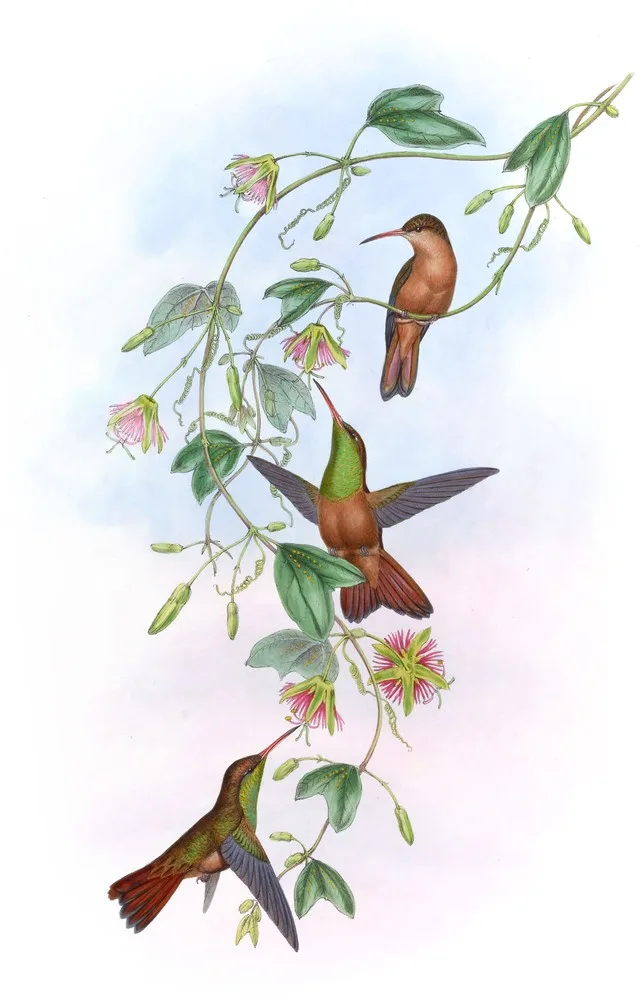
Amazilia Yucatanensis
美洲蜂鸟属·Amazilia Yucatanensis
Amazilia Yucatanensis
Yucatan Amazili
Ten ways of seeing
- upright 1.56 : 1
First Look
论画以形似,见与儿童邻。
—— 宋·苏轼《书鄢陵王主簿所画折枝》
To judge painting by likeness alone is the view of a child.
The sheet is vertical: the eye climbs and settles on the bird. Take the posture before the plumage. Then step in close: watch where colour meets line, and whether the line ever breaks. Third, find the darkest small patch: the whole tonal order is measured from there.
Name and Thing
The binomial is Amazilia yucatanensis: the first word is the genus it belongs among, the second the epithet that sets it apart. Two words carry a whole provenance. No established Chinese name exists, so it is cited by its binomial alone.
Form and Colour
The smallest of birds: a needle-fine bill, a forked tubular tongue, wings beating so fast the bird hovers and even flies backwards. Its colour is not pigment but structure — light bent by feather barbules, changing with the angle.No colour group is recorded. Three things fix the habit: leaf arrangement, tepal count, and how the flower is borne.
Composition
Tall and narrow, the bird perched mid-branch with generous margins above and below. No details are appended: a plate for looking, not for keying out. Blank paper is not unfinished work: it is where the eye rests.
Line and Colour
In the later nineteenth century chromolithography took over: colour printed rather than painted, line demoted. Decide first whether it was printed or painted; only then discuss whether it is beautiful. If you mean to copy it: block in the broad shapes and colours first, detail last; lithographic softness comes from thin washes — two or three pale layers will get you close.
Poetic Resonance
穿花蛱蝶深深见,点水蜻蜓款款飞。
—— 唐·杜甫《曲江二首》
Butterflies thread the flowers, seen deep within; dragonflies touch the water and fly on, slow and deliberate.
The poem gives the mood first and the picture supplies the form; set the line beside the plate and the bird itself becomes its resting point.
Symbolism
For the Aztecs the hummingbird was warrior and sun; for Victorian Europe it was the ultimate ornament, millions killed for breast jewellery. China has no tradition here — and that blank is itself a history of exchange. Meanings change their tune: the same flower can say opposite things within a century.
Season and Place
temperate hummingbirds follow the bloom north and back, thousands of kilometres a year. Americas only, from southern Alaska to Tierra del Fuego, richest in the Andes. China has no hummingbirds and no classical record of them. The year 1861 on the plate is that of publication, not of flowering — the gathering came a year or two earlier. The bud and the ripe fruit on one branch tell the season; the name in the title often tells the journey.
The Book and the Hand
“Gould's Hummingbirds” carries only John Gould's name. From drawing to plate the sheet passed through several hands — the engraver aimed at accuracy, the colourist at speed, and between them lies each plate's unevenness.
What to Take Away
Appreciation is not knowledge but habit — one more look each time. The flower of that year is dust, yet its image on paper has outlived every living cousin.
About this plate
Yucatan
I am much indebted to Dr. Cabot, of Boston, North America, for the loan of the type specimen of his Trochilus Yucatanensis, a bird which differs from every other species that has come under my notice.
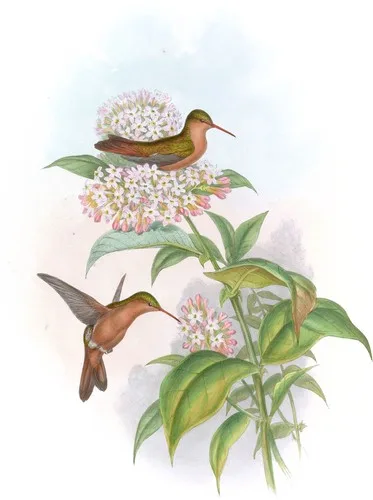
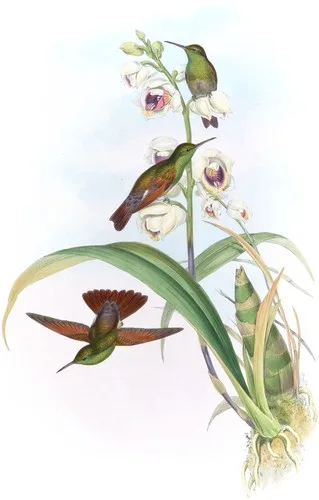
It is perhaps most nearly allied to the Amazila cerviniventris, but differs in the truncate form of the green colouring of the throat, which in that bird extends down each flank. Dr. Cabot sent at the same time another specimen, which he considered to be the female; and this may possibly be the case; but I suspect that it will prove to be another species, the A. cinnamomea (A. corallirostris of my work). The upper figure in the accompanying plate is an exact representation of this specimen; and it remains for future research to determine whether my surmise be correct or not. In all probability the A. cinnamomea flies in Yucatan, as it is very common in the neighbouring countries of Honduras and Guatemala.
The following is Dr. Cabot’s description and brief account of this species, published in the ‘Proceedings of the Boston Society of Natural History,’ to which, I learn, he has nothing to add; for, in a letter dated April 30, 1859, he says, “It gives me great pleasure to aid you as far as I am able in your most interesting and beautiful work; but I regret exceedingly to say that it is a long time since my observations were made, and that my notes were unfortunately lost overboard while coasting along the shore of Yucatan in a canoe, I regret also that I have no duplicate of the male to present to you.”
Trochilus Yucatanensis. Length 4 inches. Bill
of an inch. First primary longest; primaries curved, broadest at their tips; tail, somewhat forked, rather more than 1 ; inch long, consists of ten feathers; bill light yellowish at base and along centre of mandibles, dark horn-colour at tip and halfway along sides; male brilliant shining emerald on chin, throat, and upper part of breast; head, upper part of neck, and back dull golden green with some metallic reflexions; lower part of breast, belly, under tail-coverts, central and upper part of tail-feathers light bay; tips and both sides of central tail-feathers and outer side of lateral tail-feathers dark golden green with metallic reflexions; vent white; female nearly the same as male, but rufous instead of bright emerald on chin, neck, &c., and less white about vent. This is the most common Humming-Bird found in Yucatan. It was seen in numbers about the acacias which grew upon the tops of the ruined buildings, where the specimens from which the above description was taken were procured.
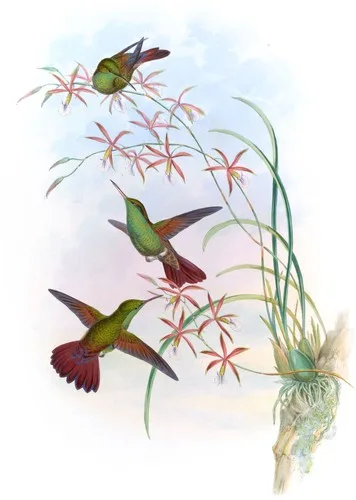
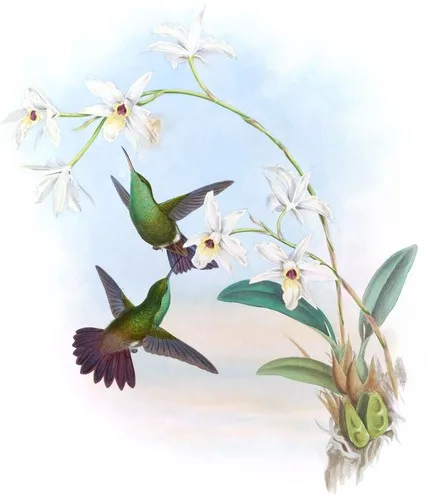
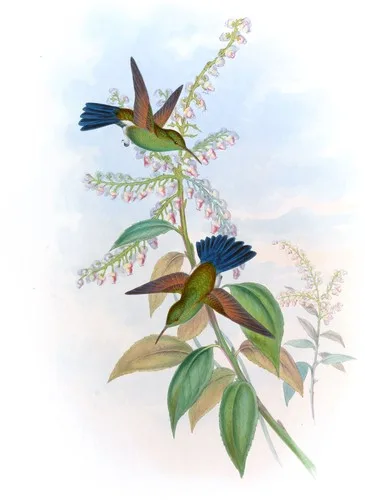
The figures are of the natural size. The plant is the Passiflora Medusæa.
References
- Trochilus Yucatanensis, Cabot in Proc. of Bost. Soc. of Nat. Hist., Nov. 19, 1845.