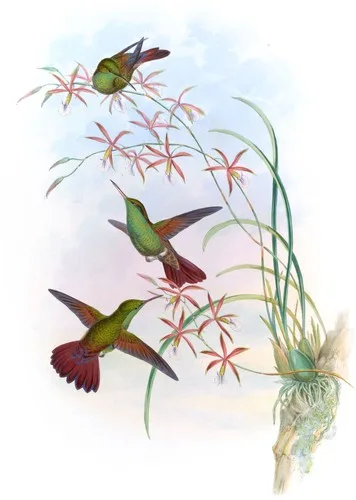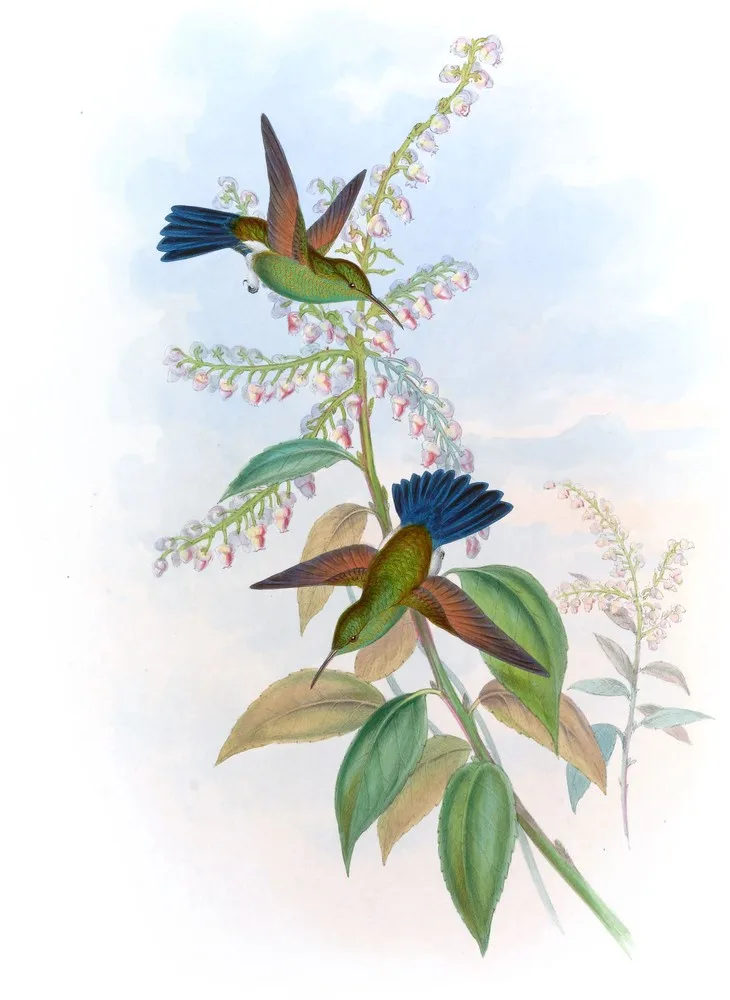
Amazilia cyanura
蓝尾蜂鸟
Amazilia cyanura
Blue-tailed Amazili
Ten ways of seeing
- upright 1.37 : 1
First Look
搜尽奇峰打草稿。
—— 清·石涛《苦瓜和尚画语录》
Exhaust the strange peaks, and then make the sketch.
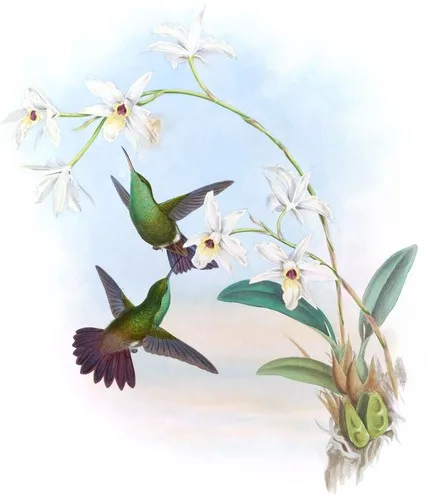
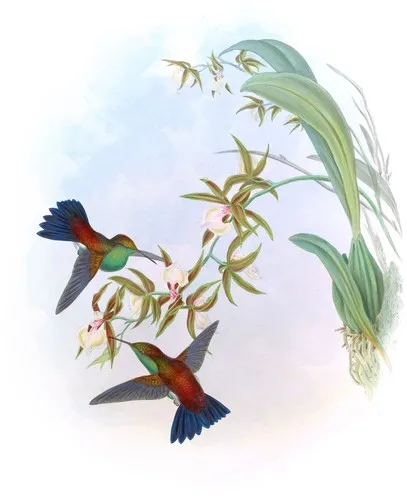
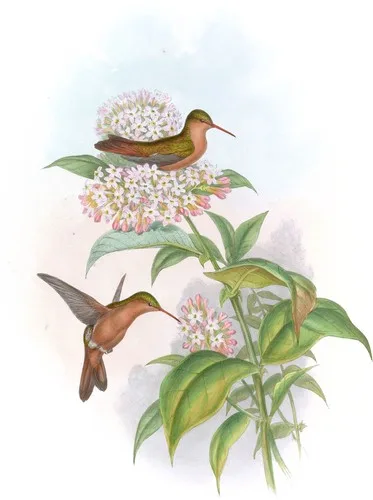
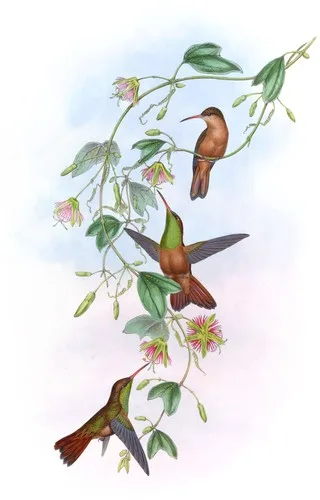
The sheet is vertical: the eye climbs and settles on the bird. Take the posture before the plumage. Then step in close: watch where colour meets line, and whether the line ever breaks. Third, find the darkest small patch: the whole tonal order is measured from there.
Name and Thing
The binomial is Amazilia cyanura: the first word is the genus it belongs among, the second the epithet that sets it apart. Two words carry a whole provenance. The Chinese name 蓝尾蜂鸟 is a modern rendering of the Latin, not an old garden name.
Form and Colour
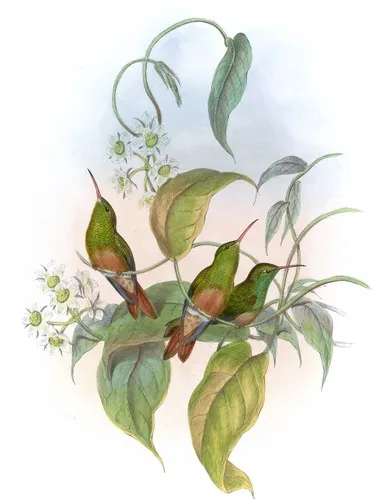
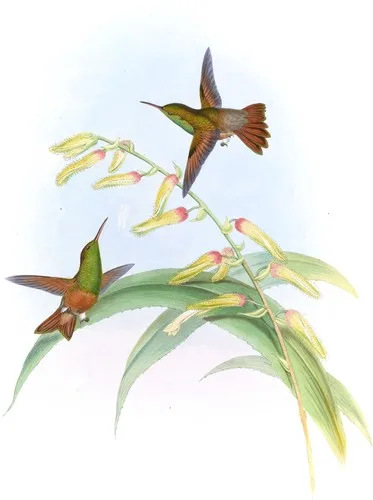
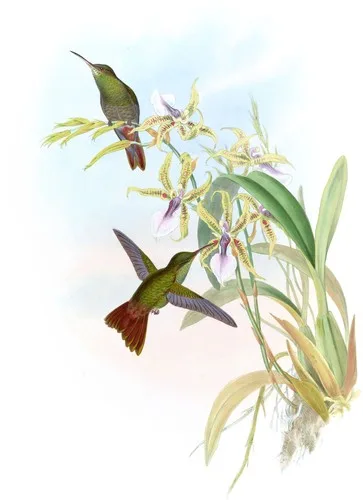
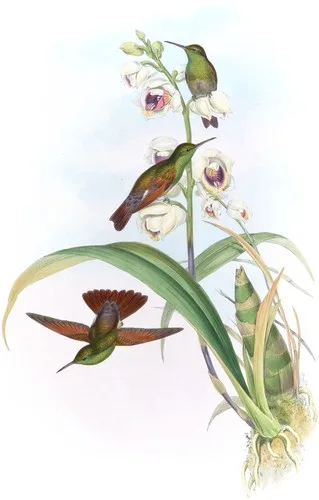
The smallest of birds: a needle-fine bill, a forked tubular tongue, wings beating so fast the bird hovers and even flies backwards. Its colour is not pigment but structure — light bent by feather barbules, changing with the angle.No colour group is recorded. Three things fix the habit: leaf arrangement, tepal count, and how the flower is borne.
Composition
Tall and narrow, the bird perched mid-branch with generous margins above and below. No details are appended: a plate for looking, not for keying out. Cover the margins with your thumb and the plate suffocates; uncover them and the flower breathes again.
Line and Colour
In the later nineteenth century chromolithography took over: colour printed rather than painted, line demoted. Craft leaves franker evidence than inscriptions. If you mean to copy it: block in the broad shapes and colours first, detail last; lithographic softness comes from thin washes — two or three pale layers will get you close.
Poetic Resonance
夫列子御风而行,泠然善也,旬有五日而后反。
—— 《庄子·逍遥游》
Liezi rode the wind and came back after fifteen days, so light was his going.
The poem gives the mood first and the picture supplies the form; set the line beside the plate and the bird itself becomes its resting point.
Symbolism
For the Aztecs the hummingbird was warrior and sun; for Victorian Europe it was the ultimate ornament, millions killed for breast jewellery. China has no tradition here — and that blank is itself a history of exchange. Flower language was added later; the flower knows nothing of it, and that innocence is part of its power.
Season and Place
temperate hummingbirds follow the bloom north and back, thousands of kilometres a year. the name arrives with late-Qing travel writing. The year 1861 on the plate is that of publication, not of flowering — the gathering came a year or two earlier. The bud and the ripe fruit on one branch tell the season; the name in the title often tells the journey.
The Book and the Hand
“Gould's Hummingbirds” carries only John Gould's name. The image is public domain; the hand-colouring is still one person's hand.
What to Take Away
Next time you watch a bird: posture first, then where the plumage is deepest, and only then the field guide. The flower of that year is dust, yet its image on paper has outlived every living cousin.
About this plate
Pacific side of Nicaragua; Realjo?
All that is known respecting this Humming-bird is, that examples were collected by Captain Sir Edward Belcher, R.N., at Realejo in Nicaragua, and subsequently presented to the Zoological Society of London in the year 1839.
On the dispersion of the Society’s collection they passed into my possession.
The Amazilia cyanura is about the size of A. Dumerili, to which species it is very nearly allied, but from which it differs in the blue colouring of its tail and upper and under tail-coverts, as indeed it does in this respect from all the other members of the genus. Now that the bird is figured, and the attention of collectors called to the subject, I doubt not that the Museums of Europe will soon be supplied with specimens; for myself, I shall hail the arrival of additional examples with pleasure, for it is a fine little bird. It is doubtless common on the Pacific side of Nicaragua generally, and I should say will most certainly be found at Realejo. The two examples I possess are precisely alike in colour.
Head, all the upper surface and wing-coverts dark bronzy green, passing into coppery bronze on the lower part of the back; wings purplish brown; the base of the primaries and secondaries both above and beneath chestnut-red; under surface shining grass-green; upper and under tail-coverts and tail dark steelblue, the under coverts fringed with grey; thighs white.
Total length 3
In the accompanying Plate the bird is figured of the size of life. The plant is the Arbutus mollis.