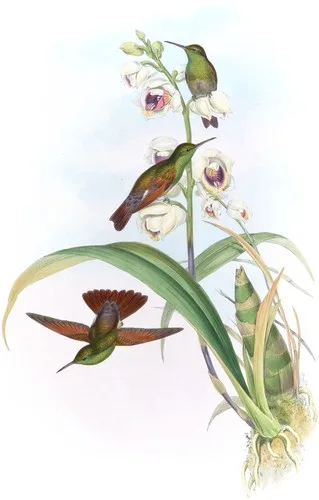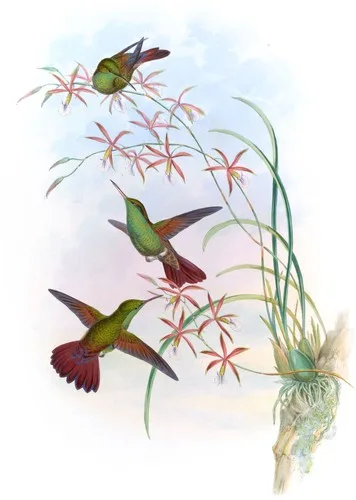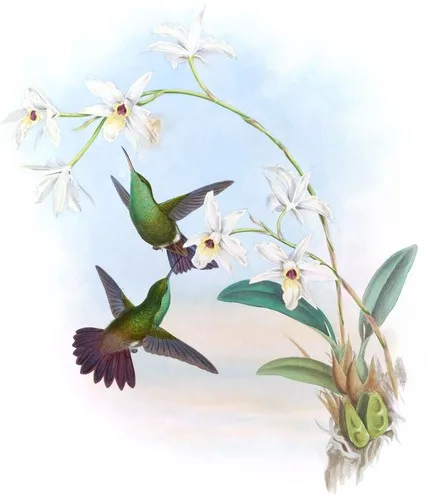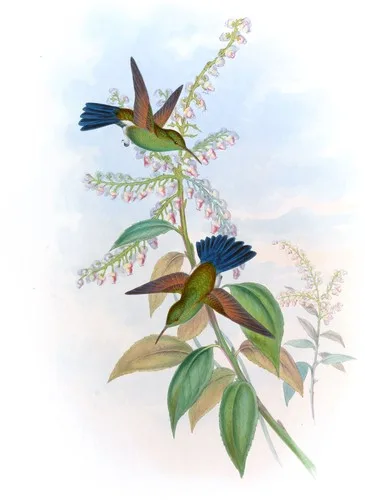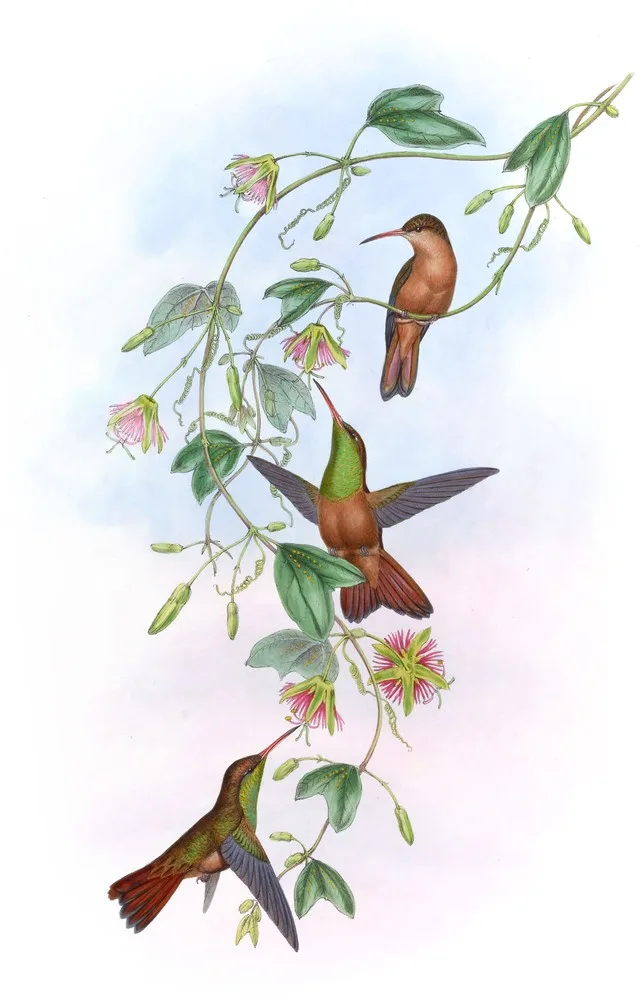
美洲蜂鸟属·Amazilia Yucatanensis
Amazilia Yucatanensis
Amazilia Yucatanensis
Yucatan Amazili
- 中文名
- 美洲蜂鸟属·Amazilia Yucatanensis
- 学名
- Amazilia Yucatanensis
- 合集
- 古尔德蜂鸟图谱
- 绘者
- John Gould(约翰·古尔德)
- 年代
- 1861
- 图版号
- Pl. 308, Vol. V
- 原书页码
- p.308
- 授权
- CC0 1.0 Universal (Public domain)
十观
- 纵幅 1.56∶1
第一眼
论画以形似,见与儿童邻。
—— 宋·苏轼《书鄢陵王主簿所画折枝》
只求画得像,是小孩的眼光。苏轼不是不要形似,是说形似之后还有一层:神。这一幅是竖的:眼睛从下往上走,落点在中段那只鸟身上。先别急着看羽毛,让姿态先立起来。第二步凑近一寸:看线与色的交界,色有没有压住线,线有没有断。第三步,把视线放到最深的那一小块:整幅的用色秩序,都是从那里排开的。
名与实
学名 Amazilia yucatanensis:前一词是属,管它归在哪一类;后一词是种加词,管它在这一类里凭什么与众不同。一百多年前的命名者,把一种植物的来历压进了两个词。此幅尚无通行中文名,姑以学名相称;在没有本地名字的地方,学名就是它唯一的身份证。
形与色
蜂鸟为美洲最小之鸟,喙细长如针,舌分叉成管,可伸入花心吸蜜;翼小而振频极高,能悬停、能倒飞。此幅未作色相归档,只能就形制论。看羽:先看覆羽的层次,再看飞羽的排列,最后才看颜色——颜色是最后才被注意到的部分。
构图与呼吸
画幅高而窄,鸟栖在枝的中段,上下留白多——十九世纪鸟谱的标准版式,留给它飞走的余地。全幅只画一只,不作解剖附图——这类图更近于“观赏”,而非“鉴定”。空白不是没画完,是给眼睛留的落脚处:一张图若四边都塞满,花反而会闷。
一刀一色
十九世纪后半叶,石版与彩色石印渐成主流:颜色可以直接印出,不再依赖手工,线条反倒退居其次。图像的“准确”提高了,手性却淡了。先判断它是“印”的还是“画”的,再谈好不好看——这是看老版画最实用的一条规矩。想动笔临它的人记住一句:先铺大块的形与色,干后再收细部;石印的柔和层次来自薄涂与网点,水彩分两三遍淡铺即可逼近。
诗境
穿花蛱蝶深深见,点水蜻蜓款款飞。
—— 唐·杜甫《曲江二首》
中土无蜂鸟,然“穿花”之态,杜甫早已写过:贴着花心走,是采蜜者的共同姿态。古人写到这一层,已不只是赏花,是借花说人;画面则只负责把那朵花留住。
花语
阿兹特克以蜂鸟为战神与太阳的化身;欧洲维多利亚时代则以蜂鸟为收藏与装饰的极致,百万只羽毛被做成胸饰。中国旧籍无此鸟,故无象征——这空白本身,就是一部博物学交流史。在图谱里,它首先是一个物种,其次才是一种象征——这个次序值得记住。
时与地
温带种类的蜂鸟则随花北迁,一年往返数千公里。仅产美洲,自阿拉斯加南部至火地岛,以安第斯山最为繁盛。中土无蜂鸟,汉籍不载,晚清海外游记始见其名。图上所记的 1861 年是刊行之年,不是采到那只鸟的年份;真正的观察记录通常比出版早一两年。看叶的老嫩、花与果是否同在枝上,季节便八九不离十;看题名里藏着的地名,来路也猜得出七分。
书与人
《古尔德蜂鸟图谱》只署了约翰·古尔德一个人的名字。版画是集体工程:绘图、刻版、上色各有其人,真正决定这幅图好不好看的,常是没留下名字的刻工与上色师。
带走一双眼睛
把这三件事带走:先整体后细节;先线后色;先看画再翻书。任何一张老图版,都可以用这三条读。1861 年的那只鸟早已化作尘土,它留在纸上的样子,却比任何一只活着的同类都长寿。
关于本图版
《古尔德蜂鸟图谱》(Gould's Hummingbirds)由约翰·古尔德绘制,1849—1887 年间印行,本图即其中一幅。美洲蜂鸟(Amazilia Yucatanensis)是本图的主角,在分类体系中列于蜂鸟科(Trochilidae)。
该合集全编共 421 幅图版,此图为其中之一,图版编号 Pl. 308, Vol. V,对应原书第 308 页,版式为纵幅。扫描件取自公有领域原件,经高分辨率修复与色彩校正,可按原大放大查看线条与设色。
原书文字(英文 / 法文)
Yucatan
I am much indebted to Dr. Cabot, of Boston, North America, for the loan of the type specimen of his Trochilus Yucatanensis, a bird which differs from every other species that has come under my notice.
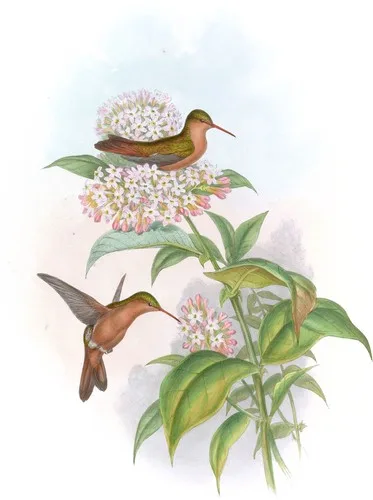
It is perhaps most nearly allied to the Amazila cerviniventris, but differs in the truncate form of the green colouring of the throat, which in that bird extends down each flank. Dr. Cabot sent at the same time another specimen, which he considered to be the female; and this may possibly be the case; but I suspect that it will prove to be another species, the A. cinnamomea (A. corallirostris of my work). The upper figure in the accompanying plate is an exact representation of this specimen; and it remains for future research to determine whether my surmise be correct or not. In all probability the A. cinnamomea flies in Yucatan, as it is very common in the neighbouring countries of Honduras and Guatemala.
The following is Dr. Cabot’s description and brief account of this species, published in the ‘Proceedings of the Boston Society of Natural History,’ to which, I learn, he has nothing to add; for, in a letter dated April 30, 1859, he says, “It gives me great pleasure to aid you as far as I am able in your most interesting and beautiful work; but I regret exceedingly to say that it is a long time since my observations were made, and that my notes were unfortunately lost overboard while coasting along the shore of Yucatan in a canoe, I regret also that I have no duplicate of the male to present to you.”
Trochilus Yucatanensis. Length 4 inches. Bill
of an inch. First primary longest; primaries curved, broadest at their tips; tail, somewhat forked, rather more than 1 ; inch long, consists of ten feathers; bill light yellowish at base and along centre of mandibles, dark horn-colour at tip and halfway along sides; male brilliant shining emerald on chin, throat, and upper part of breast; head, upper part of neck, and back dull golden green with some metallic reflexions; lower part of breast, belly, under tail-coverts, central and upper part of tail-feathers light bay; tips and both sides of central tail-feathers and outer side of lateral tail-feathers dark golden green with metallic reflexions; vent white; female nearly the same as male, but rufous instead of bright emerald on chin, neck, &c., and less white about vent. This is the most common Humming-Bird found in Yucatan. It was seen in numbers about the acacias which grew upon the tops of the ruined buildings, where the specimens from which the above description was taken were procured.
The figures are of the natural size. The plant is the Passiflora Medusæa.
References
- Trochilus Yucatanensis, Cabot in Proc. of Bost. Soc. of Nat. Hist., Nov. 19, 1845.