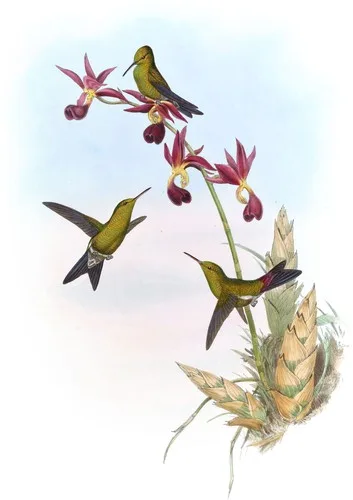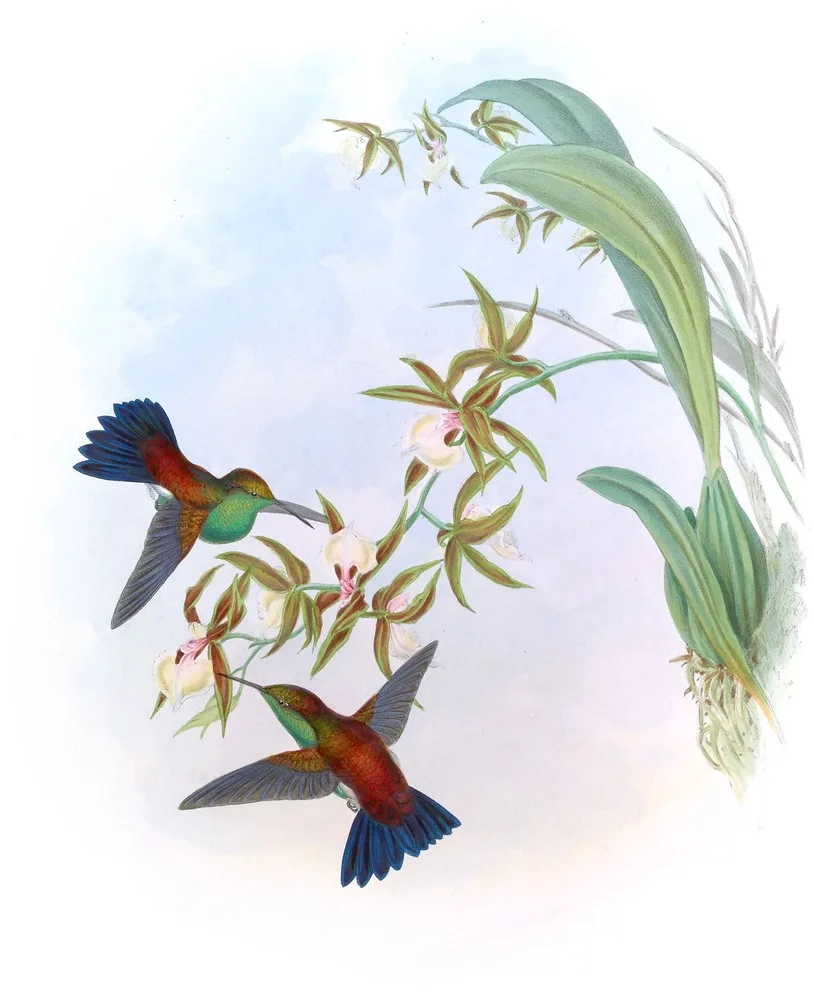
Erythonota antiqua
Erythonota antiqua
Erythronote
- 学名
- Erythonota antiqua
- 合集
- 古尔德蜂鸟图谱
- 绘者
- John Gould(约翰·古尔德)
- 年代
- 1861
- 图版号
- Pl. 316, Vol. V
- 原书页码
- p.316
- 授权
- CC0 1.0 Universal (Public domain)
十观
- 略纵 1.23∶1
第一眼
搜尽奇峰打草稿。
—— 清·石涛《苦瓜和尚画语录》
走遍山川,才有资格落笔。博物画的画家也一样:先在温室与山野里看够了活的花,纸上那一朵才不虚。这一幅略高于宽,落点在中央偏上那只鸟的头部。第二步凑近一寸:看线与色的交界,色有没有压住线,线有没有断。第三步,把视线放到最深的那一小块:整幅的用色秩序,都是从那里排开的。
名与实
学名 Erythonota antiqua:前一词是属,管它归在哪一类;后一词是种加词,管它在这一类里凭什么与众不同。双名制的好处是唯一:全世界叫这个名字的,只能是这一种。此幅尚无通行中文名,姑以学名相称;在没有本地名字的地方,学名就是它唯一的身份证。
形与色
蜂鸟为美洲最小之鸟,喙细长如针,舌分叉成管,可伸入花心吸蜜;翼小而振频极高,能悬停、能倒飞。此幅未作色相归档,只能就形制论。没有解剖图,就靠主株一处一处看过去:叶怎么排,花怎么着生,果在哪里。
构图与呼吸
画幅略高于宽,鸟身居中偏上,视线落在头部与喙。全幅只画一只,不作解剖附图——这类图更近于“观赏”,而非“鉴定”。试着用拇指遮住空白处——画面立刻变闷;放开,它才重新“喘上气”。留白,是给主体让出的气口。
一刀一色
十九世纪后半叶,石版与彩色石印渐成主流:颜色可以直接印出,不再依赖手工,线条反倒退居其次。图像的“准确”提高了,手性却淡了。先判断它是“印”的还是“画”的,再谈好不好看——这是看老版画最实用的一条规矩。想动笔临它的人记住一句:先铺大块的形与色,干后再收细部;石印的柔和层次来自薄涂与网点,水彩分两三遍淡铺即可逼近。
诗境
夫列子御风而行,泠然善也,旬有五日而后反。
—— 《庄子·逍遥游》
蜂鸟悬停于空,不落不飞,最近于“御风”。庄子说的是一种自由的姿态,蜂鸟把它做成了生理事实。诗以气行,画以形立;两种“看”叠在一起,才是看画的意思。
花语
阿兹特克以蜂鸟为战神与太阳的化身;欧洲维多利亚时代则以蜂鸟为收藏与装饰的极致,百万只羽毛被做成胸饰。中国旧籍无此鸟,故无象征——这空白本身,就是一部博物学交流史。花语是给人与人的关系用的;植物自己只关心有没有传粉的虫。这两套语言,可以并行不悖。
时与地
热带美洲几乎全年可见,花期即其季节。仅产美洲,自阿拉斯加南部至火地岛,以安第斯山最为繁盛。中土无蜂鸟,汉籍不载,晚清海外游记始见其名。图上所记的 1861 年是刊行之年,不是采到那只鸟的年份;真正的观察记录通常比出版早一两年。看叶的老嫩、花与果是否同在枝上,季节便八九不离十;看题名里藏着的地名,来路也猜得出七分。
书与人
《古尔德蜂鸟图谱》只署了约翰·古尔德一个人的名字。图版今属公有领域,可以自由取用;但纸上那层手工上色,仍是两百年前某一个人的手。
带走一双眼睛
下次看鸟,别急着认名:先看它停的姿态,再看羽色在哪一段最深,最后才翻图鉴——顺序一换,看鸟就从“对答案”变成了“看画”。二百年后,这只鸟的后代或许仍在某处活着;而纸上这一只,永远停在 1861 年的那个季节。
关于本图版
此图原刊于《古尔德蜂鸟图谱》(Gould's Hummingbirds),绘者为约翰·古尔德,成书于 1849—1887 年间。图中描绘的是 Erythonota antiqua,归入蜂鸟科(Trochilidae)。
全编共收录 421 幅图版,本图是其中一幅,原书将其列为 Pl. 316, Vol. V,见第 316 页,版式为纵幅。图为公有领域原件的修复扫描,构图与设色未经改动。
原书文字(英文 / 法文)
Trinidad, Tobago, and Venezuela
Are we to regard the several birds generally known under the name of Erythronotes as one or as many species? Great care is required at the hand of the ornithologist respecting this peculiar section of the Trrochilidæ.
In every group of birds which the monographer attempts to illustrate, some one or two species will be found to vary, or sport as it were, in their size and colouring more than others; fortunately, however, these are the exceptions, and not the rule. I may ask, is the great bird from Tobago the same as the more diminutive bird from Trinidad? Again, is the bird from the Caraccas, which is of the same size as that from Trinidad, but from which it differs in having bright chestnut under tail-coverts, the same ? Or are we to regard them as so many species? For the present, I believe it will be better to consider them identical, for this reason: I find that the specimens from Trinidad differ very considerably among themselves, some having beautiful violet-grey under tail-coverts, while in others those feathers are uniform chestnut, and in others again they are olive-grey; it is clear, therefore, that the difference in the colouring of these feathers cannot be regarded as of importance. In making these remarks, it must be understood that I exclude the bird to which M. Bourcier has given the name of Feliciæ—a bird most nearly allied, but which has never, I believe, any red colouring on the nape and back,—a feature found in all those previously noticed, whether from Trinidad, Tobago, or the Caraccas. The figures in. the accompanying Plate were taken from Trinidad specimens to which I would apply the term antiqua, as being the oldest known. If future research should discover good grounds for separating the larger Tobago birds, they might receive a new specific name, as indeed may the other also. In the imperfect state of our knowledge, I feel that Iam right in placing them together, and I do this with a strong bias to the opinion that they will never be separated. With regard to the Trinidad bird, but little has been recorded respecting it. Mr. Tucker informed me that it is very common all over the island, inhabiting the woods as well as the savannahs, but more frequently the latter, visiting almost every flower that comes in its way. In the twentieth volume of the ‘Annals and Magazine of Natural History,’ above referred to, Sir William Jardine, quoting from Mr. Kirk’s notes on the Tobago bird, says: “begins to build about the 10th of February, generally on a small stalk, or on the upper side of some twig, sometimes so hidden from the eye by a large leaf as to preclude all possibility of seeing it from above, and often so near the ground as to remain undiscovered: makes a small nest, in which it lays two pure white eggs.” Lesson, I believe, is quite wrong in giving Brazil as the habitat of this bird, for I have no reason to suppose that it is ever found there.
Not much difference occurs in the plumage of the sexes, and the young at an early age assume the adult livery, or a dress very similar to it.
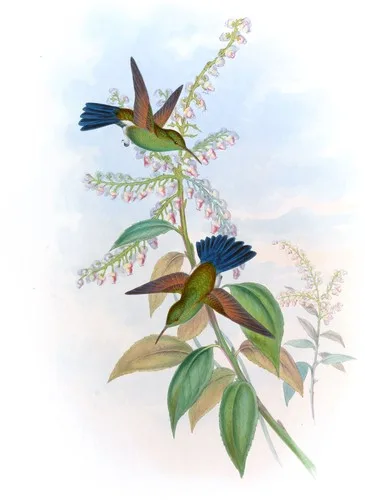
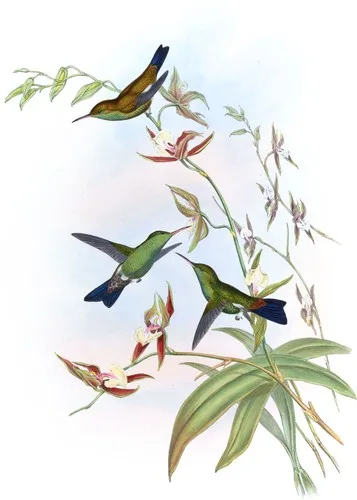
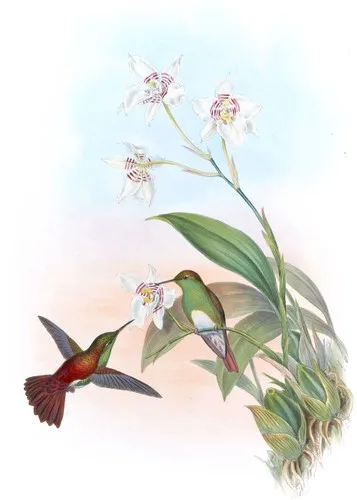
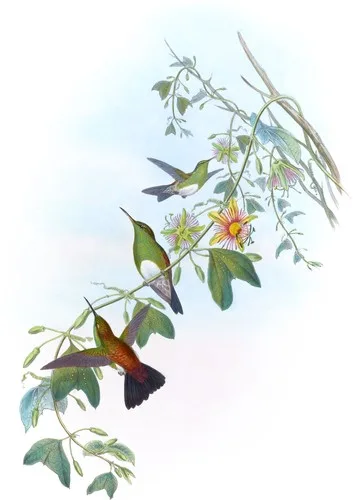
Forehead yellowish shining green; crown and nape, back, wing- and tail-coverts coppery red; wings purplish brown; tail black, with steel-blue reflexions; back of the neck green; breast and under surface shining grass-green; under tail-coverts rufous violet or grey; on each side the flanks an oblong patch of white; bill black, with a lighter base to the under mandible, that part appearing to have been flesh-colour.
The figures are of the size of life. The plant is the Odontoglossum hastilabium, var. fuscatum.
References
- Ornismya erythronotos, Less. Hist. Nat. des Ois.-Mou., p. 181. pl. 61.—Ib. Tab. des Esp. d’Ois.Mou., p. xxxii.—lb. Ind. Gen. et Syn. des Ois. du Gen. Trochilus, p. xxviii.
- Ornismya erythronotus, Less. Rev. Zool. 1839, p. 19.
- Polytmus erythronotus, Gray and Mitch. Gen. of Birds, vol. 1. p. 109, Polytmus, sp. 78.
- Saucerottia erythronota, Bonap. Consp. Gen. Av., p. 77, Saucerottia, sp. 2.—Reichenb. Auf. der Col., p. 8.—Bonap. Rev. et Mag. de Zool. 1854, p. 255.
- Trochilus erythronotus, Jard. in Ann. and Mag. Nat. Hist., vol. xx. p. 374.