Thalurania jelskii
Thalurania jelskii
Jelski’s Wood-Nymph
About this plate
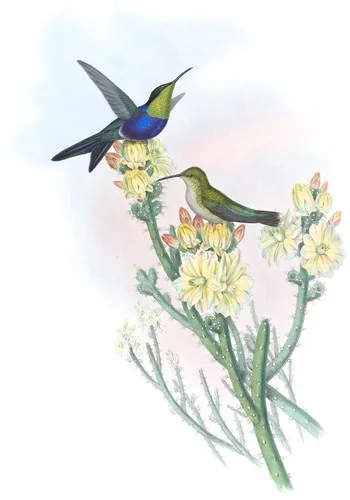
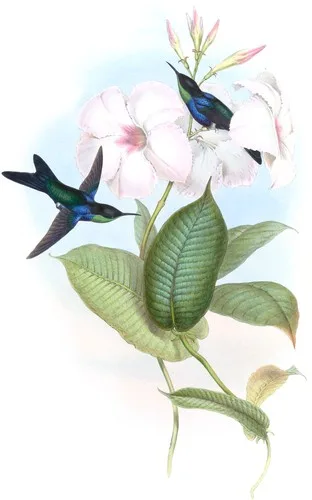
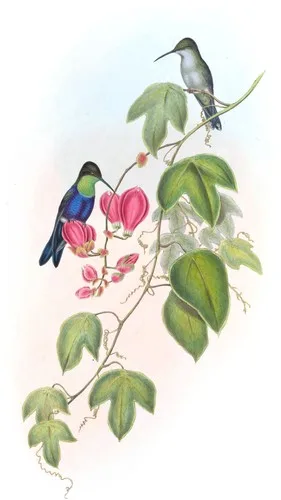
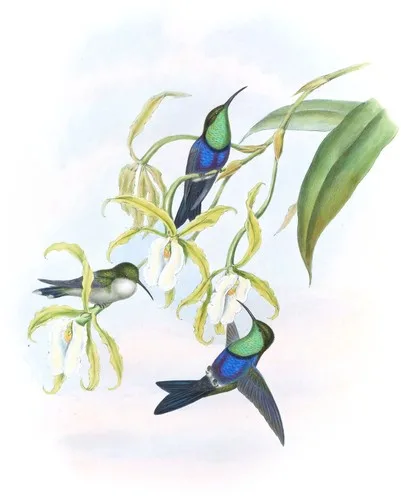
Jelski’s Wood-Nymph was discovered by the well-known Polish traveller after whom the species is named, at Soriano in Peru.
Mr. Elliot writes concerning the present bird:—
This is a diminutive of T. nigrofasciata; and there is absolutely no difference between the two except in size. The rectrices of T. jelskii are narrow, but not more so than accords with its dimensions. I compared the type with specimens of T. nigrofasciata, and could distinguish no difference, save that T. jelskii was a little smaller.
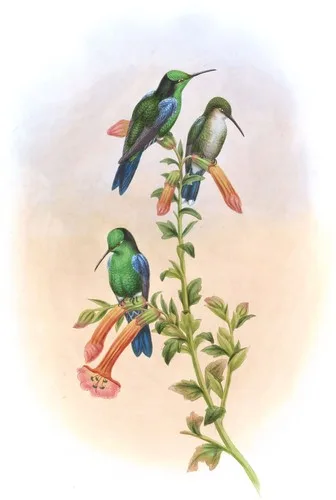
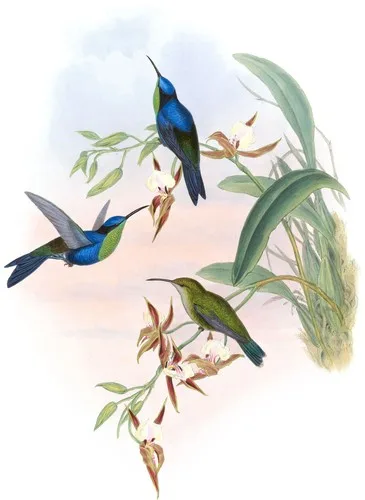
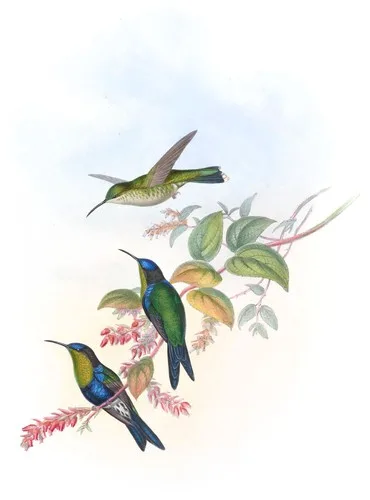
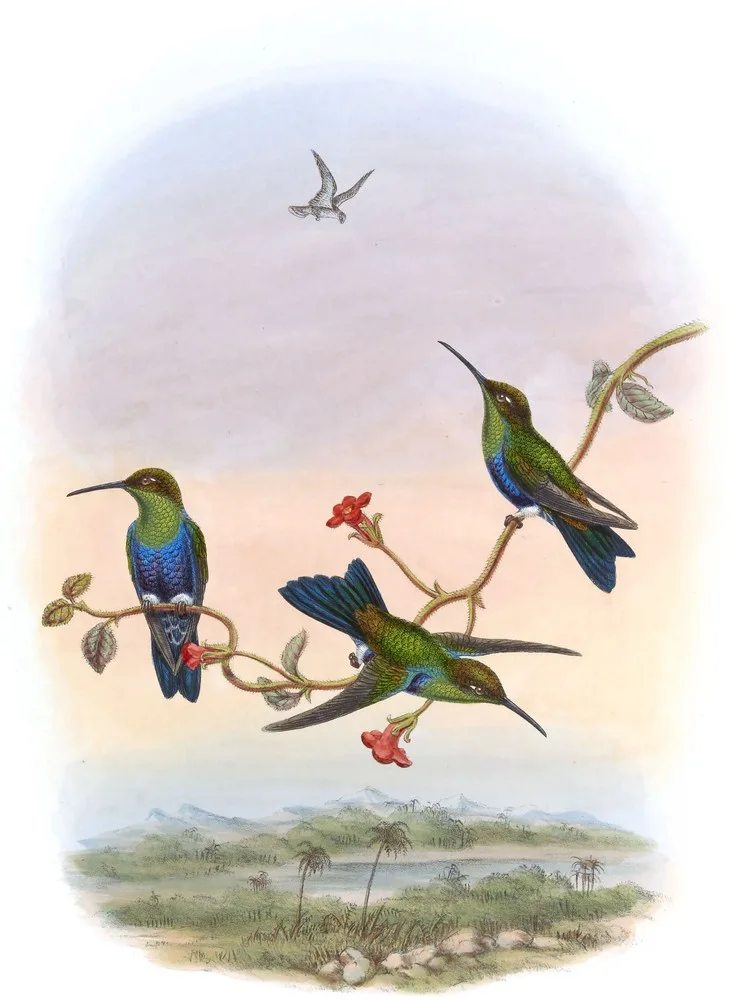
The Plate represents the adult male in three positions, and is drawn from a specimen lent to us by Dr. Taczanowski.
[R. B. S.]
References
- Thalurania jelskii, Tacz. Proc. Zool. Soc. 1874, p: 138.—Mulsant, Hist. Nat. Oiseaux-Mouches, ii. p. 70 (1877).—Elliot, Synopsis of the Humming-Birds, p. 101 (1878).— Kudes-Deslongchamps, Ann. Mus. d’Hist. Nat. de Caen, i. p. 320 (1880).—Tacz. Orn. du Pérou, i. p. 295 (1884).
Ten ways of seeing
- upright 1.37 : 1
- published 1887
- Pl. 389, Suppl. Vol.
Not a catalogue entry but a way of looking: how to stand, what to notice, how the line was cut — then, halfway, a line of Chinese poetry: how the ancients saw this same flower. After it, the flower's language, its season and homeland, its book; and at the end one line of classical prose — and a pair of eyes to take away.
-
First Look
搜尽奇峰打草稿。
—— 清·石涛《苦瓜和尚画语录》
Exhaust the strange peaks, and then make the sketch.
The sheet is vertical: the eye climbs and settles on the bird. Take the posture before the plumage. Then step in close: watch where colour meets line, and whether the line ever breaks. Third, find the darkest small patch: the whole tonal order is measured from there.
-
Name and Thing
The binomial is Thalurania jelskii: the first word is the genus it belongs among, the second the epithet that sets it apart. Two words carry a whole provenance. No established Chinese name exists, so it is cited by its binomial alone.
-
Form and Colour
The smallest of birds: a needle-fine bill, a forked tubular tongue, wings beating so fast the bird hovers and even flies backwards. Its colour is not pigment but structure — light bent by feather barbules, changing with the angle.No colour group is recorded. A single plant, laid out with nothing hidden.
-
Composition
Tall and narrow, the bird perched mid-branch with generous margins above and below. (about 1.37 : 1) No details are appended: a plate for looking, not for keying out. Blank paper is not unfinished work: it is where the eye rests.
-
Line and Colour
In the later nineteenth century chromolithography took over: colour printed rather than painted, line demoted. Craft leaves franker evidence than inscriptions. If you mean to copy it: block in the broad shapes and colours first, detail last; lithographic softness comes from thin washes — two or three pale layers will get you close.
-
Poetic Resonance
穿花蛱蝶深深见,点水蜻蜓款款飞。
—— 唐·杜甫《曲江二首》
Butterflies thread the flowers, seen deep within; dragonflies touch the water and fly on, slow and deliberate.
The poem gives the mood first and the picture supplies the form; set the line beside the plate and the bird itself becomes its resting point.
-
Symbolism
For the Aztecs the hummingbird was warrior and sun; for Victorian Europe it was the ultimate ornament, millions killed for breast jewellery. China has no tradition here — and that blank is itself a history of exchange. Meanings change their tune: the same flower can say opposite things within a century.
-
Season and Place
temperate hummingbirds follow the bloom north and back, thousands of kilometres a year. Americas only, from southern Alaska to Tierra del Fuego, richest in the Andes. China has no hummingbirds and no classical record of them. The year 1887 on the plate is that of publication, not of flowering — the gathering came a year or two earlier. Read the locality and the flowering season both with a discount: one is hearsay, the other a ten-day peak.
-
The Book and the Hand
“Gould's Hummingbirds” was drawn by John Gould and published 1849-1887. This plate is Pl. 389, Suppl. Vol., book page 389. The image is public domain; the hand-colouring is still one person's hand.
-
The Written Tradition
宁古无时,宁朴无巧,宁俭无俗。
—— 明·文震亨《长物志》
Better old than fashionable, better plain than clever, better spare than vulgar.
Gould's Hummingbirds (1849–1887) used hand-coloured lithography over gold leaf so the iridescence survived on paper — a monument to Victorian printing and collecting alike. The difference is not of quality but of question: Europe asks what it is, China asks whom it resembles.
What to Take Away
Carry three rules away: whole before detail; line before colour; picture before book. A flora exists to be consulted; look long enough and you forget to consult — someone in 1887 gave a whole day to a single flower.