Allium Sulcatum
Ail Cannelé
Ail Cannelé
About this plate
Description
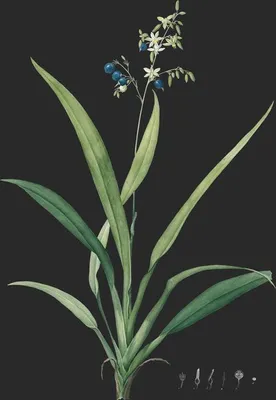
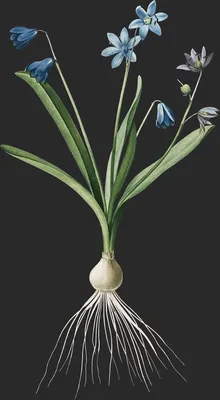
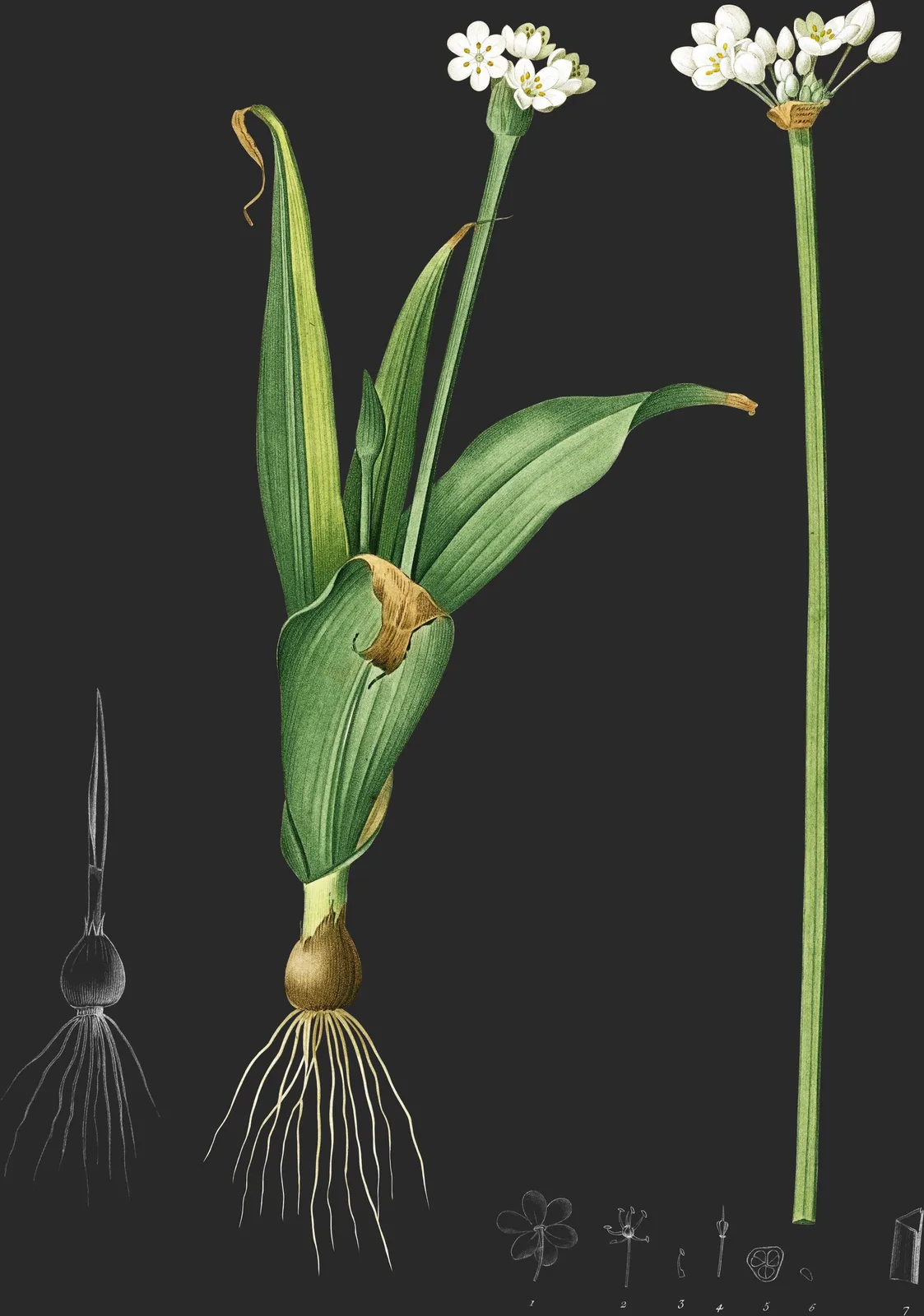
La bulbe de cet Ail est ovoïde, d’un roux un peu brun et de la grosseur d’une noisette: elle donne naissance à quatre ou cinq feuilles radicales, droites, parfaitement glabres, planes, lancéolées, engaînantes à la base, un peu roides, larges de plus d’un pouce, longues de quatre à six pouces; leur côte moyenne est saillante en dessous, anguleuse et marquée dans le milieu d’un sillon longitudinal.
Du milieu des feuilles sélèvent une ou deux hampes droites, roides, trian-gulaires, munies sur leurs trois faces de côtes saillantes, et remarquables en ce que leurs angles sont presque toujours marqués d’un sillon longitudinal, comme on peut le voir (planche 482, fig. 7). Cette hampe n’est nullement penchée avant la fleuraison: elle commence à fleurir n’étant encore que de la longueur des feuilles, et ne la dépasse qu’à la fin de la fleuraison.
La spathe est membraneuse, d’une seule pièce, en forme de cloche, divisée en deux ou trois lobes courts et peu étalés: les fleurs sont disposées en ombelle serrée; leurs pédicelles dépassent peu la longueur de la spathe, et sont même plus courts qu’elle dans le commencement de la fleuraison. L’ombelle ne porte point de bulbilles.
Les fleurs sont inodores, d’un blanc de neige; leur périgone est ouvert, un peu en cloche, à six segments ovales, obtus, égaux entre eux et dépourvus de nervures; les étamines sont toutes simples, droites, de moitié plus courtes que les segments; les anthères sont ovales, pleines d’un pollen jaunâtre; l’ovaire est blanchâtre, à trois angles obtus; le style est blanc, filiforme, pointu, de la longueur des étamines.
Je n’ai pas vu le fruit.
Histoire
L’Ail cannelé a été observé au Jardin de Montpellier sans qu’on y ait conservé de traces de son origine.
Il fleurit au premier printemps.
Observations
Cette espèce a de grands rapports avec l’Allium album, figuré planche 300, et pourrait peut-être lui être un jour réuni, comme variété: il en diffère cependant par des caractères qui paraissent de nature constante:
- ses feuilles sont deux fois plus larges, plus courtes et moins étalées;
- sa hampe est beaucoup plus sillonnée et remarquable en particulier par ses angles marqués d’une cannelure longitudinale;
- son ombelle est beaucoup plus serrée;
- sa spathe est presque toujours divisée en deux ou trois valves, et non déjetée d’un seul côté.
D. C.
Explication de la planche
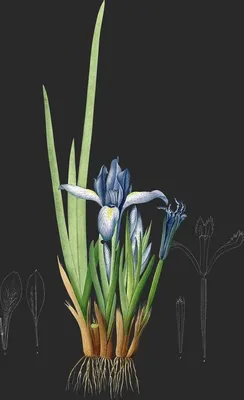
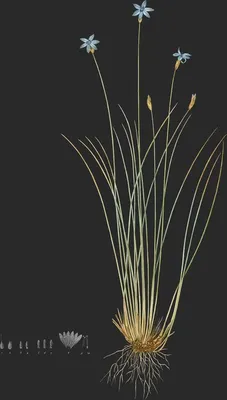
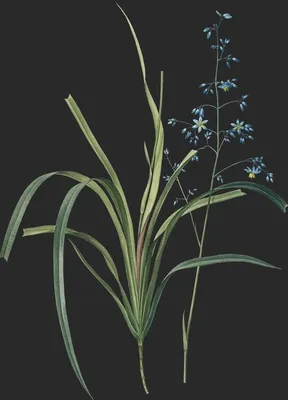
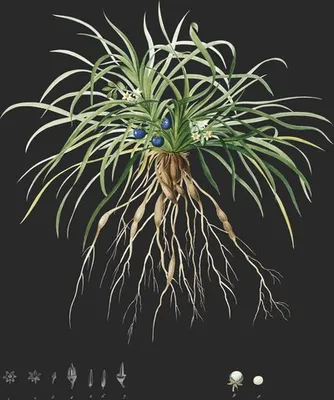
La Plante de grandeur naturelle.
- La fleur vue par-dessus.
- Les étamines et le pistil.
- Une étamine.
- Le pistil.
- Le fruit avant sa maturité, coupé en travers.
- Une graine avant sa maturité.
- La hampe coupée en travers pour montrer les cannelures.
Fam. des Asphodèles. Juss.—Hexandrie monogynie. Lin.
- Allium sulcatum. A. foliis lanceolatis glabris; scapo triquetro, angulis sulcatis; umbellâ capsuliferâ confertâ; petalis ovatis stamina duplò superantibus. Decandol. ined.
Ten ways of seeing
- measured cast yellow-green
- upright 1.43 : 1
- published 1814
- Plate 482
Not a catalogue entry but a way of looking: how to stand, what to notice, how the line was cut — then, halfway, a line of Chinese poetry: how the ancients saw this same flower. After it, the flower's language, its season and homeland, its book; and at the end one line of classical prose — and a pair of eyes to take away.
-
First Look
论画以形似,见与儿童邻。
—— 宋·苏轼《书鄢陵王主簿所画折枝》
To judge painting by likeness alone is the view of a child.
The sheet is vertical: the eye climbs and settles in the upper half. Let the plant stand before you look for detail. Then step in close: watch where colour meets line, and whether the line ever breaks. Third, find where the green is deepest: the whole tonal order is measured from that patch. The pose leans right: the upper half carries 8 points further right than the lower — a living thing, not a diagram.
-
Name and Thing
The binomial is Allium sulcatum: the first word is the genus it belongs among, the second the epithet that sets it apart. Two words carry a whole provenance. The older system filed it under Asparagaceæ by overall affinity; Linnaeus, counting stamens only, placed it in Hexandria — two ways of asking what a plant is. No established Chinese name exists, so it is cited by its binomial alone.
-
Form and Colour
Measured on this plate: flower colour covers 1.6% of the sheet, foliage 9.2%, the cast yellow-green with a second note of amber. No other plate shares exactly this measure. Bulbous plants store the year underground — bulb, corm or tuber — then send up a few thick leaves and a single scape, with six tepals in cup, funnel or star. Filed under green — a moss green, a colour that comes mostly from leaf and stem. Three things fix the habit: leaf arrangement, tepal count, and how the flower is borne.
-
Composition
Tall and narrow, the plant rising in one movement with generous margins — the upright format of most floras. (about 1.43 : 1) No details are appended: a plate for looking, not for keying out. The plant covers only 14% of the sheet, centred above centre; the emptiness is where the eye rests. Old plates set the plant slightly off centre, with unequal margins — that small imbalance is what keeps it alive.
-
Line and Colour
The first half of the nineteenth century moved from copper to steel to lithography; stipple could render the softest transition. Craft leaves franker evidence than inscriptions. If you mean to copy it: take its skeleton, its margins and the order of its colours; the burin's hatching is the language of copper — suggest it with pencil density, do not imitate it stroke for stroke.
-
Poetic Resonance
东风夜放花千树,更吹落、星如雨。
—— 宋·辛弃疾《青玉案·元夕》
East wind at night sets a thousand trees of flowers alight, then blows them down like rain of stars.
The poem gives the mood first and the picture supplies the form; set the line beside the plate and the green the corolla becomes its resting point.
-
Symbolism
The tulip was an imperial emblem in Istanbul and a speculative bubble in Amsterdam; the hyacinth sprang from a boy's blood in Greek myth. What bulbs share is concealment: next year kept underground. Meanings change their tune: the same flower can say opposite things within a century.
-
Season and Place
Early spring to early summer, genus by genus: tulips and hyacinths first, gladiolus and amaryllis later. Three homelands: the Mediterranean, Central Asia and South Africa. The tulip came from Ottoman gardens and became a Dutch mania. The year 1814 on the plate is that of publication, not of flowering — the gathering came a year or two earlier. Read the locality and the flowering season both with a discount: one is hearsay, the other a ten-day peak.
-
The Book and the Hand
“The Liliaceae” was drawn by Pierre-Joseph Redouté and published 1802-1816. This plate is Plate 482, book page 482. The image is public domain; the hand-colouring is still one person's hand.
-
The Written Tradition
庭下如积水空明,水中藻荇交横,盖竹柏影也。
—— 宋·苏轼《记承天寺夜游》
The courtyard seemed flooded with clear water, weeds crossing in it — in fact the shadows of bamboo and cypress.
Li Bai's 'orchid wine, fragrant with yujin' is often misread as tulips; the Tang yujin was a turmeric-like root used to scent wine — same name, different plant. Keep the line; it will surface the next time you meet the same plant.
What to Take Away
Next time you stand before a flowering plant, give it three minutes: leaf arrangement, direction of the flower, the darkest patch. Two centuries on, the plant may still flower in some garden; the one on this sheet stopped in the season of 1814.