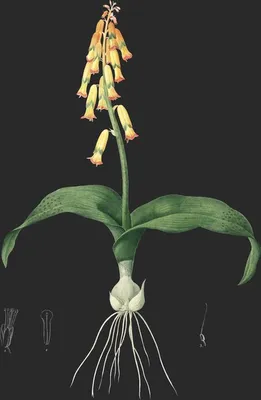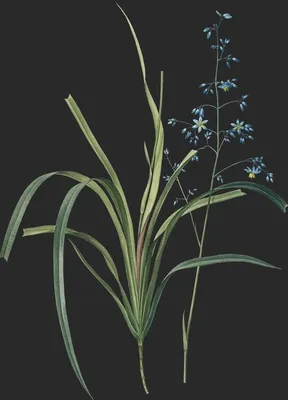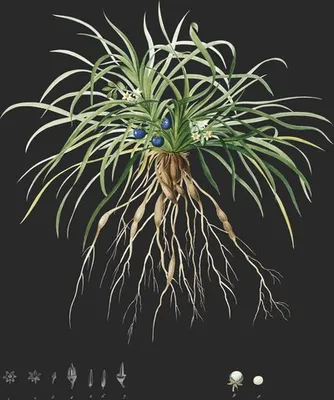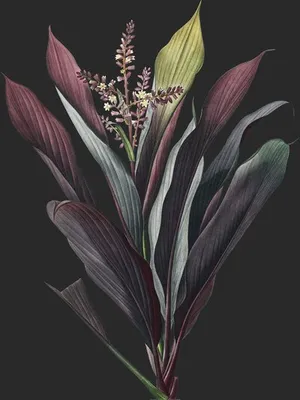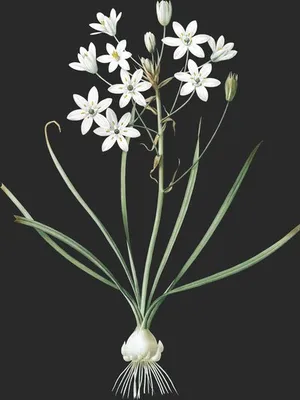
Dianella Ensifolia
山菅兰
Dianelle en Glaive
About this plate
Description
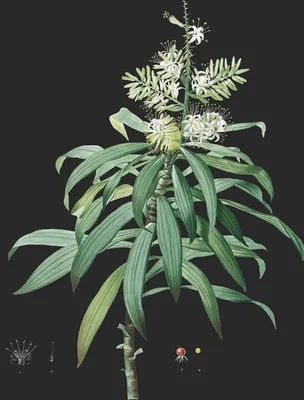
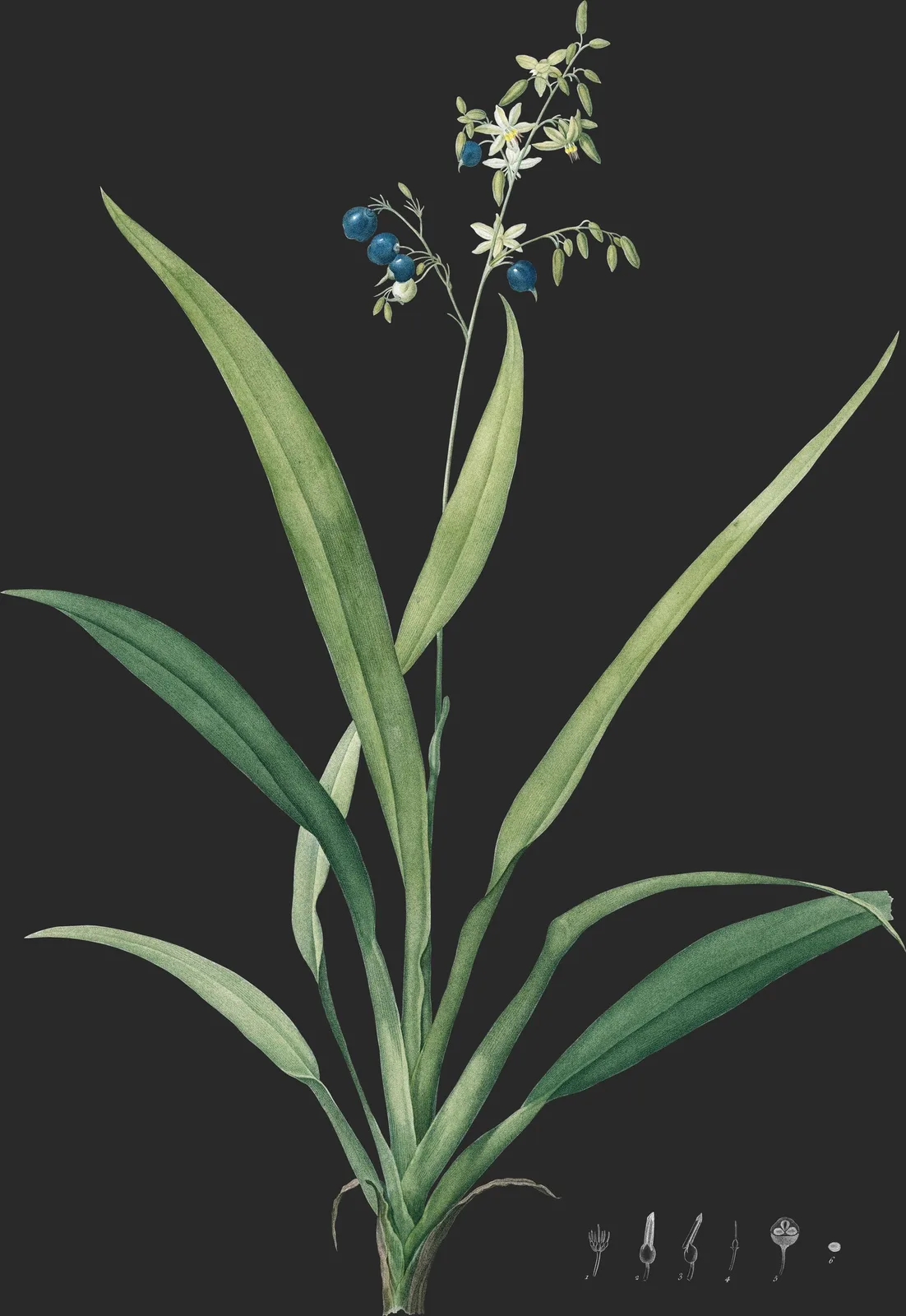
Cette plante frappe au premier aspect l’œil du botaniste par ses fleurs assez semblables à celles des Dracæna, et néanmoins accompagnées de feuilles qui ont de l’analogie avec celles des Iris.
La racine de la Dianelle est composée de fibres cylindriques, divergentes, jaunâtres et presque simples. Ses feuilles partent de la racine; elles ont jusqu’à 4 décimètres de hanteur sur 3 centimètres de largeur; elles sont striées longi-tadinalement, vertes, glabres, un peu hérissées sur les angles: on peut y distinguer deux parties; la gaine, qui est creusée en carène aiguë, et qui embrasse la tige par sa base; le limbe, qui est plane, oblong, entier, pointu.
Du milieu des feuilles s’élève une tige ou hampe droite, simple, cylindrique, plus longue que les feuilles, munie de quelques folioles oblongues, et qui l’embrassent à demi. Cette tige porte un panicule lâche, formé par des pédoncules solitaires ou géminés, qui se ramifient et portent chacun 5–7 fleurs.
La corolle est composée de six pétales tres-ouverts, oblongs, dont les trois extérieurs, qui jouent le role de calice, sont verdatres en dehors et blanchâtres en dedans, et les trois intérieurs sont blancs, avec une raie longitudinale d’un vert jaunâtre.
Dans cette corolle so trouvent six étamines placées devant les pétales; les filets sont blancs et minces dans le bas, jaunes et renfles vers leur sommet; ils portent des anthères droites, longues, linéaires, brunes, à deux loges. Le pistil est composé d’un ovaire globuleux, lisse, posé dans la corolle, d’un style droit, blane, un peu plus long que les anthères, et d’un stigmate simple.
A cette fleur succède une baie globuleuse, d’un beau violet, de la grosseur d’un petit grain de raisin. Cette baie est divisée en trois loges, dont chacune contient 4–5 graines attachées à l’angle intérieur de la loge, ovoïdes, un peu irrégalières, noires et luisantes: une seule de ces graines vient ordinairement à maturité dans chaque loge.
Histoire
La Dianelle en glaive croit dans les bois des Indes-Orientales et dans les les-de-France et de Bourbon. Sonnerat la nommait la Reine-des-Bois. Commerson, toujours poétique dans ses dénominations, l’a comparée à Diane, et l’a nommée Diana, d’ou Lamarck a tiré le nom de Dianelle.
Cette plante est presque toute l’année en fleurs et en fruits dans les serres du Jardin des Plantes. Ses fleurs, lorsqu’elles sont en bouton, sont cylindriques et s’épanouissent lentement; les pédoncules persistent après la chute des fruits.
Observations
Cette plante, que quelques auteurs placent parmi les Dracena, en diflère par ses corolles très-ouvertes, par ses étamines renflées au sommet et non au milieu du filet, par ses baies qui portent un grand nombre de graines, et surtout par son port.
Explication de la planche
La Plante de grandeur naturelle.
- Les parties de la fructification.
- Une étamine vue en dehors grossie à la loupe.
- Une étamine vue en dedans grossie à la loupe.
- Le pistil.
- La baie.
- Une des graines.
Fam. des Asperges. Juss.—Hexandrie monogynie. Lin.
- Dianella ensifolia. D. folis glabris, floribus laxè paniculatis.
- Dianella nemorosa. D. foliis ensiformibus, baceis polyspermis è cœruleo yanthinis. Lam. Dict. Enc. 1. p. 876.*
- Dianella nemorosa. Jacq. hort. Schoenb. 1. p. 49. 1. 94.*
- Draciena ensifolia. D. herbacea subeaulescens, foliis ensiformibus. Lin. Syst. reg. 975. Wild. Spec. a. p. 158. Gorin. Fruct, t.
- Gladiolus odoratus indicus. Rumph. Amb. 5. p. 145. 1. 73.
Twelve ways of seeing
One plate, read twelve times over: its name, its colour, the burin and the brush, the shape of the sheet, the season, the soil it came from, the book it belongs to, its language of flowers, the poem it answers to, the lore behind it, how to look, and what remains.
-
The Name
The plate is titled “Dianella Ensifolia”, numbered Plate 1 (book page 1). No reliable binomial survives on the plate, so it must be cited by its original title. The Chinese name 山菅兰 is a modern rendering of the Latin, not an old garden name — between a plant and its names there is always translation.
-
Form and Colour
A bulb of overlapping fleshy scales gives the lily its Chinese name, 'hundred-fold'; six tepals reflex as the flower opens, around six stamens with long, T-shaped anthers. Filed under green — a moss green. That colour comes mostly from leaf, calyx and stem; the flower occupies a small patch. A botanical plate establishes the plant before it points at the bloom. A single plant, laid out on the sheet with nothing hidden.
-
Line and Colour
The first half of the nineteenth century moved from copper to steel to lithography. Stipple could render the softest transition — Redouté's roses depend on it — while lithography suited broad, gentle washes. Look closely at the line and the colour: an unbroken line means engraving, colour crossing the outline by half a millimetre means hand-colouring. Craft leaves franker evidence than inscriptions.
-
Composition
Tall and narrow, the plant rising in one movement with generous margins above and below — the upright format of most floras. (about 1.45 : 1). No details are appended: this is a plate for looking, not for keying out.
-
Season
Early to high summer, June and July; the flowers last only days, so artists drew them just as they opened. The year 1802 on the plate is the year of publication, not of flowering — the gathering came a year or two earlier.
-
Provenance
Temperate north — China, Japan, Europe. Long used in Chinese medicine, lilies were hunted in East Asia by nineteenth-century collectors and transformed European gardens. In the same volume the kin are shelved together; set several plates side by side and the differences declare themselves.
-
The Book
“The Liliaceae” was drawn by Pierre-Joseph Redouté and published 1802-1816. This plate is Plate 1, book page 1. The image is in the public domain; the hand-colouring on the paper is still one person's hand, two centuries ago.
-
Symbolism
In the West the white lily is Marian purity, held by the angel of the Annunciation; in China the name sounds like 'a hundred years in harmony', a wedding wish. Flower language was added later; the flower knows nothing of it, and that innocence is part of its power.
-
Poetic Resonance
梨花淡白柳深青,柳絮飞时花满城。
—— 宋·苏轼《东栏梨花》
Pear blossoms pale white, willows deep green; when the catkins fly, flowers fill the town.
The poem gives the mood first and the picture supplies the form; set the line beside the plate and the green the corolla becomes its resting point.
-
Classical Lore
The Bencao Gangmu describes the bulb as garlic-like, edible and medicinal; Song writers already noted that the leaves vary while the flowers stay white. Chinese flower books ranked plants by character; European floras described them by form and name. This plate belongs to the second tradition, yet bears reading by the first. Printed in 1802, at the moment the two traditions began to see each other.
-
How to Look
Watch how far the tepals reflex, and the anther colour: green before opening, brown as the flower fades. A sectioned bulb is the mark of a botanical plate. Finally, the edge of the sheet: where the plant is cropped tells you how it was seen — specimen, garden plant, or wild thing.
-
Afterword
Two centuries on, the plant may still flower in some garden; the one on this sheet stopped in the season of 1802.