Scilla Amœna
Scille Agréable
Scille Agréable
About this plate
Description
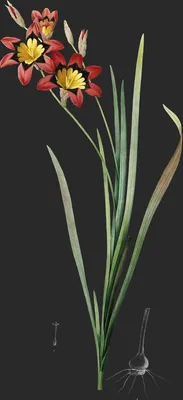
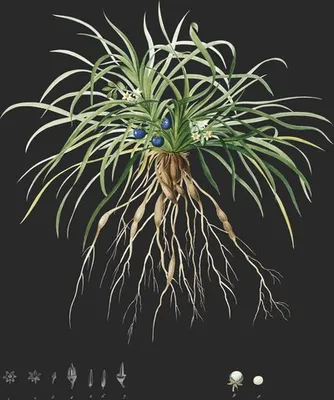
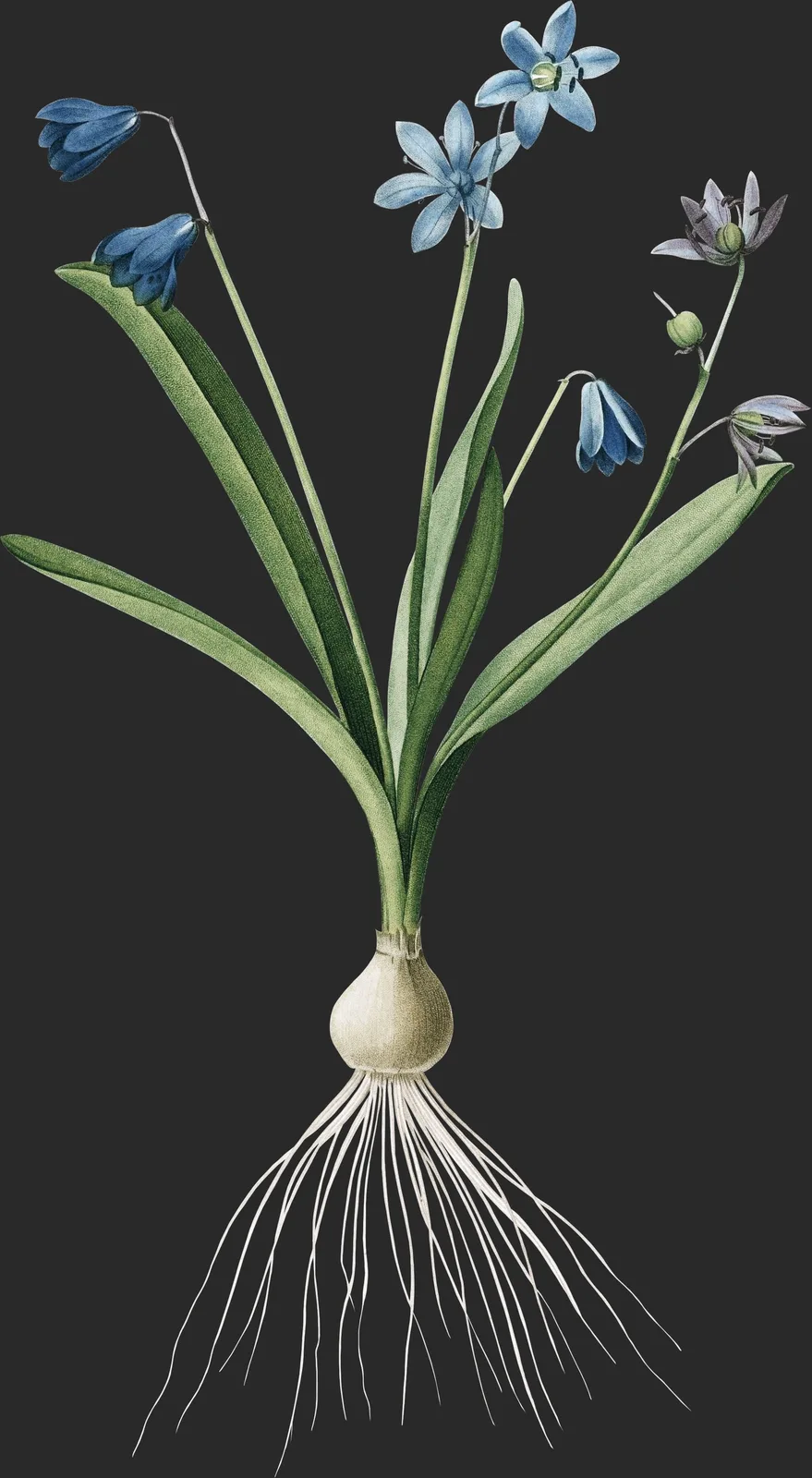
Une bulbe ovoïde, presque arrondie, plus petite qu’une nois, couverte de tuniques minces, donne naissance, par sa base, à un grand nombre de fibres radicales, simples, blanches et menues; de sa partie supérieure sortent plusieurs feuilles radicales courbées en gouttière, oblongues, obtuses, un peu calleuses au sommet, parfaitement glabres, un peu luisantes, d’abord plus courtes que les hampes, ensuite égales à leur longueur, et souvent même plus longues qu’elles.
D’entre les feuilles sortent une ou plusieurs hampes droites, simples, très-anguleuses, hautes de 1–2 décimètres, terminées chacune par une, deux ou trois fleurs, plus grandes que dans les autres Scilles, et d’un bleu améthyste. Ces fleurs sont un peu écartées, portées sur des pédicelles plus courts que la corolle, cylindriques, d’un violet foncé et verdâtre: à la base de ce pédicelle se trouve une bractée avortée, large, très-courte, à trois dents, et de couleur violette. Lorsque la fleur est solitaire, son pédicelle nait au sommet de la hampe.
La corolle est en cloche, ouverte dans sa partie supérieure, un peu serrée à la base, à six parties profondes, oblongues, égales, obtuses, longues de a centimètres au plus, munies d’une nervure longitudinale assez foncée, et de deux petites taches blanches à sa base.
Les étamines sont au nombre de six, placées devant chacune des parties de la corolle, presque de moitié plus courtes qu’elles, droites, et serrées contre le pistil: leurs filets sont en forme d’alêne, blancs, avec le sommet bleuâtre et très-aigu; les anthères sont ovales, vacillantes, de couleur bleue; le pollen a une teinte bleue qui tire sur le vert d’eau.
L’ovaire est libre, arrondi, à trois angles très-obtus, d’un vert pâle, chargé d’un style droit, filiforme, égal à la longueur des étamines: ce style est blane, avec le sommet bleu, à trois lobes très-courts et à peine visibles.
Le fruit est une capsule à trois loges, à trois valves chargées d’une cloison longitudinale sur leur face interne.
Histoire
On assure que cette plante est indigène de Constantinople et a été apportée en Europe en 15g0. Forskahl ne l’indique point dans son catalogue des plantes de Constantinople, et on la trouve certainement dans plusieurs parties de l’Europe, où elle parait véritablement naturelle. Ainsi elle se retrouve en Russie, en Autriche, en Allemagne, et jusques en France, dans le département des Landes: elle s’est presque naturalisée dans les bosquets du Jardin des Plantes de Paris. ♃.
Elle fleurit au printemps.
- Scilla amœna. S. floribus lateralibus, alternis; scapo angulato. Lin. Spec. 443. Hort. Cliff. 123. Roy. Lugd-b, 33. Jacq. austr. t. 318. Mill, Dict. n. 5. Kniph. cent. 11. n. 91. Fl. fr. 3. ed. n. 1937.
- Scilla amœna. S. scapo angulato; pedunculis alternis, flore brevioribus; bracteis obtusis, brevissimis. Willd. Spec. 2. p. 127. Pers. Ench. 366.
- Hyacinthus stellaris, coeruleus, amœnus. C. Bauh. pin. 46. Rudb. Elys. 2. p. 34. t. 7.
- Hyacinthus stellaris byzantinus. Besl. Eynst. vern. 43. f. 2. Clus. Hist. 1. p. 184.
Ten ways of seeing
- measured cast blue
- upright 1.82 : 1
- published 1805
- Plate 130
Not a catalogue entry but a way of looking: how to stand, what to notice, how the line was cut — then, halfway, a line of Chinese poetry: how the ancients saw this same flower. After it, the flower's language, its season and homeland, its book; and at the end one line of classical prose — and a pair of eyes to take away.
-
First Look
夫象物必在于形似,形似须全其骨气。
—— 唐·张彦远《历代名画记》
Likeness is the threshold; bone-and-breath is the point.
The sheet is vertical: the eye climbs and settles in the upper half. Let the plant stand before you look for detail. Then step in close: watch where colour meets line, and whether the line ever breaks. Third, find where the green is deepest: the whole tonal order is measured from that patch.
-
Name and Thing
Only the genus Scilla is given; species-level names came later. The older system filed it under Asparagaceæ by overall affinity; Linnaeus, counting stamens only, placed it in Hexandria — two ways of asking what a plant is. No established Chinese name exists, so it is cited by its binomial alone.
-
Form and Colour
Measured on this plate: flower colour covers 2.0% of the sheet, foliage 5.4%, the cast blue with a second note of yellow-green. No other plate shares exactly this measure. Bulbous plants store the year underground — bulb, corm or tuber — then send up a few thick leaves and a single scape, with six tepals in cup, funnel or star. Filed under green — a moss green, a colour that comes mostly from leaf and stem. A single plant, laid out with nothing hidden.
-
Composition
Tall and narrow, the plant rising in one movement with generous margins — the upright format of most floras. (about 1.82 : 1) No details are appended: a plate for looking, not for keying out. The plant covers only 14% of the sheet, centred above centre; the emptiness is where the eye rests. Old plates set the plant slightly off centre, with unequal margins — that small imbalance is what keeps it alive.
-
Line and Colour
The first half of the nineteenth century moved from copper to steel to lithography; stipple could render the softest transition. Craft leaves franker evidence than inscriptions. If you mean to copy it: take its skeleton, its margins and the order of its colours; the burin's hatching is the language of copper — suggest it with pencil density, do not imitate it stroke for stroke.
-
Poetic Resonance
郁金香是兰陵酒,枉入诗人赋咏来。
—— 宋·王安石《答熊本推官金陵寄酒》
The poem gives the mood first and the picture supplies the form; set the line beside the plate and the green the corolla becomes its resting point.
-
Symbolism
The tulip was an imperial emblem in Istanbul and a speculative bubble in Amsterdam; the hyacinth sprang from a boy's blood in Greek myth. What bulbs share is concealment: next year kept underground. Meanings change their tune: the same flower can say opposite things within a century.
-
Season and Place
Early spring to early summer, genus by genus: tulips and hyacinths first, gladiolus and amaryllis later. Three homelands: the Mediterranean, Central Asia and South Africa. The tulip came from Ottoman gardens and became a Dutch mania. The year 1805 on the plate is that of publication, not of flowering — the gathering came a year or two earlier. Read the locality and the flowering season both with a discount: one is hearsay, the other a ten-day peak.
-
The Book and the Hand
“The Liliaceae” was drawn by Pierre-Joseph Redouté and published 1802-1816. This plate is Plate 130, book page 130. The image is public domain; the hand-colouring is still one person's hand.
-
The Written Tradition
人无癖不可与交,以其无深情也。
—— 明·张岱《陶庵梦忆》
Never make a friend of a man without an obsession: he has no deep feeling.
Li Bai's 'orchid wine, fragrant with yujin' is often misread as tulips; the Tang yujin was a turmeric-like root used to scent wine — same name, different plant. Keep the line; it will surface the next time you meet the same plant.
What to Take Away
Appreciation is not knowledge but habit — one more look each time. A flora exists to be consulted; look long enough and you forget to consult — someone in 1805 gave a whole day to a single flower.