Trillium Rhomboideum
Trillium Rhomboïdal
Trillium Rhomboïdal
About this plate
Description
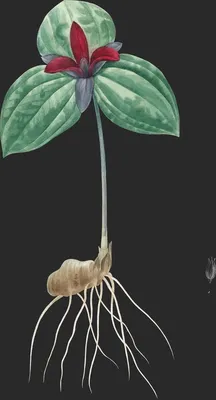
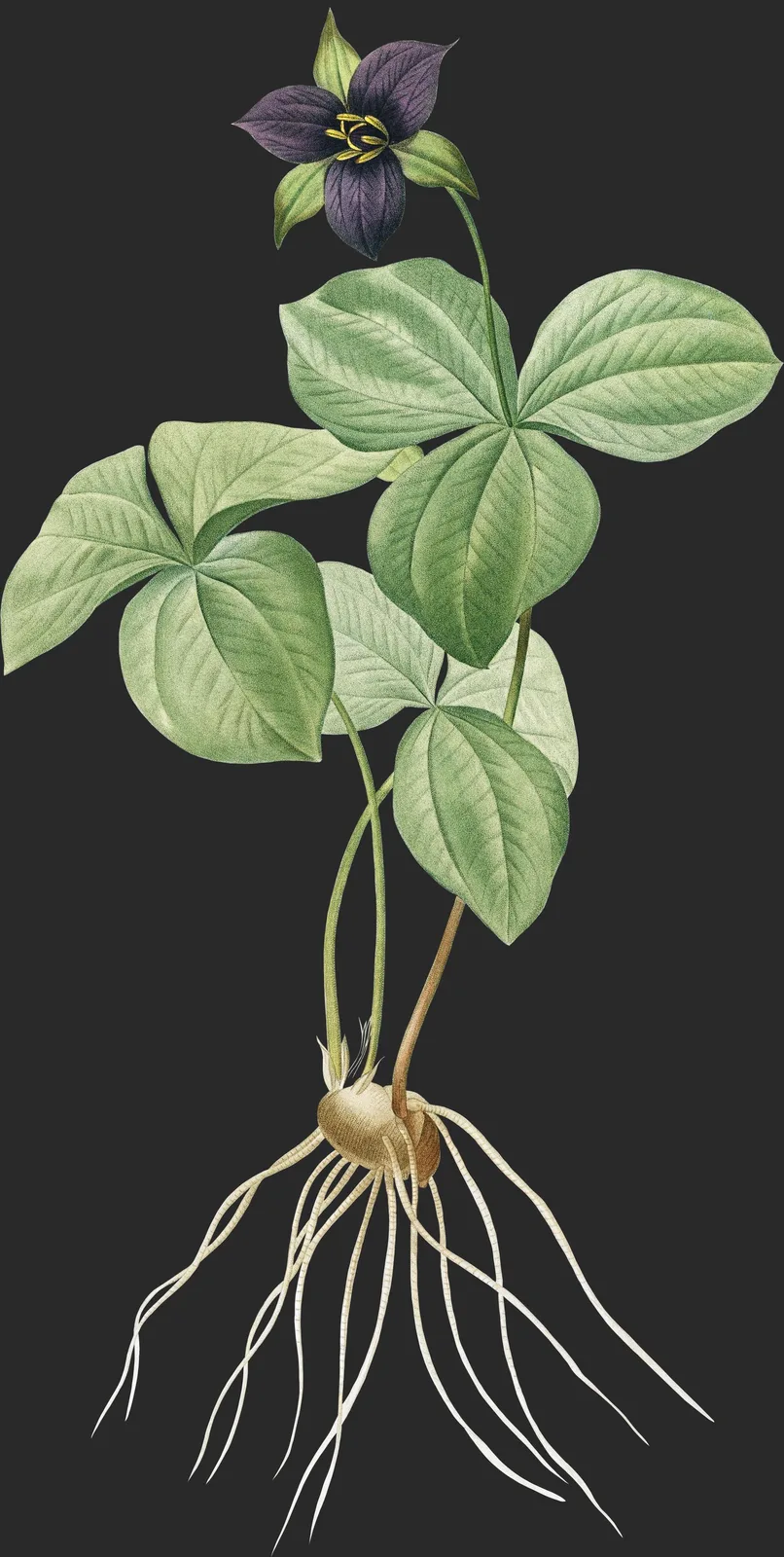
Cette espèce diffère du Trillium sessile par sa fleur pédonculée, et par ses feuilles non panachées; mais quels que soient les rapports de leur structure, nous pensons qu’il ne sera pas inutile de donner la description détaillée du Trillium rhomboidal, alin de mieux faire connaitre l’organisation de ce genre singulier.
Une souche blanchâtre, épaisse, horizontale, souterraine, émet, par sa base, des radicules, simples, cylindriques, qui se dirigent en bas, et qui sont marquées, surtout vers leur origine, de stries transversales; vers la partie supérieure de la souche, naissent deux ou trois hampes, dont la longueur atteint à peine un décimètre: ces hampes sont eylindriques, lisses, glabres, ainsi que le reste de la plante, munies à leur origine d’une écaille ovale, membraneuse et engainante, nues dans toute leur longueur, et terminées par un verticille de trois feuilles.
Ces feuilles sont ovales, presque rhomboïdales, un peu pointues, sessiles, étalées, glabres, d’un vert foncé, munies de trois nervures rameuses, entières sur les bords, longues de 4&nd’;5 centimètres, sur 3 centimètres de largeur. Du milieu d’entre elles s’élève un pédicelle cylindrique, un peu incliné, long de 3 centimètres, et terminé par une seule fleur.
Celle-ci, quoique d’une seule pièce, parait composée de six parties disposées sur deux rangs très-distinets; les trois extérieures, appelées calice par quelques auteurs, sont foliacées, ovales-lancéolées, pointues, lisses, marquées de cinq nervures, étalées des la base, un peu roulées en dehors vers le sommet, longues de 18–20 millimètres, sur 8&nd’;10 de largeur; les trois intéricures, qu’on désigne souvent sous le nom de corolle, sont alternes avec les précédentes, ouvertes, un peu roulées en dehors, plus longues que les divisions externes; leur couleur est d’un pourpre foncé, couleur qui se retrouve aussi souvent à la surface supérieure des divisions calicinales.
Les six étamines sont placées devant les parties de la fleur; leurs filets sont très-courts, d’un pourpre foncé, droits, terminés par des anthères linéaires, droites, à deux loges pleines d’un pollen jaunâtre.
L’ovaire est d’un pourpre foncé, presque ovoïde à sa base, rétréci au sommet en forme de pyramide, à six crêtes et à six sillons profonds et arrondis; il se termine par trois stigmates sessiles, jaunes, droits, courts, larges, et divisés en dessus par un sillon très-distinet. Cet ovaire se change en une baie à trois loges, qui, selon Michaux, est noirâtre, presque globuleuse à sa maturité.
Histoire
Le Trillium rhomboidal croit dans les montagnes devées de l’Amérique septentrionale; dans la Caroline, selon Michaux; dans la Virginie, selon Linné; en Canada, d’après Cornuti. ♃.
Les individus que nous avons observés avaient été envoyés de Caroline par M. Michaux, et étaient cultivés dans le jardin de M. Cels; ils y fleurissent au printemps. On les conserve dans des vases placés dans les lieux ombragés.
Fam. des Asparagées. Juss.—Hexandrie trigynie. Lin.
- Trillium rhomboideum. T. foliis lato-rhomboideis, pedunculo inclinato, ca-lycis laciniis omnibus longitudine subaqualibus, rectis: exterioribus ovali-lanceolatis; interioribus plus minisve ovalibus, baccâ subglobosâ nigricante. Michaux. fl. bor-amer. 1. p. 215.
- Trillium rhomboideum. T. foliis lato-rhomboideis, pedunculo inclinato. Pers. Ench. 1. p. 398.
- A. Atro-purpureum. T. fore majore, laciniis petaloideis atro-purpureis. Michaux. loc. cit.
- Trillium erectum. T. flore pedunculato erecto. Lin. Spec. 484, Mill. Diet. n. 2. Lam. illustr. 1. 267. f. 2. Curt. bot. mag. t. 470. Willd. Spec. 2. p. 27 1.
- Paris foliis ternis, flore pedunculato erecto. Lin. amœn. acad. 1. p. 154.
- Solanum triphyllum brasilianum. C. Bauh. pin. 167. prod. 91.
- Solanum triphyllum canadense. Corn. canad. 166. t. 167.
- Solano congener triphyllum canadense. Moris. hist. 3. p. 532. s. 13. t. 3. fig. mutuat. ex Corn.
- B. Album. T. flore dimidio cireiter minore, laciniis petaloideis albis obtusis acuminatis. Michaux. loc. cit.
- C. Grandiflorum. T. flore masimo, laciniis petaloideis amplissimis exalbidis. Michaux. loc. cit.
Ten ways of seeing
- measured cast amber
- upright 1.99 : 1
- published 1805
- Plate 134
Not a catalogue entry but a way of looking: how to stand, what to notice, how the line was cut — then, halfway, a line of Chinese poetry: how the ancients saw this same flower. After it, the flower's language, its season and homeland, its book; and at the end one line of classical prose — and a pair of eyes to take away.
-
First Look
论画以形似,见与儿童邻。
—— 宋·苏轼《书鄢陵王主簿所画折枝》
To judge painting by likeness alone is the view of a child.
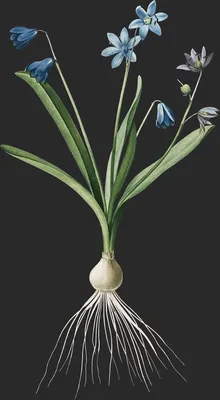
The sheet is vertical: the eye climbs and settles in the upper half. Let the plant stand before you look for detail. Then step in close: watch where colour meets line, and whether the line ever breaks. Third, find where the green is deepest: the whole tonal order is measured from that patch.
-
Name and Thing
The binomial is Trillium rhomboideum: the first word is the genus it belongs among, the second the epithet that sets it apart. Two words carry a whole provenance. The older system filed it under Asparagaceæ by overall affinity; Linnaeus, counting stamens only, placed it in Hexandria — two ways of asking what a plant is. No established Chinese name exists, so it is cited by its binomial alone.
-
Form and Colour
Measured on this plate: flower colour covers 1.5% of the sheet, foliage 16.5%, the cast amber with a second note of yellow-green. No other plate shares exactly this measure. A bulb of overlapping fleshy scales gives the lily its Chinese name, 'hundred-fold'; six tepals reflex as the flower opens, around six stamens with long, T-shaped anthers. Filed under green — a moss green, a colour that comes mostly from leaf and stem. Read the outline, then the colour layers, then the brush.
-
Composition
Tall and narrow, the plant rising in one movement with generous margins — the upright format of most floras. (about 1.99 : 1) No details are appended: a plate for looking, not for keying out. The plant covers only 26% of the sheet, centred above centre; the emptiness is where the eye rests. Cover the margins with your thumb and the plate suffocates; uncover them and the flower breathes again.
-
Line and Colour
The first half of the nineteenth century moved from copper to steel to lithography; stipple could render the softest transition. Decide first whether it was printed or painted; only then discuss whether it is beautiful. If you mean to copy it: take its skeleton, its margins and the order of its colours; the burin's hatching is the language of copper — suggest it with pencil density, do not imitate it stroke for stroke.
-
Poetic Resonance
方石斛栽香百合,小盆山养水黄杨。
—— 宋·陆游《龟堂杂兴十首 其五》
The poem gives the mood first and the picture supplies the form; set the line beside the plate and the green the corolla becomes its resting point.
-
Symbolism
In the West the white lily is Marian purity, held by the angel of the Annunciation; in China the name sounds like 'a hundred years in harmony', a wedding wish. In a flora it is a species first and a symbol second; the order is worth keeping.
-
Season and Place
the flowers last only days, so artists drew them just as they opened. Temperate north — China, Japan, Europe. Long used in Chinese medicine, lilies were hunted in East Asia by nineteenth-century collectors and transformed European gardens. The year 1805 on the plate is that of publication, not of flowering — the gathering came a year or two earlier. Read the locality and the flowering season both with a discount: one is hearsay, the other a ten-day peak.
-
The Book and the Hand
“The Liliaceae” was drawn by Pierre-Joseph Redouté and published 1802-1816. This plate is Plate 134, book page 134. The image is public domain; the hand-colouring is still one person's hand.
-
The Written Tradition
宁古无时,宁朴无巧,宁俭无俗。
—— 明·文震亨《长物志》
Better old than fashionable, better plain than clever, better spare than vulgar.
The Bencao Gangmu describes the bulb as garlic-like, edible and medicinal; Song writers already noted that the leaves vary while the flowers stay white. Keep the line; it will surface the next time you meet the same plant.
What to Take Away
Appreciation is not knowledge but habit — one more look each time. A flora exists to be consulted; look long enough and you forget to consult — someone in 1805 gave a whole day to a single flower.