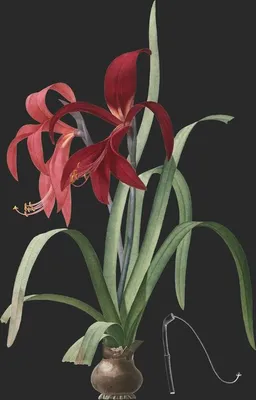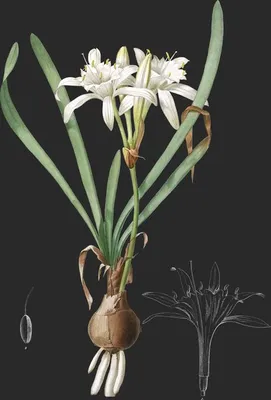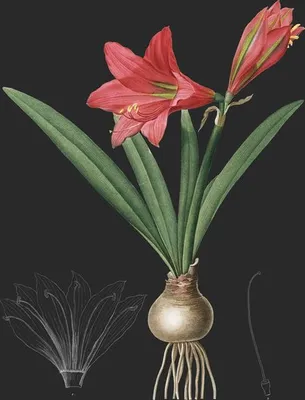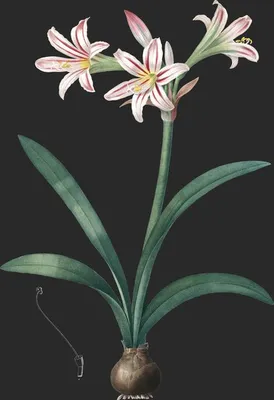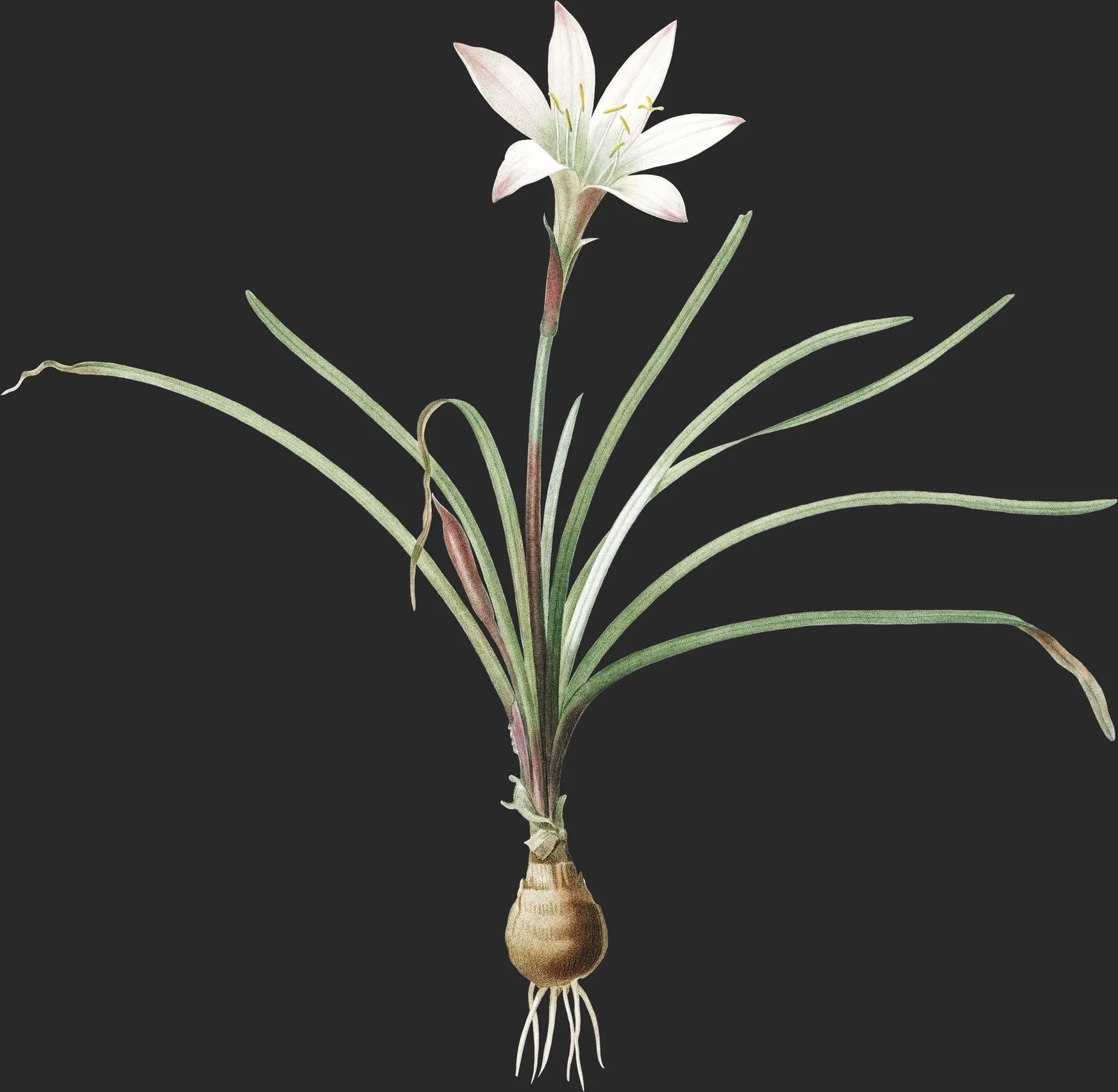
Amaryllis Atamasco
南方火眼蝶
Amaryllis de Virginie
About this plate
Description
Les Amaryllis dont la hampe ne porte qu’une seule fleur, semblent sou-vent, au premier coup-d’eil, s’écarter des autres espèces de ce genre, par la régularité qu’elles allectent dans la forme de leurs bractées et de leur corolle et dans la direction de leurs organes sexuels; mais ces différences sont de peu d’importance lorsquon les examine sous un point de vue playsiologique. Dans les Amaryllis à plusieurs fleurs, chacune d’elles est portée sur un pédicelle particulier qui, à sa base, est muni d’une bractée: il en est de même dans celles qui n’ont qu’une fleur; mais la bractée, au lieu d’être oblongue ou li-néaire, entoure entièrement le pédicelle, comme cela a lieu dans plusieurs circonstances analogues, d’oi il résulte qu’elle prend T’apparence d’une spathe, et qu’elle cache le pédicelle. Si la corolle des Amaryllis multiflores et irrégulière, cette irrégularité tient en partie à ce que ces corolles sont forcées à se déjeter de côté, afin que plusieurs fleurs puissent avoir place au sommet du même pédoncule: lorsqu’il n’y a qu’ane seule fleur, cette canse d’irrégularité n’existe pas; dans les fleurs déjetées de côté, le pistil et les étamines se courbent comme pour regagner la verticale: cette courbure doit être peu ou point sensible dans les fleurs qui sont elles-mêmes presque verticales.
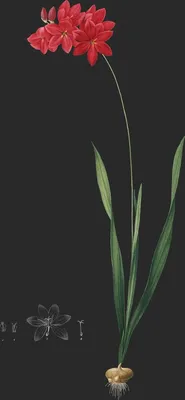
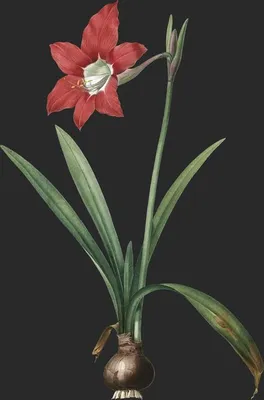
L’Amaryllis de Virginie sort d’une bulbe arrondie, brune, grosse comme une nois; les feuilles et la hampe s’élevent de deux places différentes de la bulbe; les feuilles sont glabres, linéaires, plus longues que la hampe, mais étalées sur la terre ou du moins peu redressées; la hampe est cylindrique, glabre, haute de a décimètres au plus: elle porte à son sommet une seule fleur droite ou légèrement penchée; cette fleur sort d’une spathe membraneuse, tu-bolée, divisée à son sommet en deux lobes pointus, et souvent rougeâtres: elle est portée sur un court pédicelle caché dans la spathe.
La corolle est en forme d’entonnoir, dont le tube, très-étroit à la base, va toujours en s’élargissant; elle se divise en six lanières oblongues, pointues, presque égales entrelles; cette corolle est blanche, avec une teinte parpurine à l’extérieur, qui s’ellace à mesure que la lleur avance en áge.
Les six étamines sont insérées sur la corolle et plus courtes qu’elles: elles entourent un style filiforme et courbé vers son sommet; ce style se termine par trois stigmates étalés, et nait d’un ovaire, à trois angles arrondis, placé sous la corolle.
Histoire
Cette espèce d’Amaryllis est originaire de la Virginie et de la Caroline; elle y croit dans les prés: on la cultive depuis long-temps dans les jardins de botanique, et même dans quelques parterres; elle fleurit en été. ♃.
Fam. des Narcisses. Juss.—Hexandrie monogynie. Lin.
- Amaryllis atamasco. A. spathâ bifida acutâ, flore pedicellato, corolla campanalata subequali erecta basi breve tubulosa, staminibus declinatis æequalibus. Ait. Kew. 1. p. 416. Wild. Spec. 2. p. 51.
- Amaryllis atamasco. A. spathâ unillorâ bifidâ, corollâ subequali, genitalibus declinatis. L’Her. Sert. 10.
- Amaryllis atamasco. A. spathâ unillorâ, corollâ requali, pistillo declinato. Lin. Spec. 293. Hort. Cliff. 135. Gron. virg. 36. Roy. Lugd-b. 36. Mill. Dict. n. 2. Kniph. Cent. 3. n. 11. Lam. Dict. Enc. 1. p. 121. n. 4. Curt. Bot. Mag. t. 239.
- Lilio-narcissas virginiensis. Catesb. Car. 3. p. 12. t. 12.
- Lilio-narcissus sextus. Trew. Seligm. t. 37.
- Lilio-narcissus vernus angustifolius, flore purpurascente. Barr. Icon. t. 994.
- Lilio-narcissus indicas pamilas monanthos albus. Moris. hist. 2. p. 266. s. 4. t. 34. f. 4. Tourn. Inst. 386.
- Lilio-narcissus indieus albus. Weinm. Phyt. 3. p. 276. t. 632. f. 6.
- Lilio-narcissus liliflorus carolinianus, flore albo singolari cum rubedine diluto. Pluk. alm. 220. t. 43. f. 3.
- Lilio-narcissus minimus foliis graminois. Rudb. Elys. 2. p. 94. t. 16.
Twelve ways of seeing
- measured cast amber
- square 0.98 : 1
- published 1802
- Plate 31
Not a catalogue entry but a way of looking: how to stand, what to notice, how the line was cut, when it flowers, where it came from, who made it — and then the poems and the classics that taught China to see the same flower. Read the twelve in order and the plate opens.
-
First Look
论画以形似,见与儿童邻。
—— 宋·苏轼《书鄢陵王主簿所画折枝》
To judge painting by likeness alone is the view of a child.
Nearly square, plant and detail each holding a corner. Then step in close: watch where colour meets line, and whether the line ever breaks. Third, find where the green is deepest: the whole tonal order is measured from that patch.
-
Name and Thing
The binomial is Amaryllis atamasco: the first word is the genus it belongs among, the second the epithet that sets it apart. Two words carry a whole provenance. The older system filed it under Amaryllidaceæ by overall affinity; Linnaeus, counting stamens only, placed it in Hexandria — two ways of asking what a plant is. The Chinese name 南方火眼蝶 is a modern rendering of the Latin, not an old garden name.
-
Form and Colour
Measured on this plate: flower colour covers 1.4% of the sheet, foliage 1.6%, the cast amber with a second note of yellow-green. No other plate shares exactly this measure. Bulbous plants store the year underground — bulb, corm or tuber — then send up a few thick leaves and a single scape, with six tepals in cup, funnel or star. Filed under green — a moss green, a colour that comes mostly from leaf and stem. Read the outline, then the colour layers, then the brush.
-
Composition
Nearly square, plant and details sharing the corners. (about 0.98 : 1) No details are appended: a plate for looking, not for keying out. The plant covers only 10% of the sheet, centred above centre; the emptiness is where the eye rests. Cover the margins with your thumb and the plate suffocates; uncover them and the flower breathes again.
-
Line and Colour
The first half of the nineteenth century moved from copper to steel to lithography; stipple could render the softest transition. Take a loupe to three places: petal edge, leaf vein, caption. An unbroken line means engraving; colour crossing the outline means a hand.
-
Season
Early spring to early summer, genus by genus: tulips and hyacinths first, gladiolus and amaryllis later. The year 1802 on the plate is that of publication, not of flowering — the gathering came a year or two earlier. The best time to read such a plate is its flowering season: three minutes under the tree explains what no text can.
-
Provenance
Three homelands: the Mediterranean, Central Asia and South Africa. The tulip came from Ottoman gardens and became a Dutch mania; South African bulbs filled European glasshouses after 1800. In the same volume the kin are shelved together; set several plates side by side.
-
The Book and the Hand
“The Liliaceae” was drawn by Pierre-Joseph Redouté and published 1802-1816. This plate is Plate 31, book page 31. The image is public domain; the hand-colouring is still one person's hand.
-
Poetic Resonance
东风夜放花千树,更吹落、星如雨。
—— 宋·辛弃疾《青玉案·元夕》
East wind at night sets a thousand trees of flowers alight, then blows them down like rain of stars.
The poem gives the mood first and the picture supplies the form; set the line beside the plate and the green the corolla becomes its resting point.
-
The Written Tradition
宁古无时,宁朴无巧,宁俭无俗。
—— 明·文震亨《长物志》
Better old than fashionable, better plain than clever, better spare than vulgar.
Li Bai's 'orchid wine, fragrant with yujin' is often misread as tulips; the Tang yujin was a turmeric-like root used to scent wine — same name, different plant. You need not parse every word: take the line, and the flower acquires a second face.
-
Symbolism
The tulip was an imperial emblem in Istanbul and a speculative bubble in Amsterdam; the hyacinth sprang from a boy's blood in Greek myth. What bulbs share is concealment: next year kept underground. Meanings change their tune: the same flower can say opposite things within a century.
-
What to Take Away
Next time you stand before a flowering plant, give it three minutes: leaf arrangement, direction of the flower, the darkest patch. The flower of that year is dust, yet its image on paper has outlived every living cousin.