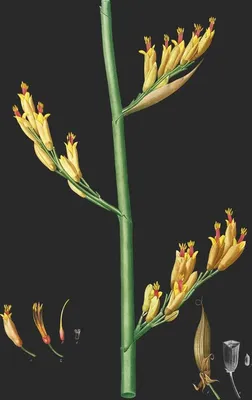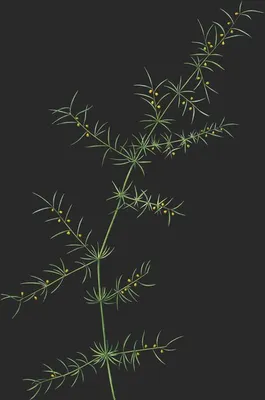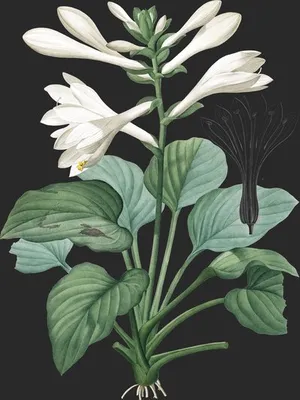
Amaryllis Humilis
Amaryllis Peu Élevé
Amaryllis Peu Élevé
About this plate
Description
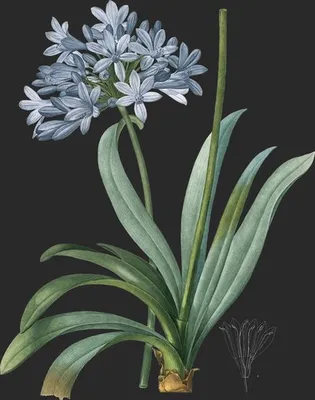
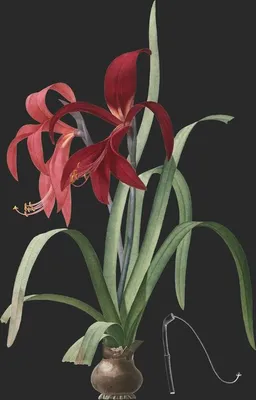
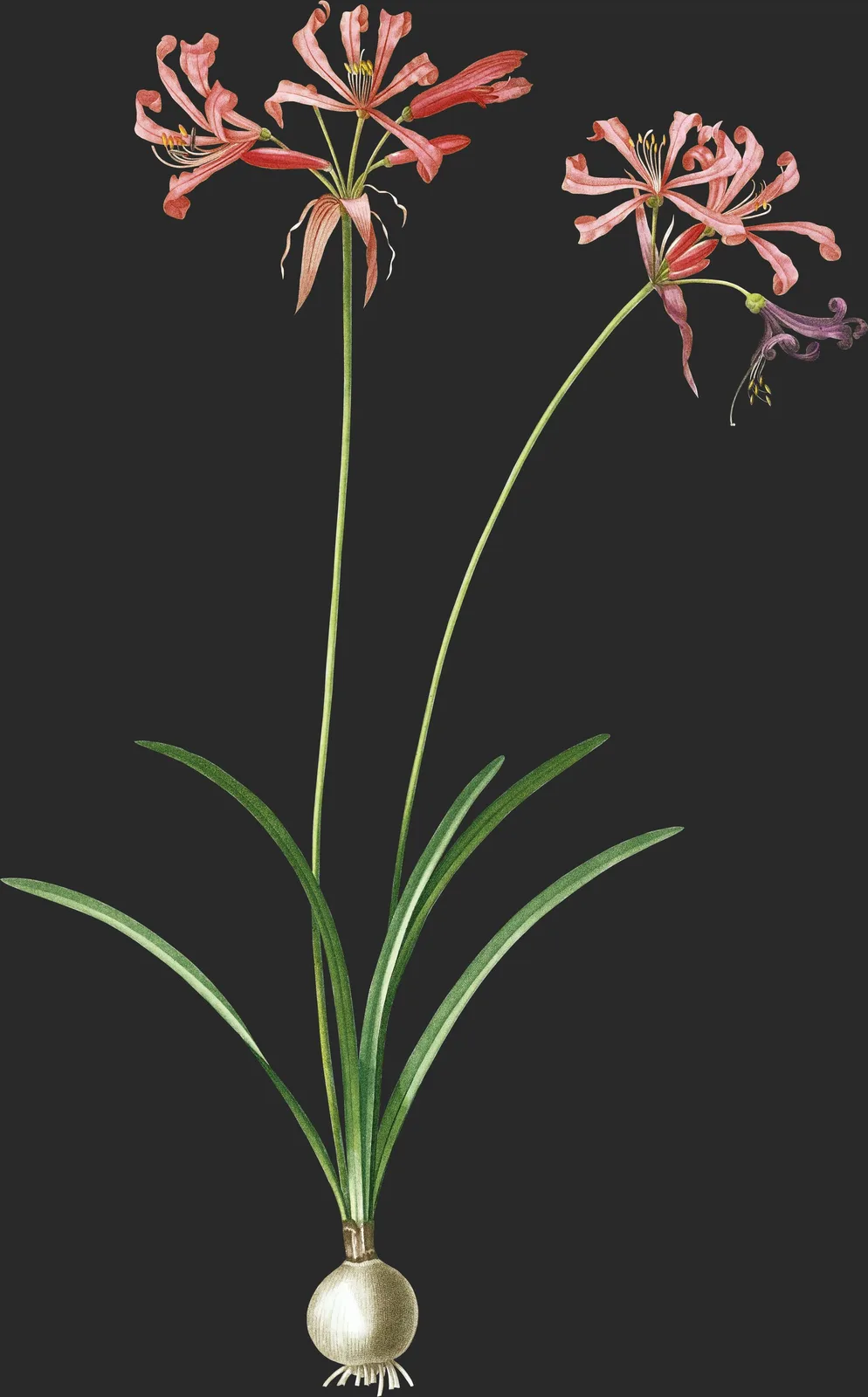
Une bulbe sphérique plus grosse qu’une noix, produit un faisceau de quatre à cinq feuilles linéaires-en-languette, dont les trois intérieures sont longues de huit a seize centimetres (trois à six pouces), aplaties en ruban, les extericures un peu plus longues, larges de sept millimètres (quatre lignes), un peu en gouttière, et très-vertes en dessus, glabres, un peu cylindriques, et d’un vert pale en dessous, obtuses à leur sommet.
Une hampe eylindrique, de la grosseur d’une plume de corbeau, s’élève de la bulbe à côté de la base des feuilles; sa longueur est de vingt-cinq à trente-deux centimètres (neuf pouces à un pied). Une seconde hampe s’élève aussi quel-quelois à côté de la première.
Six ou sept fleurs terminales en ombelle couronnent la hampe. Une spathe de plusieurs valves accompagne l’ombelle; les deux plus grandes de ces valves sont opposées, lancéolées, rougeâtres, se fanent lentement et sont plus allongées que les pédicelles des fleurs; les quatre valves intérieures sont très-déliées, filiformes. Les pédicelles ont vingt-sept millimètres (un pouce) de long; ils sont cylindriques triquètres, un peu épaissis par leur base. Un ou deux des pédicelles sont très-courts. Le périgone est à six divisions ouvertes irrégulièrement; les deux supérieures sont redressées; les deux antres moyennes ouvertes presque transversalement, et les deux dernières abaissées et divergentes. Les divisions sont linéaires-lancéolées, en onglet à leur base, élargies vers leur sommet, terminées en pointe, ondulées et recourbées au-dessus de leur onglet dans leur portion élargie. La ligne moyenne de ces divisions est rouge; leurs côtés sont roses. Les filaments des étamines s’abaissent étant rapprochés en faisceau; ils sont plus courts que les divisions du périgone, droits avant que les anthères soient ouvertes et, courbés en dessus, lorsque les anthères s’ouvrent. Ces filaments sont rougeâtres, eylindriques, adnés par leur base aux divisions, et soudes ensemble par cette base. Les anthères, brunes et oblongues, prennent la même direction que les filets. L’ovaire est infère, presque globuleus, et produit un style pourpre, filiforme, un peu plus long que les étamines, coudé en dessus à son sommet, terminé par un stigmate court, blanchâtre, à trois cornes.
Histoire
Cette plante est indigène du Cap de Bonne-Espérance. Elle fleurit au Jardin des Plantes, dans les serres, au mois d’octobre.
Fam. des Narcisses. Juss.—Hexandrie monogynie. Lin.
- A maryllis humilis. A. scapis paucilloris; petalis patentibus, infino divaricato; foliis linearibus, obtusis planis. Jacq. hort, Shænbr. 1. p. 36. t. 69.
- Amaryllis homilis. A. spathâ tri-seu quadriflorâ; petalis lanceolatis sub-ringenti-patentibus, apice undulato-reflexis, infimo divaricato; genitalibus ascendentibus petalis brevioribus; folis linearibus obtusis, glabris, nudis, planis. Willd. spec. pl. 2. p. 60. Persoon. enchir. 1. p. 354.
Twelve ways of seeing
- measured cast red
- upright 1.61 : 1
- published 1814
- Plate 450
Not a catalogue entry but a way of looking: how to stand, what to notice, how the line was cut, when it flowers, where it came from, who made it — and then the poems and the classics that taught China to see the same flower. Read the twelve in order and the plate opens.
-
First Look
六法者何?一、气韵生动是也;二、骨法用笔是也;三、应物象形是也;四、随类赋彩是也;五、经营位置是也;六、传移模写是也。
—— 南齐·谢赫《古画品录》
The six laws: spirit resonance alive; bone-method in the brush; matching form; colour by kind; planning the placing; copying the masters.
The sheet is vertical: the eye climbs and settles in the upper half. Let the plant stand before you look for detail. Then step in close: watch where colour meets line, and whether the line ever breaks. Third, find where the orange is deepest: the whole tonal order is measured from that patch. The pose leans right: the upper half carries 13 points further right than the lower — a living thing, not a diagram.
-
Name and Thing
The binomial is Amaryllis humilis: the first word is the genus it belongs among, the second the epithet that sets it apart. Here the epithet humilis means “low” — the name records the feature the namer noticed first. The older system filed it under Amaryllidaceæ by overall affinity; Linnaeus, counting stamens only, placed it in Hexandria — two ways of asking what a plant is. No established Chinese name exists, so it is cited by its binomial alone.
-
Form and Colour
Measured on this plate: flower colour covers 4.3% of the sheet, foliage 3.3%, the cast red with a second note of amber. No other plate shares exactly this measure. Bulbous plants store the year underground — bulb, corm or tuber — then send up a few thick leaves and a single scape, with six tepals in cup, funnel or star. Filed under orange — an amber orange, built in washes from a pale ground. A single plant, laid out with nothing hidden.
-
Composition
Tall and narrow, the plant rising in one movement with generous margins — the upright format of most floras. (about 1.61 : 1) No details are appended: a plate for looking, not for keying out. The plant covers only 9% of the sheet, centred above centre; the emptiness is where the eye rests. Blank paper is not unfinished work: it is where the eye rests.
-
Line and Colour
The first half of the nineteenth century moved from copper to steel to lithography; stipple could render the softest transition. Craft leaves franker evidence than inscriptions.
-
Season
Early spring to early summer, genus by genus: tulips and hyacinths first, gladiolus and amaryllis later. The year 1814 on the plate is that of publication, not of flowering — the gathering came a year or two earlier. Note the season. Phenology is the most practical tool of appreciation.
-
Provenance
Three homelands: the Mediterranean, Central Asia and South Africa. The tulip came from Ottoman gardens and became a Dutch mania; South African bulbs filled European glasshouses after 1800. The volume was made in 1802-1816, when most of this knowledge came from living plants under glass.
-
The Book and the Hand
“The Liliaceae” was drawn by Pierre-Joseph Redouté and published 1802-1816. This plate is Plate 450, book page 450. The image is public domain; the hand-colouring is still one person's hand.
-
Poetic Resonance
郁金垂嫩柳,罯画委高笼。
—— 唐·元稹《春六十韻》
The poem gives the mood first and the picture supplies the form; set the line beside the plate and the orange the corolla becomes its resting point.
-
The Written Tradition
多识于鸟兽草木之名。
—— 《论语·阳货》
…and from the Songs one learns the names of birds, beasts, plants and trees.
Li Bai's 'orchid wine, fragrant with yujin' is often misread as tulips; the Tang yujin was a turmeric-like root used to scent wine — same name, different plant. You need not parse every word: take the line, and the flower acquires a second face.
-
Symbolism
The tulip was an imperial emblem in Istanbul and a speculative bubble in Amsterdam; the hyacinth sprang from a boy's blood in Greek myth. What bulbs share is concealment: next year kept underground. This plate leans orange, which in flower language adds one more degree of feeling. Flower language was added later; the flower knows nothing of it, and that innocence is part of its power.
-
What to Take Away
If you keep one line, keep Guo Xi's: from afar its momentum, up close its texture. A flora exists to be consulted; look long enough and you forget to consult — someone in 1814 gave a whole day to a single flower.