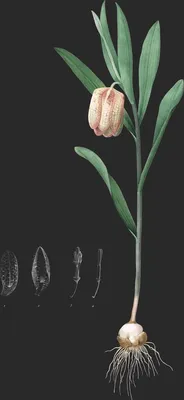
Fritillaria Melegris
贝母属·Fritillaria Melegris
Fritillaire Pintade
About this plate
Description
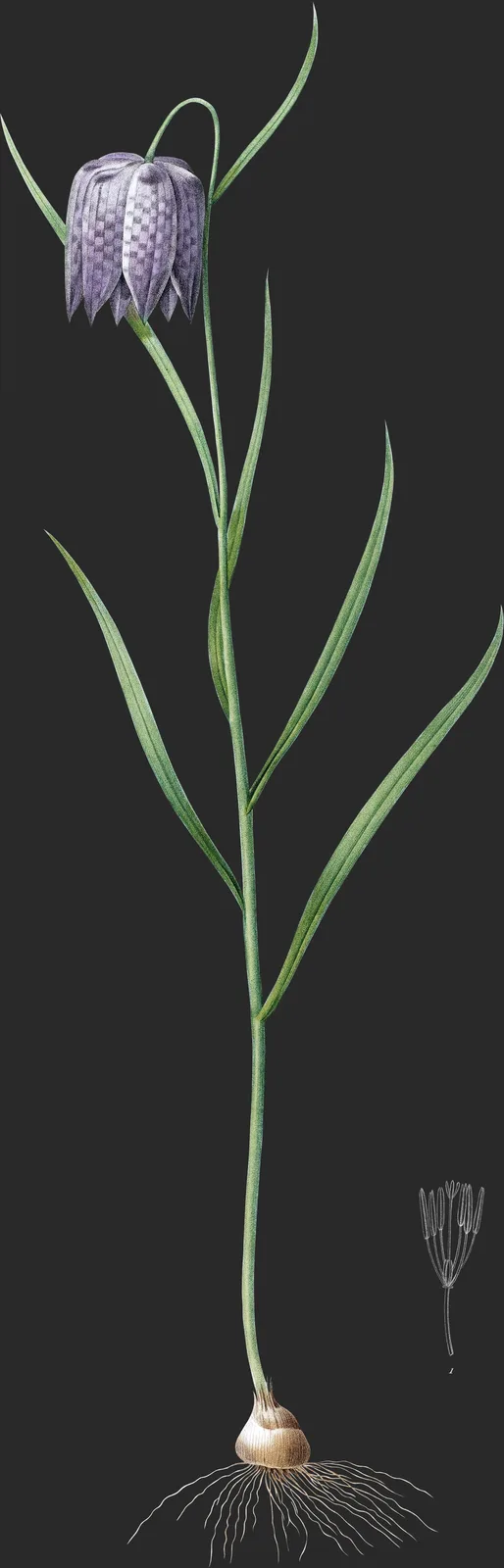
Sa bulbe est solide, arrondie, un peu comprimée, d’un blanc jaunâtre, garnie de fibres radicales à sa partie inférieure. De cette bulbe s’élève une tige droite, menue, cylindrique, de la hauteur des à 3 décimètres, garnie de quelques feuilles éparses, étroites, linéaires, courbées en gouttière, demi-embras-santes à la base, souvent un peu torses, d’un vert glauque, pointues à leur sommet; quelquefois ces feuilles sont accidentellement opposées.
Les fleurs sont ordinairement solitaires au sommet de la tige; quelquefois on en compte deux ou trois: elles sont toujours pendantes, communément tachetées de pourpre et de blanc, et marquées de petits carreaux alternativement colorés comme un damier; mais cette disposition des couleurs n’est pas constante. On en trouve des variétés à fleur toute blanche; d’autres à fleur d’un jaune verdâtre (du moins d’aprés le témoignage des auteurs); d’autres à fleur presque entièrement pourpre et marquée seulement de taches plus foncées.
Le périgone est à six parties rapprochées à peu près en forme de cloche, égales entre elles, ovales, obtuses, marquées vers leur base interne d’une fossette verdatre et elliptique, qui parait à l’extérieur sous la forme d’une bosse-lure. Les étamines sont placées devant les parties du périgone et cachées dans la cloche.
L’ovaire est libre, triangulaire, charge d’un style court, épais, a trois lobes; la capsule est oblongue, triangulaire.
Histoire
Cette plante croit naturellement dans les paturages humides, soit des plaines, soit des montagnes de l’Europe. On la trouve dans presque toute la France, quoiqu’elle ne soit bien commune nulle part. ♃.
Elle fleurit au printemps. La disposition des couleurs de sa fleur lui a fait donner les noms de Damier, Pintade, Fritillaire panachée, etc.
On la cultive dans les jardins de botanique, et même dans quelques jardins d’amateur, à cause de la bizarrerie de ses couleurs. Elle exige un terrain gras et frais. On la multiplie par les cayeux, qu’on sépare tous les trois ou quatre ans, au milieu de l’été, et qu’on replante en automne. On la propage aussi de graines qu’on sème dans des terrines. Les jardiniers disent que, si on coupe la tige de cette plante, on fait périr l’oignon.
Fam. des Lis. Juss.—Hexandrie monogynie. Lin.
- Fritillaria meleagris. F. folis alternis linearibos canaliculatis, caule unifloro. Wild. Spec. 2. p. 91. Fl. fr. 3. p. 201. syn. n. 1907.
- Fritillaria meleagris. F. folis omnibus alternis, cale unifloro. Lin. Spec. 436. hort. Ups. 31. Fl. succ. 2. n. 383. Mill. Dict. n. 1. Scop. carn. éd. 2. n. 405. Gouan. illustr. 25. Lam. Dict. 2. p. 550. t. 245. f. 1. Sow. engl. bot. t. 622.
- Fritillaria caule paucifloro, foliis caulinis gramineis alternis. Hall. helv. n. 1235.
- Fritillaria è folioram alis florens. Lin. hort. Cliff. 119.
- Fritillaria radice depressa. Roy. Lugd-b. 30.
- Fritillaria præcox purpurea variegata. C. Bauh. pin. 64. Tourn. inst. 377. Moris. hist. 2. p. 402. sect. 4. t. 18. f. 1.
- Meleagris. Renealm. Spec. 147. t. 146. Dod. pempt. 233.
- Fritillaria volgaris. Roy. hist. 1146.
- Fritillaria Clus. hist. 1. p. 152.
- B. Flore albo. Flor. franç. loc. cit.
- Fritillaria alba præcox. C. Bauh. pin. 64. Tourn. inst. 377.
- C. Flore luteo. Fl. fr. loc. cit.
- Fritillaria lutea maxima italica. Park. part. 43. Tourn. 377. Mill. Dict. n. 4.
- Fritillaria serotina floribus ex flavo virentibus. C. Bauh. pin. 64. Tourn. 377.
- D. Flore atro purpureo. Fl. Jr. loc. cit.
Twelve ways of seeing
- measured cast amber
- upright 3.11 : 1
- published 1807
- Plate 222
Not a catalogue entry but a way of looking: how to stand, what to notice, how the line was cut, when it flowers, where it came from, who made it — and then the poems and the classics that taught China to see the same flower. Read the twelve in order and the plate opens.
-
First Look
论画以形似,见与儿童邻。
—— 宋·苏轼《书鄢陵王主簿所画折枝》
To judge painting by likeness alone is the view of a child.
The sheet is vertical: the eye climbs and settles in the upper half. Let the plant stand before you look for detail. Then step in close: watch where colour meets line, and whether the line ever breaks. Third, find where the green is deepest: the whole tonal order is measured from that patch. The pose leans left: the upper half carries 19 points further left than the lower — a living thing, not a diagram.
-
Name and Thing
The binomial is Fritillaire pintade: the first word is the genus it belongs among, the second the epithet that sets it apart. Two words carry a whole provenance. The older system filed it under Liliaceæ by overall affinity; Linnaeus, counting stamens only, placed it in Hexandria — two ways of asking what a plant is. No established Chinese name exists, so it is cited by its binomial alone.
-
Form and Colour
Measured on this plate: flower colour is sparing, 0.5% of the sheet against 3.6% of foliage, the cast tending amber — as with pale or white blooms, outline and tone do the talking. A bulb of overlapping fleshy scales gives the lily its Chinese name, 'hundred-fold'; six tepals reflex as the flower opens, around six stamens with long, T-shaped anthers. Filed under green — a moss green, a colour that comes mostly from leaf and stem. A single plant, laid out with nothing hidden.
-
Composition
Tall and narrow, the plant rising in one movement with generous margins — the upright format of most floras. (about 3.11 : 1) No details are appended: a plate for looking, not for keying out. The plant covers only 9% of the sheet, centred above centre; the emptiness is where the eye rests. Old plates set the plant slightly off centre, with unequal margins — that small imbalance is what keeps it alive.
-
Line and Colour
The first half of the nineteenth century moved from copper to steel to lithography; stipple could render the softest transition. There is evidence on the back too: the plate mark pressed into the paper, the slight relief of the pigment, lines worn shallow in a later printing.
-
Season
Early to high summer, June and July; the flowers last only days, so artists drew them just as they opened. The year 1807 on the plate is that of publication, not of flowering — the gathering came a year or two earlier. The plate records ten days of peak; the other three hundred are leaf, fruit and rest.
-
Provenance
Temperate north — China, Japan, Europe. Long used in Chinese medicine, lilies were hunted in East Asia by nineteenth-century collectors and transformed European gardens. In the same volume the kin are shelved together; set several plates side by side.
-
The Book and the Hand
“The Liliaceae” was drawn by Pierre-Joseph Redouté and published 1802-1816. This plate is Plate 222, book page 222. The image is public domain; the hand-colouring is still one person's hand.
-
Poetic Resonance
方石斛栽香百合,小盆山养水黄杨。
—— 宋·陆游《龟堂杂兴十首 其五》
The poem gives the mood first and the picture supplies the form; set the line beside the plate and the green the corolla becomes its resting point.
-
The Written Tradition
百合之根,以众瓣合成也。
—— 明·李时珍《本草纲目·菜部》
The root of the lily is many scales gathered into one — hence the name bai he, “a hundred joined”.
The Bencao Gangmu describes the bulb as garlic-like, edible and medicinal; Song writers already noted that the leaves vary while the flowers stay white. The difference is not of quality but of question: Europe asks what it is, China asks whom it resembles.
-
Symbolism
In the West the white lily is Marian purity, held by the angel of the Annunciation; in China the name sounds like 'a hundred years in harmony', a wedding wish. Meanings change their tune: the same flower can say opposite things within a century.
-
What to Take Away
Appreciation is not knowledge but habit — one more look each time. Two centuries on, the plant may still flower in some garden; the one on this sheet stopped in the season of 1807.